I’ve been to Lake Kaindy twice.
The first time was in 2022, when I took my husband there ourselves. The second was in 2025, when his entire Chilean family came to visit and we made the trip out together as a group. It isn’t an easy place to reach, tucked into a remote stretch of the Tian Shan mountains outside Almaty, and both times we only had a handful of days in the country to work with. We still carved three of them out for Kaindy, along with Kolsay Lake and Charyn Canyon nearby, and I’d tell anyone visiting Kazakhstan to do the same. It’s worth the detour.
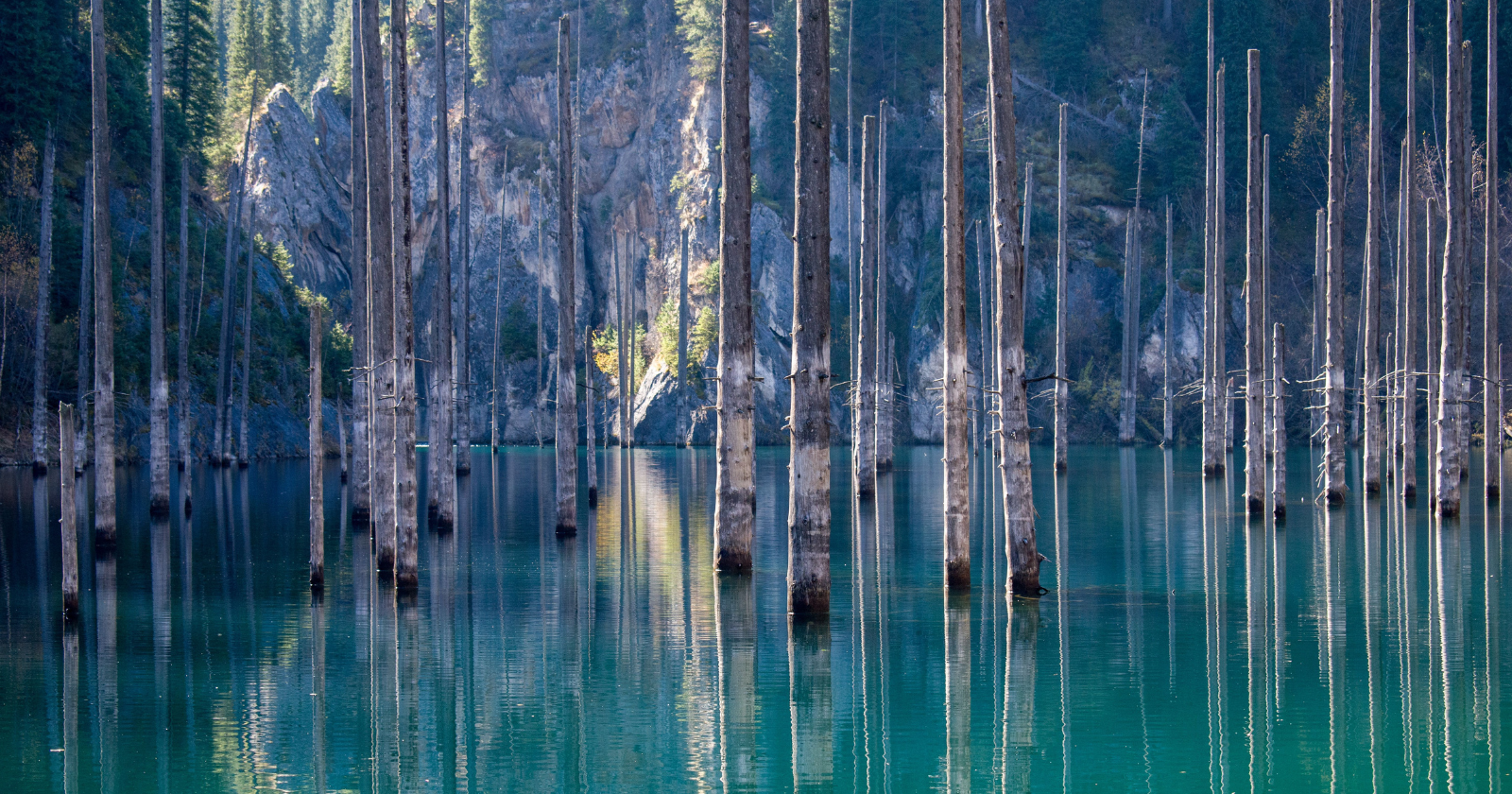
Every photo of the lake tells the same visual lie, gently, and standing in front of it in person doesn’t fully break the spell either. Bare spruce trunks rise straight out of turquoise water, so intact and so upright that the whole scene reads as recently frozen in time rather than more than a hundred years decayed. Look closer and the trees are undeniably dead: bare above the surface, needles still clinging on below it, preserved rather than alive.
But “the trees are dead” and “the forest is dead” turn out to be two different claims, and only one of them is straightforwardly true.
What actually happened in the valley
In 1911, a massive earthquake tore through the Tian Shan mountains and dislodged enormous amounts of limestone rubble, which slid down the rock face and sealed off a narrow valley like an accidental dam. Rain and snowmelt did the rest, filling the basin until an entire stand of spruce trees stood fully submerged.
The lake’s now-famous turquoise color comes partly from dissolved limestone in that same rubble. The water stays near freezing year-round, which is the specific reason the drowned trunks never fully rotted away: cold water slows the bacteria and fungi that would otherwise reduce a fallen forest to nothing within a few decades.
More than a century later, the trees are still standing, still bare, still holding their shape in water cold enough to have effectively pressed pause on decomposition. Whatever killed them did its work quickly. Whatever should have broken them down afterward never really got the chance.
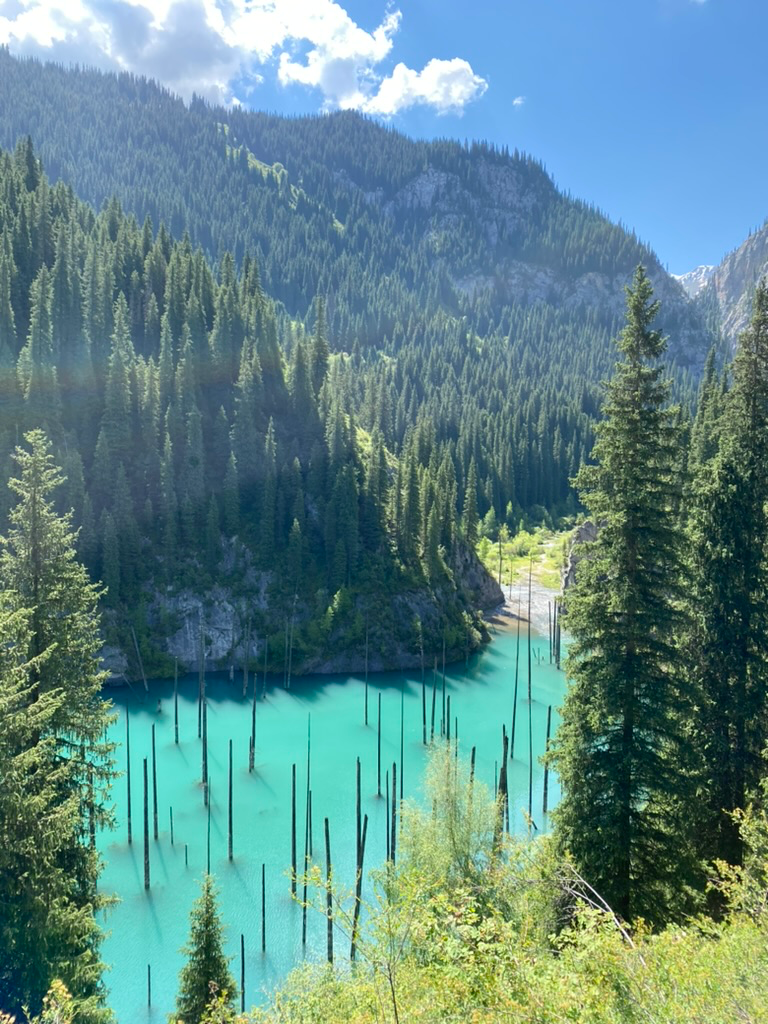
That accident of chemistry is the reason Kaindy photographs so well and so eerily, and it’s also part of why a video we made recently kept surfacing while researching this.
Its whole argument is that a forest was never really located inside any single trunk in the first place, which changes what question is actually worth asking about a hundred-year-old drowned stand of spruce.
The part of a forest nobody photographs
What tourists come to see at Kaindy is the visible half of the story. What actually made that valley a forest, rather than just a stand of individual trees standing near each other, was mostly invisible even before the water arrived.
Suzanne Simard, a forest ecologist who has spent decades studying underground fungal networks, describes what connects trees below the soil as “infinite biological pathways that allow the forest to behave as a single organism.” Her research has traced actual carbon moving from a dying tree into its healthy neighbors through these fungal connections, sometimes within 24 hours of the transfer beginning. Trees sharing nutrients, warning signals, and resources through a hidden mesh of roots and fungus is not a metaphor. It’s a documented, measurable exchange, and it’s the part of a forest that a photograph of tree trunks can never show you.
The video’s case, built on exactly this kind of research, is that intelligence in a forest isn’t something happening inside any individual trunk. It happens in the network itself: the exchange, the coordination, the constant chemical conversation running underground with no single point of control. If that’s the more accurate way to define what a forest actually is, a hundred-year-old photo of upright, needle-covered trunks is showing the skeleton of the story, not the story.
Simard herself is careful about how far to push that framing. She has said she tries “to be careful with my use of anthropomorphic terms,” which is a useful check against turning a genuinely documented biological system into something closer to a fairy tale. The network isn’t a brain, and a forest isn’t sitting somewhere making decisions the way a person does. But the caution cuts both ways. Underselling a forest as a loose collection of separate trees standing near each other is its own kind of inaccuracy, just a more comfortable and familiar one.
So what actually died at Kaindy
Here’s where honesty has to override a tidy ending. Nobody has published research specifically tracing what happened to the fungal network under that valley when the water rose, and it would be dishonest to claim otherwise just because it makes a better closing line.
What can be said with more confidence: the network that once moved carbon and signals between those spruce roots depended on soil chemistry, oxygen, and biological activity that a permanently flooded, near-freezing lakebed does not offer in anything like the same way. The visible trunks survived the flood by essentially being pickled in place, held in a kind of chemical stasis that has nothing to do with being alive. Whatever invisible system once connected their roots almost certainly did not get the same reprieve, even though nobody has gone looking to confirm exactly how or when it ended.
That gap, between what can be seen clearly and what can only be reasoned toward, is a more honest place to leave this than pretending the postcard image tells the whole story. It’s also a more interesting one, once the discomfort of not having a clean answer wears off.
What the postcard doesn’t show
A forest that looks perfectly preserved from a shore is a different thing than a forest that survived.
Kaindy’s trunks are a genuine, remarkable piece of geological accident, frozen by a lucky combination of limestone, cold water, and time. But if the more recent science of forests is right, and a forest is really its underground network more than its visible trunks, the eerie photographs of Kaindy are documenting a monument, not a survivor.
The trees still stand, bare and patient, exactly where the water left them. Whatever they were quietly exchanging with each other underground before 1911 almost certainly ended the moment the valley filled, long before any tourist arrived to admire how untouched the whole scene looks.
None of that made the place any less worth the trip, both times. Knowing what’s actually gone, rather than just what still looks intact, is exactly the kind of thing I’d want to know before standing on that shore myself, and it’s the kind of detail I hope anyone reading this brings with them the next time they make it out to Kaindy.