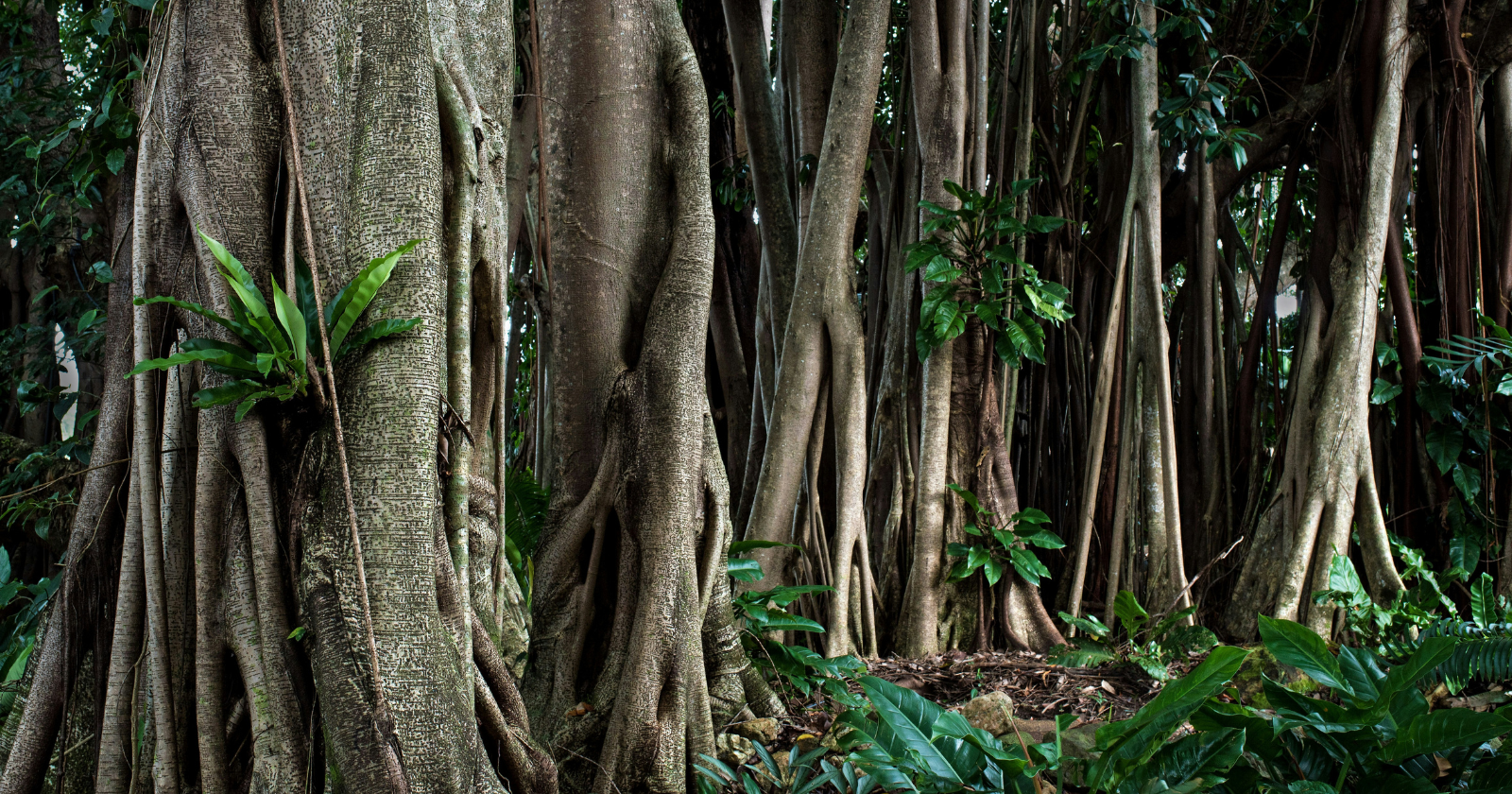
A living root bridge starts out looking like something somebody forgot to pull up. A single pale root, no thicker than a shoelace, gets threaded by hand through a hollowed-out betel nut trunk laid across a stream.
Come back in twenty or thirty years and that same root has thickened, spread, and fused with a dozen others into a structure solid enough for a small crowd to cross at once. Most things humans build get weaker with age. This is the rare one that does the opposite.
The structures are called jingkieng jri by the Khasi and Jaintia communities who grow them, across the hills of Meghalaya in northeast India. The name translates roughly to root bridge, which undersells what’s actually happening. Nobody is building these the way we usually mean that word. They’re growing them, on a timeline that outlasts the person who starts one.
The bridge that starts as a single root and a hollow trunk
The process begins with planting a Ficus elastica, the rubber fig, on the bank of a river or the edge of a ravine. Once the tree is established and starts sending out aerial roots, someone guides the young, flexible roots horizontally rather than letting them drop straight down, threading them through hollowed betel nut trunks or lengths of bamboo laid across the gap like a temporary scaffold. The roots grow along that guide until they reach the far side and anchor there.
Meghalaya’s biodiversity board puts the timeline at fifteen to twenty-five years before a bridge can safely carry a person’s weight, next to three or four years for a comparable concrete span. Once it’s there, a finished bridge can reportedly hold up to fifty people crossing at once. Gaps between roots eventually get packed with stones for an even walking surface, and some bridges get handrails woven in too.
“We call it meiramew, which means ‘the profound act of giving and merging with mother nature,'” says Montila Khongbeh, a resident of Mawkyrnot village. Building one is a multi-generation commitment, and the matrilineal Khasi communities that grow these bridges treat it that way, with women reportedly doing much of the ongoing tending. The skill itself isn’t widely spread. Fewer than two dozen elders are thought to still hold the full building knowledge, passed down mostly during the rainy season, when young roots are pliable enough to weave.
Everything else we build is fighting a losing argument with time
An ordinary bridge starts losing ground the day it opens. Steel corrodes, concrete develops microfractures under repeated freeze and thaw, timber rots where water sits. Engineers can slow this with maintenance schedules, but they can’t reverse it, because the material itself is fixed the moment it’s poured or welded into place. A bridge is at its structural best on day one.
A living root bridge does the reverse, because the material never stopped being alive. “Stable bridges like these made of closely intertwined roots can reach more than 50 meters in length and exist for several hundreds of years,” says Ferdinand Ludwig, professor of green technologies in landscape architecture at the Technical University of Munich, who has documented dozens of these structures directly.
We came across a video a while back that gets into part of this story in more depth than an article really can. It walks through the idea that a root tip isn’t just growing blindly toward water and nutrients. It behaves something like a sensing organ, picking up gravity, moisture, and chemical signals in the soil and adjusting course accordingly, sending faint electrical pulses through the ground the whole way, with no central brain coordinating any of it. Watching it laid out made the Meghalaya bridges make a different kind of sense to us. The roots aren’t following a blueprint someone drew up once. They’re responding, over and over, for decades, to exactly the load a person is asking them to carry.
His colleague on the same research, Thomas Speck, professor of botany at the University of Freiburg, explains the mechanism in plainer terms: “The roots react to mechanical loads with secondary root growth.” Put simply, the parts of a root doing the most work get measurably thicker over time, in direct response to the job they’re being asked to do.
What the roots are actually doing while nobody’s watching
What are the roots actually doing, mechanically, while they thicken and reach for each other? A 2019 survey published in Scientific Reports mapped 76 living root bridges across three expeditions between 2015 and 2017, geolocating 72 of them. Spans ranged from 2 to 52.7 meters, at elevations from just above sea level up past 1,200 meters, and roughly 80 percent came in under 20 meters long. The same researchers compared the cross-sections of roots that had spent years carrying a horizontal load against roots simply growing straight down under their own weight. The vertical roots stayed mostly round. The horizontal, load-bearing ones flattened and elongated into something closer to a T-shape, the same basic move a structural engineer makes when adding material to the underside of a beam under bending load.
The researchers also documented how separate roots stop being separate. When two roots are pressed together at a crossing point long enough, they fuse through a process called inosculation, essentially the same wound-healing response a tree uses to close over an injury. A lattice that started as dozens of individual roots, each carrying its own share of the load, slowly becomes one continuous, load-sharing structure. That’s the actual, physical reason age works backward here: the extra years mean measurably more of the bridge has fused into a single, continuous piece.
A skill that might not outlive the bridges it built
In 2022, Meghalaya’s living root bridges were added to UNESCO’s tentative list for World Heritage status, a step toward the kind of formal recognition that tends to bring funding and attention with it. Architects and researchers, Ludwig among them, already treat building with living plants as a genuine option for future cities. That interest is arriving at an odd moment, though. The number of people who can actually grow one of these bridges from scratch is small and getting smaller, and most of what they know has never been written down anywhere at all.
A thirty-year-old root bridge in Meghalaya is nowhere near finished growing. Left alone, it keeps thickening, keeps fusing, keeps answering whatever load it’s asked to carry, for longer than most of the people who visit it will be alive. Whether the knowledge required to start the next one survives that long is a separate question, and right now nobody has a satisfying answer to it.