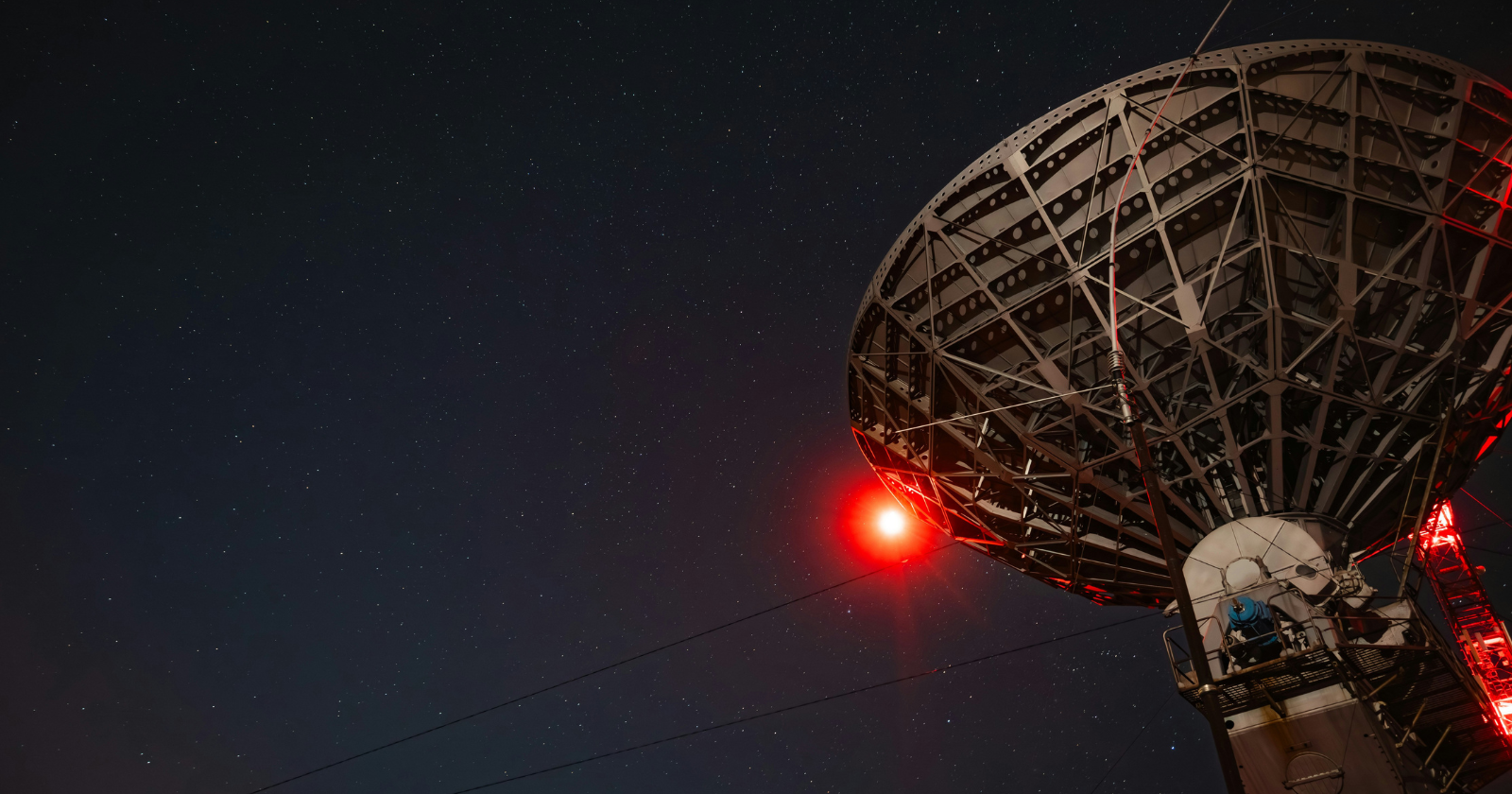
The Event Horizon Telescope isn’t really one telescope. It’s a case study in what happens when a scientific problem is too big for any single instrument to solve, so a few hundred researchers break it into pieces small enough to actually execute.
No single dish on Earth is large enough to resolve something as distant and compact as a black hole’s shadow. The fix wasn’t inventing a bigger telescope. It was linking eight existing ones, on four continents, so they could function as one telescope roughly the diameter of the planet.
The underlying trick, linking radio dishes that are nowhere near each other and treating them as one giant instrument, is called very-long-baseline interferometry, and astronomers first demonstrated it worked back in 1967. The Event Horizon Telescope didn’t invent the method. It pushed a fifty-year-old idea about as far as it can currently go, adding enough telescopes, at high enough frequencies, with clocks precise enough, to resolve something as small and as far away as a black hole’s shadow.
Step one: point eight telescopes at the same target on the same nights
Picking a target worth the coordination
The team chose M87, a galaxy about 55 million light years away with a supermassive black hole at its center roughly 6.5 billion times the mass of the sun. A black hole that large has an event horizon big enough, relative to its distance from Earth, to actually be resolvable, in theory, if enough telescopes could be synchronized precisely enough to act as one.
Waiting for clear skies everywhere at once
Radio telescopes tuned to the frequencies the EHT needed are sensitive to water vapor in the atmosphere, so the team needed clear, dry conditions at facilities in Hawaii, Arizona, Mexico, Chile, Spain, and Antarctica, all at the same time, during a narrow observing window in April 2017. Eight observatories ultimately took part, each one recording independently rather than transmitting live data anywhere.
Step two: record more data than any network could move
Half a ton of hard drives
Each telescope in the array logged roughly 350 terabytes of raw data a day, and by the end of the observing run the collaboration had recorded about 5 petabytes total. University of Arizona astronomer Dan Marrone, who helped manage the data recording, put the scale in physical terms afterward: “We had 5 petabytes of data recorded. It amounts to more than half a ton of hard drives.”
Sending that volume over standard internet connections wasn’t realistic. As Marrone put it, “There’s no internet that can compete with 5 petabytes of data on a plane.”
The eight-month wait for a flight out of Antarctica
Seven of the eight sites got their hard drives moving fairly quickly. The eighth, the South Pole Telescope, could not. Antarctica’s research station closes to all incoming and outgoing flights from February through October, so the drives recorded there in April 2017 sat in cold storage for the rest of that year, waiting for the next cargo flight out. They finally reached MIT’s Haystack Observatory on December 13, 2017, eight months after the observations themselves, having traveled through McMurdo Station, then Christchurch, New Zealand, then California, before the last leg to Massachusetts.
Step three: reconstruct the image four separate times, without anyone comparing notes
Once all the data had finally arrived and been synchronized at supercomputing centers in Massachusetts and Germany, the collaboration split its imaging analysts into four independent teams in June 2018, each working without contact with the others for seven weeks, specifically so no team’s assumptions about what a black hole should look like could contaminate anyone else’s result. Two teams used a long-standing radio astronomy technique called CLEAN. The other two, including one led by computer scientist Katie Bouman, built newer image-reconstruction methods borrowed from other fields entirely. On July 24, 2018, roughly forty members of the collaboration gathered in Cambridge, Massachusetts to compare all four results at once. All four were rings, roughly the same size, brighter on one side than the other. Nobody had seen anyone else’s image before that meeting.
What came out the other end
The image was released publicly on April 10, 2019. EHT Project Director Sheperd Doeleman opened the announcement plainly: “We have taken the first picture of a black hole. This is an extraordinary scientific feat accomplished by a team of more than 200 researchers.” Heino Falcke, chair of the EHT Science Council, explained what the picture actually showed: “we expect a black hole to create a dark region similar to a shadow—something predicted by Einstein’s general relativity that we’ve never seen before.”
Why the pieces mattered more than the whole
I think a lot about how people, myself included, tend to treat a big project as one enormous, undifferentiated task instead of a stack of smaller ones that can each be checked off on its own. It’s the same mistake whether you’re planning a household move or trying to image a black hole. The Event Horizon Telescope never had a single moment where anyone solved the whole problem.
It had eight telescopes independently pointed correctly, five petabytes of data that had to survive a slow boat, plane, and truck journey out of Antarctica intact, and four separate teams that each had to independently arrive at the same ring before anyone could trust it. No individual piece of that was actually impossible. Getting all of them right, in sequence, over two years, was the part that had never been done before.
I don’t manage anything on the scale of a global astronomy collaboration, obviously. My version of this is closer to running a household with two small kids in it while also working full time, where the actual list of things that need doing on any given day is long enough that treating it as one undifferentiated blob of responsibility guarantees I forget something and feel behind on everything else by mid-morning.
What the Event Horizon Telescope actually demonstrates, more than the picture itself, is that an outcome nobody could plan for in a single step is still reachable if you’re willing to plan for it in twenty separate ones instead.