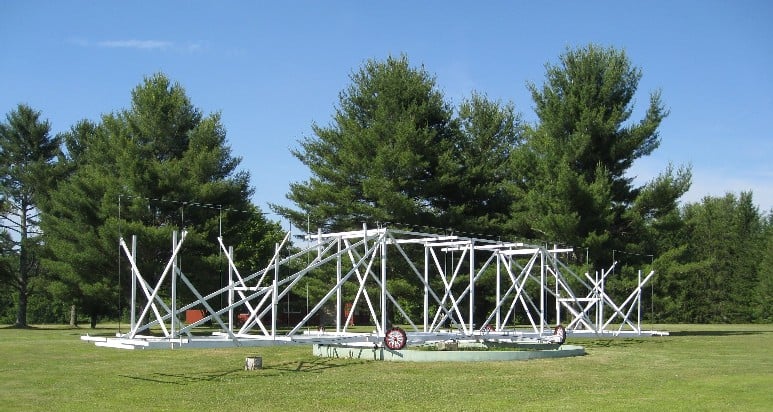
Here is a puzzle. A radio engineer is chasing down a source of static that keeps interrupting overseas phone calls. He rules out thunderstorms, since the hiss shows up on clear days too. He rules out the sun, since the timing keeps drifting away from noon by about four minutes every day. He rules out anything tied to the actual 24 hour clock people set their watches by, because whatever is causing this noise clearly isn’t following it.
What kind of clock runs four minutes fast every single day, forever, and what could possibly be on the other end of it.
The engineer was Karl Jansky, an employee of Bell Telephone Laboratories stationed at a field site in Holmdel, New Jersey, the same stretch of New Jersey farmland where Bell Labs would make an even more famous accidental discovery three decades later. The clock turned out to be the sky itself.
A puzzle that didn’t behave like weather
Bell Labs had a practical, unglamorous problem in the early 1930s. Their new transatlantic radio-telephone service kept picking up static, and the company needed to know where it came from before it could fix it. Jansky, an engineer trained at the University of Wisconsin who had joined Bell Labs in 1928, took the assignment.
He built a directional antenna about 100 feet across and 20 feet tall, mounted on four wheels salvaged from a Ford Model T so the whole rig could rotate on a circular track and scan the sky in every direction, all built for less than a thousand dollars. Coworkers nicknamed it Jansky’s merry-go-round. For the better part of a year it recorded a hiss that came and went on a schedule nothing on Earth kept, alongside the ordinary thunderstorm static he had actually been sent to catalogue.
Something built to solve a phone-company engineering complaint had turned up a signal that had nothing to do with phone calls at all. We built an entire video around a much later example of the same kind of accident, an instrument on Voyager 1 that was never assigned the job of finding anything in interstellar space either, and ended up being the only thing still listening when the spacecraft actually got there.
The clock that gave it away
Jansky eventually noticed the hiss peaked on a cycle of 23 hours and 56 minutes, not the 24 hour solar day people live by, but a sidereal day, the time it takes the Earth to rotate once relative to the distant stars rather than relative to the sun. Anything tracking that particular clock has to be coming from beyond the solar system.
“My records show that the hiss type static mentioned in my previous paper comes, not from the sun as I suggested in that paper, but from a direction fixed in space,” Jansky wrote to his father in a February 1933 letter. “The evidence I now have is very conclusive and, I think, very startling.”
By comparing his readings against star maps, he traced the strongest signal to the constellation Sagittarius, the direction of the center of the Milky Way. The New York Times put the discovery on its front page on May 5, 1933, and NBC’s Blue Network broadcast the actual hiss to listeners nationwide, with reporters describing it as something close to steam escaping from a radiator. A phone company had set out to protect the sound quality of overseas calls and ended up handing the public its first recorded sound from beyond the solar system.
One instrument stayed on, the other got reassigned
It’s worth being precise about what Jansky actually found, because it is an entirely different phenomenon from the tone in the video above, not a variation on the same thing. Jansky detected real electromagnetic radio waves, radiation generated by high energy electrons spiraling through the galaxy’s magnetic field, arriving from a specific direction in the sky.
The tone Voyager 1 caught decades later is a local electrostatic disturbance in the plasma immediately around the spacecraft, with no directionality to speak of and no connection to the galactic center at all. One is light. The other is a nearby gas ringing like a struck bell. Treating them as the same discovery would get the physics wrong on both sides.
What lines up instead is what happened to the two instruments afterward, and the contrast is its own kind of interesting. Once Jansky solved Bell Labs’ actual engineering question, the company saw no commercial reason to keep funding sky surveys and reassigned him to other projects, denying his request to build a larger dish for further study. The discovery essentially sat there for years until an amateur radio operator named Grote Reber built his own backyard dish to follow up on it.
Voyager’s plasma wave instrument had the opposite fate. Nobody actively chose to keep listening for anything either, but nobody bothered to switch it off once its planetary work was done, and that single unglamorous decision, made for no better reason than that shutting it down wasn’t worth the trouble, is the entire reason we have a record of what interstellar space sounds like.
Two accidental discoveries, born from two completely different kinds of institutional indifference, one that ended a line of research and one that accidentally preserved it. I find something almost comforting in how ordinary both decisions were. Nobody at Bell Labs sat down and decided radio astronomy wasn’t worth pursuing, the same way nobody at NASA sat down decades later and decided the plasma wave instrument deserved to stay on past its planned job. Both choices were closer to shrugs than verdicts, and the universe answered one of them anyway.