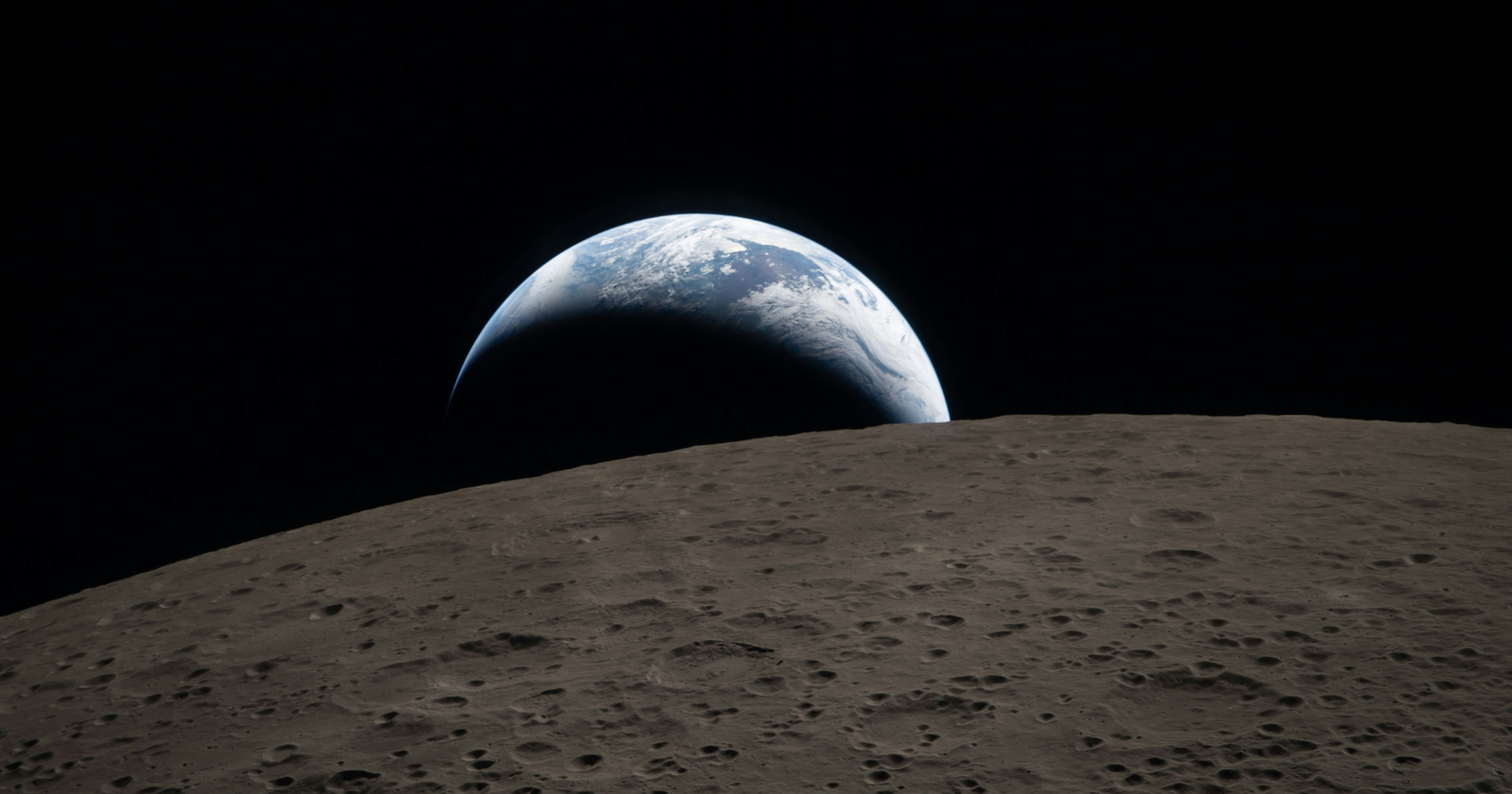
“It’s a bright spot on the moon. And we would like to call it ‘Carroll.'” Jeremy Hansen said those words into a radio to Mission Control, and his voice was shaking too hard to get through the sentence cleanly. He was speaking for the whole crew of Artemis II, a mission that had just carried four astronauts farther from Earth than any human being in history. What he was asking for had nothing to do with the record they had just broken.
This spring, NASA sent Reid Wiseman, Victor Glover, Christina Koch, and Hansen on a nine-day loop around the moon and back, the first crewed lunar mission in more than fifty years. Somewhere inside that trip, the four of them asked NASA to name a crater after Commander Wiseman’s late wife, Carroll, who died of cancer in 2020. I have reread that request more times than I probably need to admit. It says something true about what it does to a person to travel that far from home, and it has stayed with me all summer.
Fifty-six years, broken in an afternoon
On April 6, 2026, at 1:57 p.m. EDT, Artemis II crossed a mark that had stood since 1970. That was the year Apollo 13 astronauts James Lovell, John Swigert, and Fred Haise set the previous distance record at 248,655 miles from Earth. They did not choose that record. An oxygen tank exploded, and the moon’s gravity became the safest way home. Wiseman’s crew went further, eventually reaching 252,756 miles from Earth before turning back toward the Pacific Ocean. Along the way, Christina Koch became the first woman to fly on a moon-bound mission, and Victor Glover became the first Black astronaut sent on a lunar mission. Hansen, for his part, became the first Canadian ever to make the trip.
Hansen marked the moment with something that sounded less like a mission log and more like a thank-you note. “As we surpass the furthest distance humans have ever traveled from planet Earth, we do so honoring the extraordinary efforts and feats of our predecessors,” he said. It is an unusual milestone to celebrate, breaking a record that was originally set by an emergency. I think that is part of why the crew reached for gratitude instead of pride when the moment came.
A bright spot named Carroll
The request to Mission Control came the next day. Hansen spoke first, and it took him a moment to get through it. “A number of years ago, we started this journey in our close-knit astronaut family, and we lost a loved one … her name was Carroll, the spouse of Reid, the mother of Katie and Ellie,” he said. Then he pointed, in the way you point at something impossibly far away, toward a lunar feature sitting right on the boundary between the moon’s near and far side, visible from Earth during certain transits. “It’s a bright spot on the moon. And we would like to call it ‘Carroll.'”
Carroll Wiseman worked as a registered nurse in a neonatal intensive care unit, and later as a school nurse near Houston. She died of cancer in 2020, at 46, leaving behind Reid and their two daughters. Wiseman has said that even while she was sick, she encouraged him to keep flying, because it was the work he loved and she did not want him to give it up on her account. Carrying her memory into space felt, in his words, like “continuing to go down this path that we had forged for 17 years together.” All four astronauts were in tears by the time Mission Control confirmed the name.
Seventeen years, forged
I keep coming back to that word, forged, because it captures something a marriage does over the years that a softer word like built never quite reaches. My husband Matias and I are nowhere near seventeen years yet, but we have our own small version of it. Once a week, once our daughter is asleep and the nanny has gone home for the day, we go out for dinner and drinks, just the two of us, and it is usually the only uninterrupted conversation we get all week. Some weeks that dinner feels like a small luxury. Other weeks it is the thing that gets us through everything else the week held.
You do not need to go to the moon to understand what Wiseman meant by that phrase. You just need one ordinary stretch of years with someone, the kind with sick days and work trips and a baby who will not sleep through the night, and the relationship stops looking like the shape it started as. He asked for a piece of the moon that would carry her name because, in his telling, their life together was still doing the shaping, even after she was gone. That is the version of a marriage nobody puts in a wedding toast, the version made of ordinary years instead of one perfect day.
What comes home with you
Artemis II was a short trip, home in just over nine days, so the crew never had the long stretch away from Earth that changes how some astronauts feel once they land. That made me curious about the longer version of this. Astronauts who spend six months on the International Space Station sometimes come back describing something stranger than jet lag, a sense of watching their own life instead of living it, like part of them stayed a half step behind. Researchers sometimes call this depersonalization, and milder, everyday versions of it turn out to be far more common than most people would guess. I am not a psychologist, and a topic like this deserves a professional’s read more than mine, but the pattern itself is well documented in the debriefs flight surgeons run with returning crews.
There’s a well-documented explanation for why this happens — something about how the vestibular system recalibrates after months without gravity, and why the brain’s sense of self can lag behind the body on the way back to normal. What’s stranger is that researchers have found a quieter version of the same mechanism in ordinary life: on a long drive you barely remember taking, or in a conversation where your own voice suddenly sounds like it belongs to someone else. Astronauts Come Home Feeling Like They’re Being Watched video by Space Daily offers a clear explanation of both the space version and the everyday one.
The kind of distance that does not create space
What I keep sitting with is the contrast. Four astronauts spent nine days setting a physical distance record that no human being had ever touched, and the thing they chose to mark permanently on the moon’s surface was not the record. It was a woman who worked night shifts in a neonatal ICU and raised two daughters. If losing someone you built a life with is something you are carrying right now, I will not pretend a crater on the moon fixes that, and a good therapist will do more for you than any article ever could. Going farther from Earth than anyone in history made these four astronauts want to say the names of the people they loved out loud, on the record, for good.