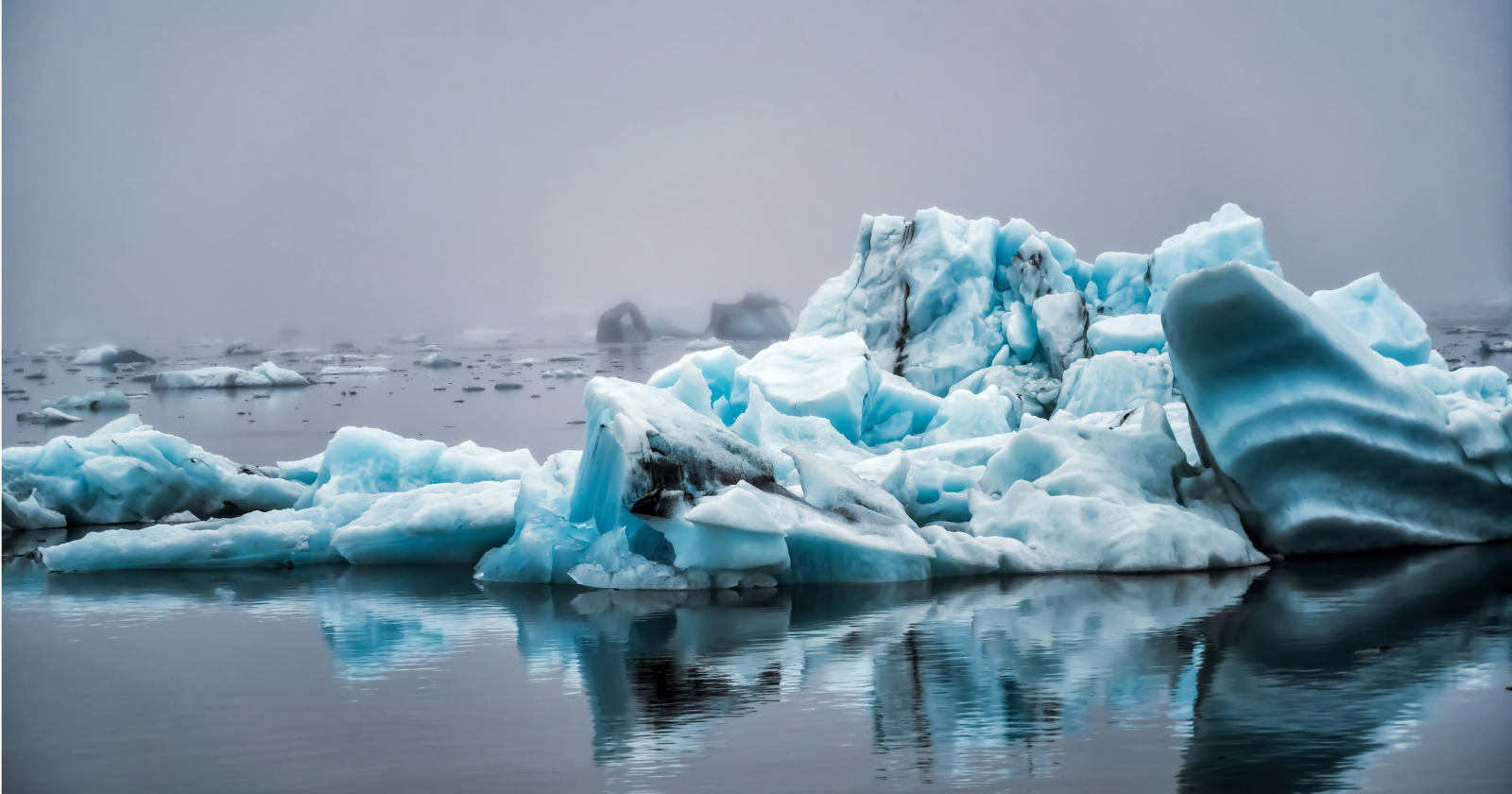
Somewhere beneath the seafloor of nearly every continent right now, there’s a layer of ice you could hold a lit match to and watch it burn.
Not the ice itself, exactly. What’s trapped inside it. Methane hydrate looks like a chunk of frozen water, and behaves like one until the pressure around it drops, at which point it releases the natural gas locked inside its crystal structure and that gas will ignite on contact with a flame.
Scientists nicknamed it fire ice for exactly that reason, and it sits under the ocean in quantities that make conventional gas fields look modest by comparison.
The version we already have under our own ocean floor
Methane hydrate forms where cold temperatures and high pressure combine, mostly in deep ocean sediment and underneath Arctic permafrost. Water molecules form a cage-like lattice, and methane gas gets trapped inside the cage instead of escaping to the surface the way it normally would.
The scale of it is difficult to overstate. According to a US Geological Survey fact sheet, the volume of carbon locked inside methane hydrates worldwide is estimated to be roughly twice the amount contained in all other fossil fuels on Earth combined, coal included. That’s not a typo. It just happens to be sitting somewhere almost nobody can reach it economically yet.
Which is the part that keeps this from being the energy story it sounds like at first. Keith Kvenvolden, an emeritus organic geochemist with the USGS who spent decades studying these deposits, was blunt about the gap between what’s down there and what anyone can actually use: “I think there will be some production from hydrates, for example, in permafrost areas where they are a bit easier to get to. But to think about vast deposits that will be commercially exploitable, it’s my opinion it just won’t happen.” The gas is real. The math on getting it out safely and affordably has never quite closed, and it’s been sitting unsolved for longer than most energy problems get left alone.
A resource that large sitting that far out of reach is a strange thing to sit with, and it’s part of why a video we made recently kept surfacing in my head while I researched this. It’s about Titan, Saturn’s largest moon, where methane doesn’t hide in ice crystals at all. It falls as rain, fills entire seas the size of the Great Lakes, and sits there in plain liquid form under skies of orange haze. NASA has actually calculated that Titan holds hundreds of times more liquid hydrocarbon than every known oil and gas reserve on Earth combined, out in the open, and it’s still functionally useless to us because there’s no oxygen anywhere nearby to burn it.
Two versions of the same locked door
Line the two up and the shape rhymes in an odd way. Earth keeps its methane compressed into an icy solid that requires exact temperature and pressure to stay stable, buried under water so deep that reaching it is its own engineering problem. Titan keeps its methane in open liquid seas that anyone could, in theory, scoop out with a bucket, except it sits one and a half billion kilometers away and the chemistry needed to burn it doesn’t exist there. Two planets, two completely different ways of making the same resource nearly impossible to use. It’s less a coincidence than a pattern: abundance and accessibility rarely show up together, whether you’re talking about a moon of Saturn or the floor of your own ocean.
The part that isn’t just a curiosity
Here on Earth, methane hydrate isn’t only an interesting resource problem. It’s also a genuine climate variable, and honest researchers are careful not to overstate or understate it. James Kennett, a climate researcher who has studied the deposits for years, has pointed to specific vulnerable zones rather than treating the whole reserve as one uniform threat: “There are key areas that I would tend to be more concerned about, particularly in the Arctic Ocean. Those are potentially vulnerable to instability with even a one degree temperature warming.” If frozen methane deposits in shallow, cold-sensitive areas destabilize as ocean temperatures rise, they release a greenhouse gas far more potent than carbon dioxide in the short term, adding to the very warming that destabilized them in the first place.
None of that makes methane hydrate a ticking bomb waiting to go off everywhere at once. Most of the world’s reserves sit in deep, stable conditions that aren’t going anywhere soon. But the Arctic edges of the deposit are exactly the kind of detail that separates a genuinely useful resource story from a comforting one, and it’s worth knowing which one you’re actually being told. Good science reporting on this tends to hold both facts at once: an enormous reserve and a narrow, specific risk zone within it, rather than collapsing the two into a single headline.
What’s actually locked away
I think about this pattern more than I probably should: the biggest reserves of anything, whether it’s energy, opportunity, or just time in a day, tend to sit exactly where they’re hardest to reach. That’s not a reason to ignore them. It’s a reason to be honest about the difference between something existing and something being usable. My own version of this shows up in far more ordinary places, the pile of things I keep meaning to get to once life slows down, which it never quite does on its own schedule. Twice the carbon of every fossil fuel on Earth is sitting under our oceans right now, doing nothing, because getting it out safely still hasn’t been solved. Sometimes the harder problem isn’t finding the resource. It’s building a door to it that doesn’t collapse the room on the way in, and knowing which locked doors are actually worth the effort of opening.