For more than three decades, one particular star has been watched more closely than almost any other star in the night sky. Every major telescope built in that time has pointed at it at some point, sometimes for years at a stretch. And somehow, all of that attention still missed something roughly the size of two Jupiters, sitting right there in the data the whole time.
I love a good mystery. Most nights I’m in the kitchen making dinner with a true crime documentary playing in the background, half listening for the twist I’ve already guessed. My husband is Chilean, and every time we fly to Santiago to see his family, someone brings up how the Atacama Desert has some of the clearest skies on the planet, which is why a huge share of the world’s most powerful telescopes sit up in those mountains. I never fully understood why astronomers needed such a specific stretch of desert until I read about what one of those telescopes, working alongside the James Webb Space Telescope, just found hiding in plain view.
The star in question is called Beta Pictoris, and it just got caught keeping a secret for more than a decade.
What exactly was hiding there?
Astronomers have studied Beta Pictoris so thoroughly that it shows up in textbooks as a go-to example of how planets form. It sits about 63 light years away, and at roughly 23 million years old, it is a toddler by star standards. The system was already famous for two enormous planets, Beta Pictoris b and Beta Pictoris c, one of which was among the very first exoplanets ever photographed directly. In the middle of 2026, two separate teams of researchers announced a third one, Beta Pictoris d, and it turned out to have been sitting there the entire time.
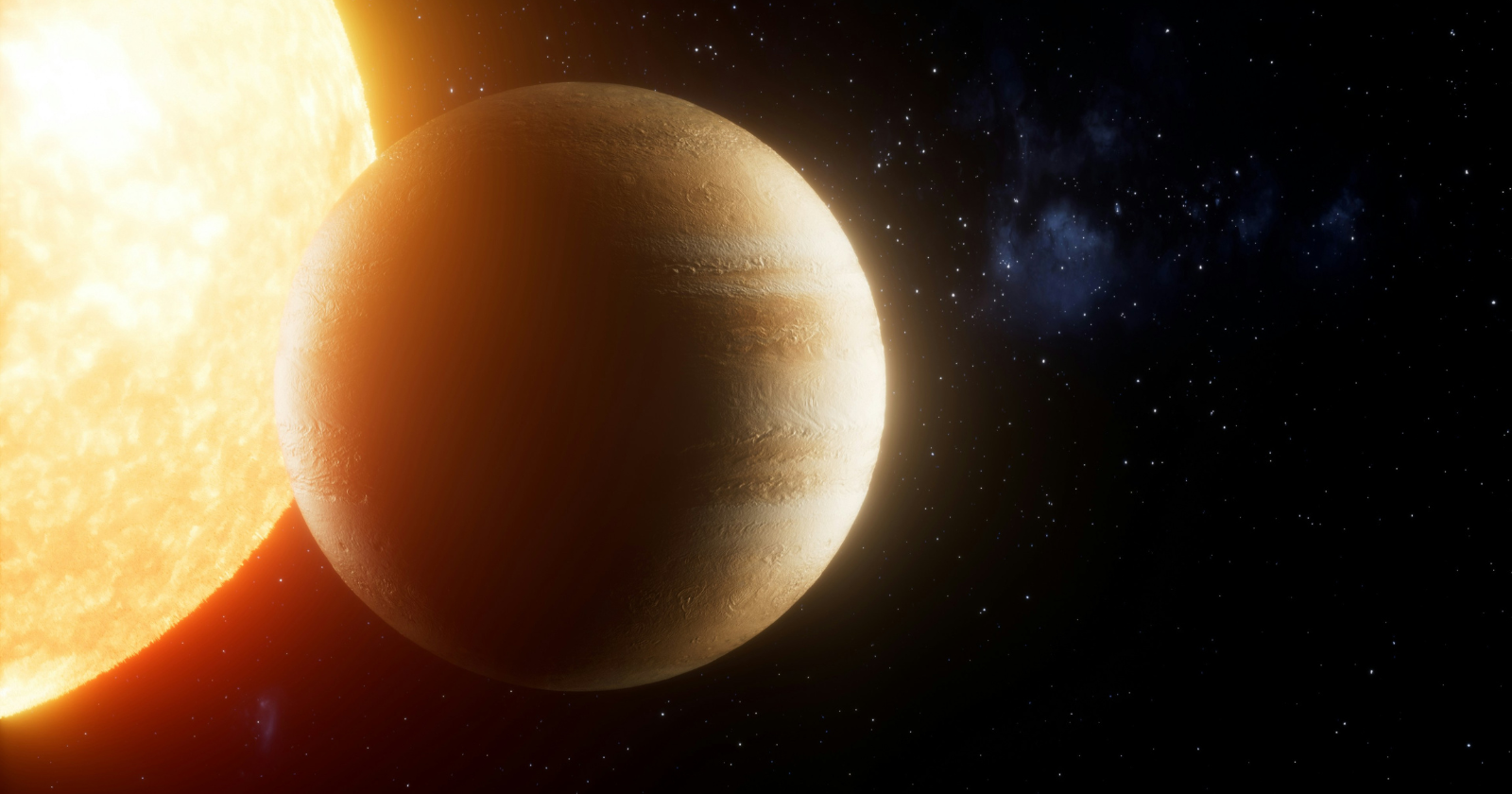
The new planet is smaller than its two siblings, although calling anything with two to four times the mass of Jupiter small feels a bit generous. It circles its star at a distance similar to where Neptune sits in our own solar system, right at the inner edge of the bright ring of dust and debris that surrounds Beta Pictoris. That ring of dust turned out to be the whole reason nobody had spotted it sooner.
How does a planet hide inside one of the most photographed systems in the galaxy?
This is the part that made me put my fork down. Beta Pictoris is surrounded by a thick, glowing disk of dust and debris left over from its own formation, and that disk scatters starlight in ways that can look a lot like a faint planet if you are not careful. For years, that glare buried Beta Pictoris d, the way a bright porch light can swallow the exact outline of whatever is standing just behind it.
One team, led by researcher Aidan Gibbs at the University of California, San Diego, was not even looking for a new planet when they found it. They were using the James Webb Space Telescope’s NIRSpec instrument to study the atmosphere of an already known planet, Beta Pictoris b, when an unexpected signal turned up in the data where nobody expected one. “We weren’t looking for a new planet,” Gibbs said, and instead of a fuzzy blob of light, the signal turned out to be a distinctive chemical fingerprint, a barcode of carbon monoxide absorption lines that ordinary dust does not produce. Follow-up observations later picked up water vapor and methane too, which confirmed they had found an actual planet’s atmosphere rather than a trick of the light.
On a side note, glare and haze hiding something in plain sight is not just a trick that happens around distant stars. There is a place much closer to home that pulled off the same trick for years, buried under a thick orange haze of its own. Saturn’s moon Titan looks, from a distance, like the most familiar place imaginable, complete with rain, rivers, beaches, and seas. It took decades before anyone could even see through that haze to find out that almost none of it is what it looks like. This video walks through what is actually going on down there, and it’s worth checking out if this idea of something hiding in plain sight has you in the mood for one more good mystery:
How did two very different telescopes land on the same secret?
At almost the same time, a separate team led by astronomer Ben Sutlieff of the University of Edinburgh was looking at the same star for a completely different reason, using the ground based Very Large Telescope, the one that sits in that same Chilean desert my husband’s family has told me about for years. They were not hunting for a new world either. They just wanted to see how the known planet, Beta Pictoris b, had changed over time. “This was a serendipitous discovery,” Sutlieff said, and once his team started digging through the observatory’s archives, they found the same faint object sitting quietly in images going back eleven years.
Co-author Jayne Birkby of the University of Oxford described what it felt like to go back through those old images once the team finally knew what to look for. The planet had been “playing hide-and-seek with us all this time,” and in the oldest picture it was barely visible next to its much brighter neighbor. Two teams, working with two different telescopes and two completely different techniques, landed on the same discovery within weeks of each other, which is about as close to independent confirmation as astronomy gets.
What does a hidden planet explain about the mess around it?
Here’s the detail I found most satisfying. Astronomers had noticed for years that the bright dust disk around Beta Pictoris had an oddly sharp inner edge and other strange shapes, and some had already predicted that a planet like this one had to exist to explain it. Now they finally have the missing piece that fits the puzzle they had been staring at for so long. Beta Pictoris d sits in almost exactly the right spot and carries almost exactly the right mass to be quietly sculpting that disk with its own gravity.
Why does this matter for everything we haven’t found yet?
The bigger story here is the method, not just the planet. Spotting a world through the chemical signature in its atmosphere, instead of waiting for a clean picture of it, means astronomers can find planets buried inside bright dust or hiding beside a much brighter sibling. Researchers now suspect several of the most famous, most photographed planetary systems in the sky could be hiding smaller, fainter worlds the same way Beta Pictoris was. With more sensitive instruments on the way, including the Extremely Large Telescope currently under construction, some of astronomy’s oldest and best studied neighborhoods may still have a few more surprises tucked away in the glare.