
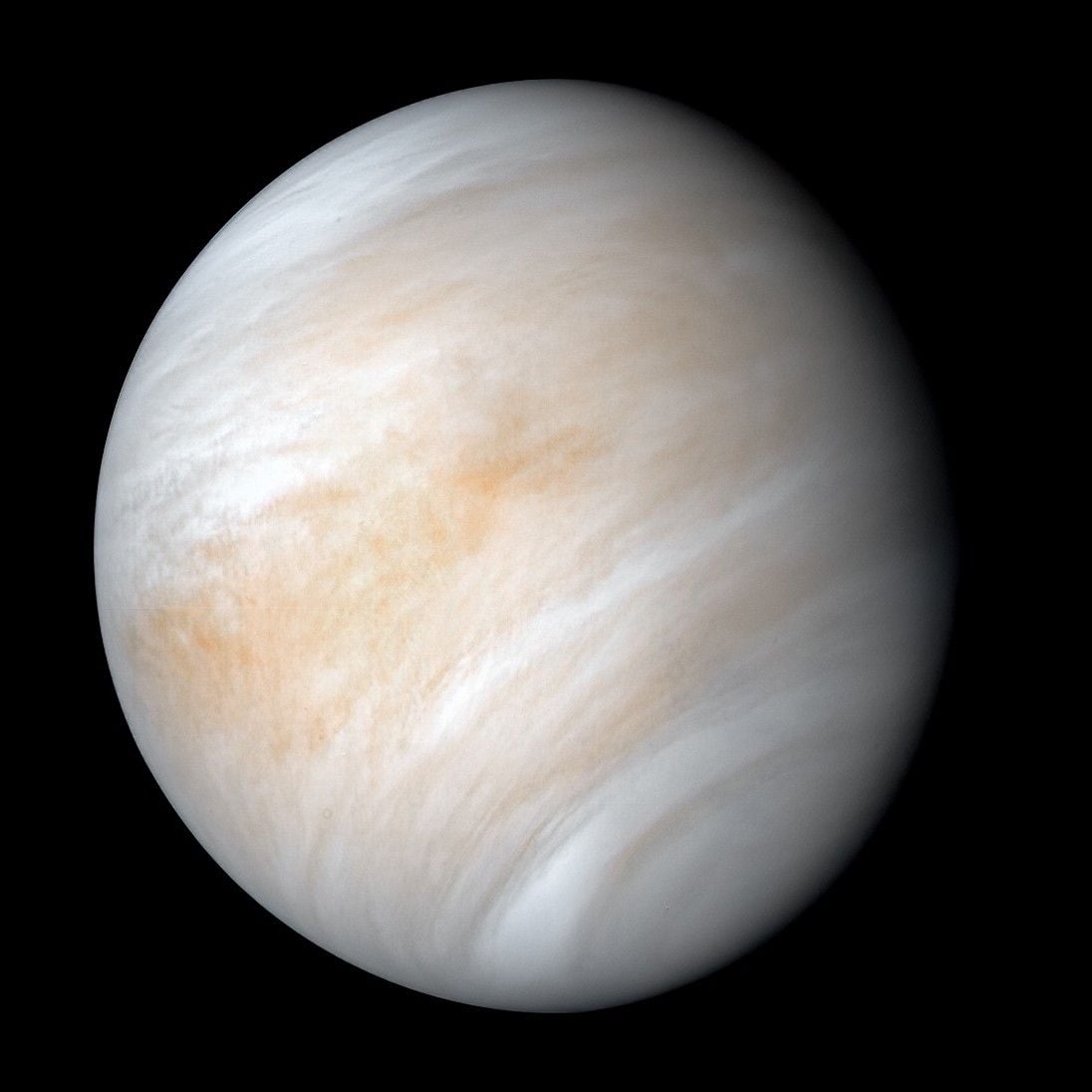
Venus is usually introduced as the planet that makes Mars look gentle. Its surface is hot enough to melt lead, its pressure is comparable to being nearly a kilometre under Earth’s ocean, and its clouds are chemically hostile. Yet about 50 kilometres above that surface, the numbers change in a way that is still easy to miss.
NASA’s Venus facts page says that about 30 miles up, or roughly 50 kilometres, temperatures range from 30 to 70 degrees Celsius, and the atmospheric pressure is similar to what we find at Earth’s surface. A NASA Langley concept study called HAVOC, short for High Altitude Venus Operational Concept, used 50 kilometres as the operating altitude for a proposed airship and listed the environment there at about 75 degrees Celsius and 1.05 atmospheres.
That does not make Venus habitable in any ordinary sense. The air is overwhelmingly carbon dioxide, the clouds contain corrosive sulphuric acid, and any crewed vehicle would still need a sealed habitat, chemical protection and a way to survive arrival and departure. But by temperature and pressure alone, the Venusian cloud layer is surprisingly close to familiar terrestrial conditions, and in those limited measures it is more forgiving than the surface of Mars.
The comparison is narrow, but real
On the ground, Venus is almost absurdly hostile. NASA lists its surface temperature at about 467 degrees Celsius and surface pressure at about 93 times Earth’s sea-level pressure. The planet’s thick atmosphere traps heat through a runaway greenhouse effect, leaving the lower atmosphere and surface far outside the range of conventional landers, let alone human exploration.
The Soviet Venera landers proved that landing was possible, but also showed how short-lived the achievement could be. The longest surface operations lasted only hours. The difficulty was not a lack of imagination. It was heat, pressure and chemistry pressing on every seal, wire, instrument and structure at once.
At altitude, however, Venus becomes a different engineering problem. The HAVOC presentation by Dale Arney and Chris Jones at NASA Langley compared Venus at 50 kilometres with Earth and Mars. At that level, the study gave Venus an atmospheric pressure of 106.6 kilopascals, close to Earth’s 101.3 kilopascals, and far above Mars’ 0.64 kilopascals in the comparison table. It also listed Venus’ gravity at that altitude as 8.73 metres per second squared, closer to Earth’s 9.81 than Mars’ 3.71.
Temperature is less Earth-like than pressure, but still striking in context. Seventy-five degrees Celsius is dangerous for unprotected humans and difficult for equipment. It is also nothing like the 467-degree surface below. NASA’s broader Venus facts page gives the cloud-level range as 30 to 70 degrees Celsius, putting parts of that region in a range that engineering systems can at least plausibly manage.
Why Mars is not automatically easier
Mars has the psychological advantage of a solid surface. Rovers can drive there. Landers can sit there. Astronauts can imagine walking there in pressure suits. Venus, by contrast, asks mission designers to think in terms of aircraft, balloons or airships floating above a surface they may never touch.
But a surface is not the same as a gentle environment. NASA describes Mars as a cold desert world with a very thin atmosphere. Its temperatures can climb to about 20 degrees Celsius or fall to around minus 153 degrees Celsius, and its sparse air lets heat escape rapidly. The atmosphere offers little protection from impacts or radiation, and liquid water cannot persist for long on the surface under present conditions.
That is why the Venus comparison matters. At 50 kilometres, Venus has pressure closer to Earth than Mars does, stronger radiation shielding from the atmosphere, and abundant sunlight above or within the cloud system. The HAVOC study treated these as reasons to revisit Venus not as a surface destination, but as an atmospheric one.
The idea is not new in its broad outline. Scientists and engineers have discussed Venus balloons for decades, and the Soviet Vega missions successfully deployed balloons in the Venusian atmosphere in 1985. What HAVOC did was turn the idea into a staged exploration architecture, beginning with robotic airships and extending, on paper, to crewed stays in the atmosphere.
Earth-like does not mean Earth
The phrase “Earth-like” can mislead if it is allowed to carry too much weight. Venus at 50 kilometres is Earth-like in pressure and partly in temperature. It is not Earth-like in composition, chemistry, weather, operational risk or habitability.
The atmosphere is mostly carbon dioxide, not breathable air. The cloud particles are acidic. Winds at cloud level can move at high speed around the planet. Any floating platform would need to resist corrosion, manage thermal loads, maintain buoyancy, generate power, communicate through a difficult atmosphere and eventually, for a crewed mission, launch back out of Venus’ gravity well.
There is also no current NASA plan to send astronauts into Venus’ clouds. HAVOC was a concept study, not an approved mission. Its value is that it makes the physical comparison explicit and forces a question that Mars-first thinking can obscure: if a destination is judged by pressure, temperature, gravity, radiation shielding and solar energy, Venus’ upper atmosphere deserves a place in the conversation.
That does not displace Mars. Mars has accessible geology, ancient riverbeds, polar ice, a long exploration infrastructure and a surface that can be mapped, drilled and traversed. Venus offers a different target: atmospheric science, climate history, chemistry and the chance to study a rocky planet that may once have followed a very different path.
A planet worth measuring carefully
Venus has become increasingly important for another reason. It is a warning case for climate evolution and a comparison point for rocky exoplanets. Earth and Venus are similar in size, but their climates diverged drastically. Understanding why is not only a Venus question. It bears on how scientists interpret rocky worlds around other stars.
The altitude near 50 kilometres is part of that story because it is one of the few places on Venus where long-duration in situ measurements might be technically plausible. A balloon or airship does not have to endure the full surface environment. It can ride the atmosphere, sample cloud chemistry, measure winds and trace how energy moves through the planet’s climate system.
NASA’s Venus facts page frames the cloud layer partly through astrobiology, noting that its temperature and pressure could accommodate some Earthly extremophile life, while also stressing that no finding provides compelling evidence for life in the clouds. That caution is essential. The point is not that Venus is secretly friendly. It is that the planet’s hostility is vertically uneven.
Below, Venus is a furnace under crushing pressure. Above, for a narrow band in the clouds, temperature and pressure briefly approach values familiar from Earth. That thin region does not make Venus easy. It does make it stranger, and more strategically interesting, than the phrase “Earth’s evil twin” usually allows.