
For most of the space age, Earth’s magnetic field has been described as a shield. It deflects much of the charged material streaming from the Sun and helps keep the upper atmosphere from being stripped away too quickly. A 2025 modelling study adds a more complicated possibility: under the right geometry, the same magnetic environment may also help carry pieces of Earth’s atmosphere to the Moon.
The study, published in Communications Earth & Environment on 11 December 2025, was led by Shubhonkar Paramanick of the University of Rochester. The authors used three-dimensional magnetohydrodynamic simulations to examine whether atmospheric ions from Earth could be transported across the Earth-Moon system and implanted into lunar soil.
This is one modelling study, not settled consensus. But it speaks to a problem that has been sitting in lunar science since Apollo: some light volatile elements in the lunar regolith, including nitrogen and noble gases, do not look easy to explain by the solar wind alone.
The result is striking because it does not simply say that Earth’s atmosphere leaked to the Moon before the planet had a magnetic field. Earlier ideas had leaned toward that possibility. Paramanick and colleagues argue that the non-solar component in lunar soil is better explained by implantation during the long history of Earth’s geodynamo, while the planet did have a magnetic field.
In other words, the shield may also have acted, at times, like a transport system.
The Moon crosses Earth’s magnetic tail
The geometry matters. NASA puts the Moon’s average distance from Earth at about 384,400 kilometres, close to the 385,000-kilometre figure commonly used for the Earth-Moon separation. That is far compared with any low-Earth orbit, but it is not always outside Earth’s magnetic environment.
Earth’s magnetosphere is compressed on the dayside by the solar wind and stretched into a long magnetotail on the nightside. Around full Moon, the Moon passes through that region. Earlier work had already shown that terrestrial ions can be present there. A 2017 Nature Astronomy paper, using observations from Japan’s Kaguya spacecraft, reported oxygen ions from Earth reaching the Moon when it was inside Earth’s plasma sheet.
The 2025 study extends that picture with a broader transport model. It compares a contemporary magnetised Earth with an Archean, unmagnetised Earth scenario, then asks how solar wind and “Earth wind” components would mix and arrive at the lunar near side. The authors use “Earth wind” for atmospheric ions that escape after the solar wind interacts with the terrestrial atmosphere.
The model finds that atmospheric transfer is efficient only when the Moon is inside Earth’s magnetotail. It also finds that the lunar soil’s non-solar contribution is best explained by implantation over the long history of the geodynamo under conditions closer to present-day solar wind, rather than by a short early interval when Earth may have lacked a magnetic field.
Why Apollo soil still matters
The study is not based on a new scoop of Moon dust. It is a model checked against existing lunar sample constraints. That distinction matters. The authors are not claiming to have watched individual nitrogen atoms leave Earth and land on a specific Apollo grain. They are asking whether known isotope and abundance patterns in returned lunar material are compatible with a long-running source from Earth’s atmosphere.
The paper notes that hydrogen, carbon, nitrogen and light noble gases appear in lunar soils even though they are essentially absent from lunar rocks. Solar wind implantation is already a major part of the story. The problem is that the solar wind does not comfortably explain everything, especially the nitrogen puzzle and some isotopic variation.
Older work had proposed that terrestrial nitrogen and noble gases might be present in lunar soils. The 2017 Kaguya result strengthened the case that Earth-origin ions can reach the Moon. The new contribution is the dynamical modelling of how magnetised and unmagnetised Earth cases compare, and whether a magnetic field is necessarily a barrier to atmospheric transfer.
Paramanick and colleagues conclude that it is not. In their simulations, the magnetic field shapes a magnetotail that can carry and mix atmospheric material, even if it also reduces some forms of atmospheric escape. The net picture is not the simple shield-versus-leak binary that often appears in popular descriptions.
A buried archive, not just a surface coating
The most interesting Moon-base implication may not be that future crews could scrape up useful volatiles near the surface. That possibility is tempting, but the paper is more cautious. Its stronger argument is archival.
If atmospheric ions from Earth have been implanted into lunar regolith across billions of years, then buried lunar soils may preserve a chemical record of Earth’s atmosphere through deep time. The authors specifically suggest that the history of the terrestrial atmosphere could be preserved in buried lunar soils. That makes subsurface regolith more than a construction material or a dust hazard. It becomes a possible planetary archive.
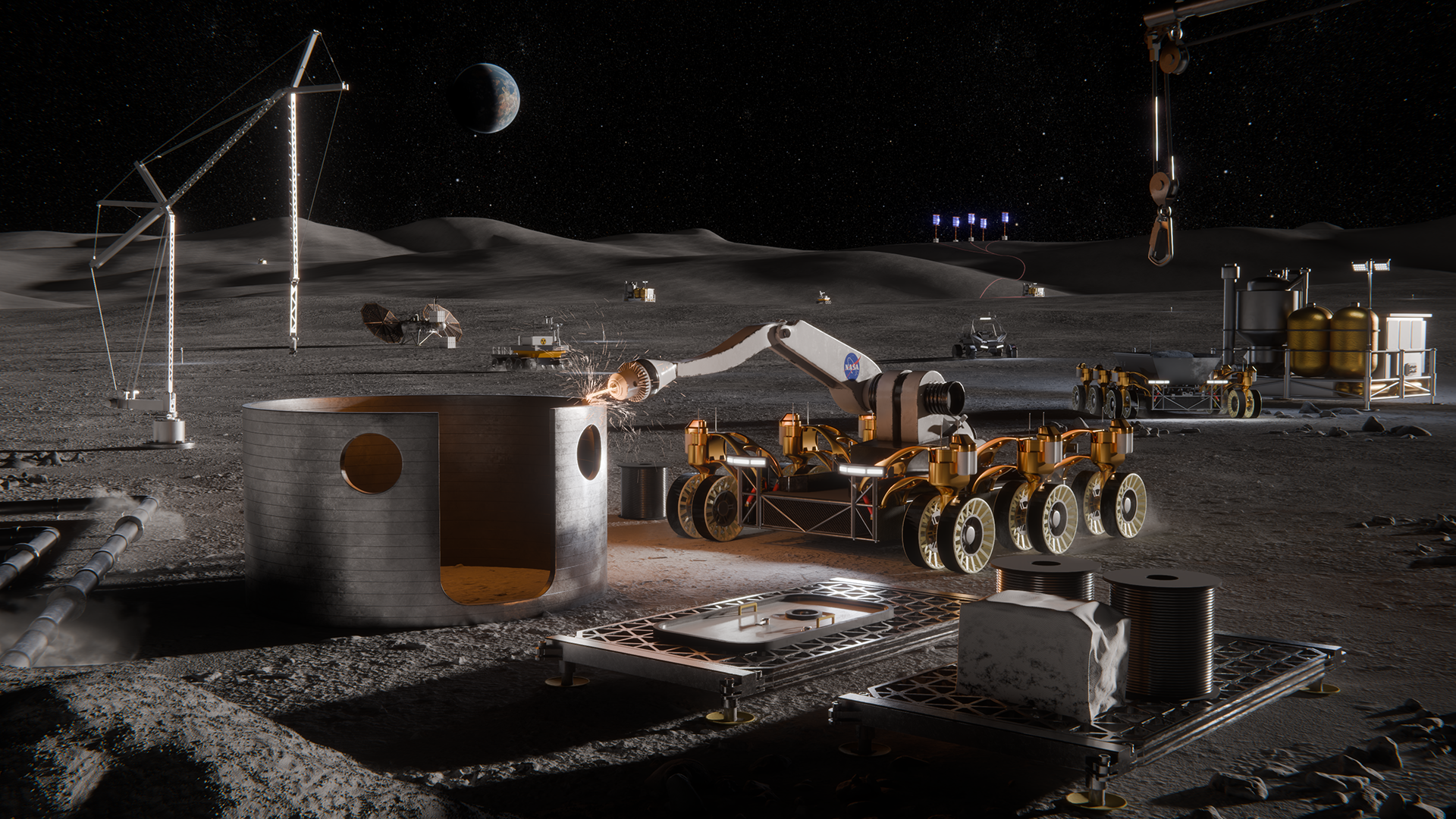
This matters for future lunar infrastructure because a base is not just a place to live. It is a platform for excavation, drilling, sample handling and long-term field geology. A sustained human or robotic presence could make it possible to sample layered regolith that was buried and shielded after exposure at different times in lunar history.
That kind of work would be very different from treating the Moon as a quarry. The goal would be to read the order of exposure and burial, separate solar wind signatures from Earth-origin material, and test whether the model’s predicted atmospheric contribution is visible in layers of different age.
The finding has limits
The limits are important. Lunar regolith is constantly disturbed by impacts, radiation, electrostatic charging and micrometeorite gardening. Its surface is not a neat sedimentary archive in the terrestrial sense. The record, if present, is mixed, exposed, buried and reworked over long timescales.
The 2025 model also depends on assumptions about ancient solar wind conditions, Earth’s upper-atmosphere structure, the hydrodynamic escape boundary and the Moon’s magnetic history. The authors say Apollo sample abundances are highly sensitive to the altitude of Earth’s escape boundary, which they estimate was never smaller than 190 kilometres at the time of ion implantation.
There is also a resource distinction. Volatiles in regolith are not automatically practical supplies for a base. Even when useful elements are present, extraction can be difficult, energy intensive and location dependent. For astronauts, engineers and mission planners, a scientific archive and a usable stockpile are not the same thing.
Still, the argument changes the value of the dirt underfoot. Beneath a future Moon base, regolith may not simply be local material to move, melt, shield with or avoid breathing. It may carry a faint record of Earth’s own atmosphere, delivered across the Earth-Moon system by a magnetic structure that does not only protect the planet, but may also quietly connect it to its nearest neighbour.
Sources
- Paramanick et al., Communications Earth & Environment: Terrestrial atmospheric ion implantation occurred in the nearside lunar regolith during the history of Earth’s dynamo
- Terada et al., Nature Astronomy: Biogenic oxygen from Earth transported to the Moon by a wind of magnetospheric ions
- NASA Science: Moon Facts
- Space.com: Earth’s atmosphere leaks all the way out to the Moon
