
Artemis II broke a human spaceflight record in a way that looks almost modest until the geometry is understood. The four astronauts did not land on the Moon. They did not enter lunar orbit. They did not even need to make the record the centrepiece of the mission. They flew past the Moon, looped around its far side, and let a carefully designed free-return path carry them farther from Earth than any people had ever been.
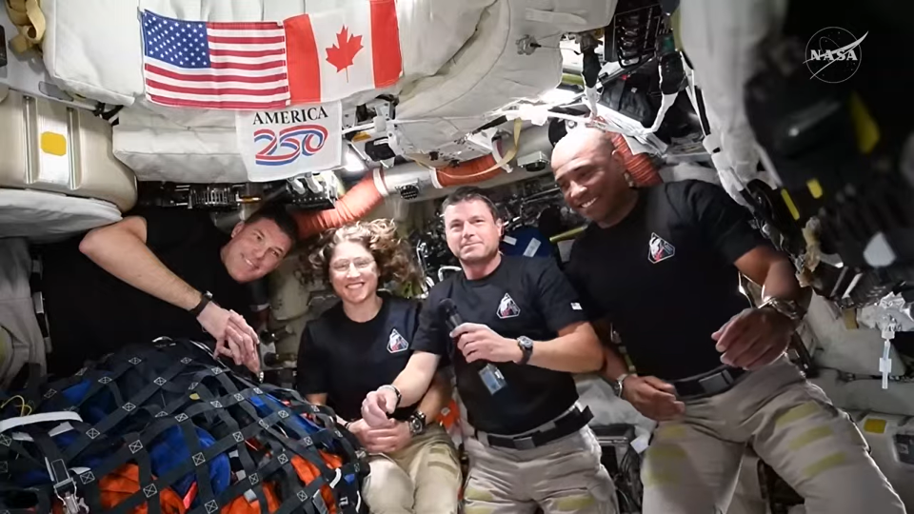
On April 6, 2026, NASA astronauts Reid Wiseman, Victor Glover and Christina Koch, along with Canadian Space Agency astronaut Jeremy Hansen, passed the old Apollo 13 distance mark and then kept going. NASA’s live Flight Day 6 update reported that the crew reached the mission’s maximum distance from Earth at 252,756 miles, or about 406,771 kilometres, at 7:02 p.m. Eastern.
That placed Orion 4,111 miles farther from Earth than Apollo 13 had been in 1970. The margin was small by the scale of space, but it was large enough to move the outer boundary of human travel for the first time in more than half a century.
The record was not a landing record
The easiest mistake is to assume that the farthest humans from Earth must have been the people who walked on the Moon. In fact, landing is not what sets the distance record. The record is set by where the spacecraft is relative to Earth, and that depends on the Moon’s position in its elliptical orbit, the spacecraft’s path around the Moon and how far beyond the lunar far side the trajectory carries the crew.
Artemis II was a lunar flyby, not a landing attempt. Orion approached the Moon, passed behind it, lost direct radio contact with Earth for about 40 minutes, and then emerged again as the Deep Space Network reacquired the signal. NASA reported closest approach at about 4,067 miles above the lunar surface, with Orion moving much faster relative to Earth than it was relative to the Moon.
Two minutes later, the spacecraft reached its greatest distance from Earth. The timing matters. The record was not set at launch, not at trans-lunar injection, and not by touching the Moon. It was set because the crew’s path curved around the far side while the Moon itself was far enough from Earth for the geometry to exceed the Apollo 13 mark.
Why Apollo 13 held the mark for so long
Apollo 13’s record was born from an emergency. The mission launched in April 1970 as a planned lunar landing, but an oxygen tank explosion in the service module forced NASA to abandon the landing and use the Moon as part of the way home. Jim Lovell, Jack Swigert and Fred Haise looped around the far side on a trajectory that became one of the defining survival stories in spaceflight.
That survival path took Apollo 13 to 248,655 miles from Earth, according to the figure NASA used in its Artemis II updates. It was never meant to be the mission’s most durable achievement. Yet for 56 years, no other crew went farther.
The reason is partly historical. After Apollo 17 in 1972, humans did not travel beyond low Earth orbit. Space stations, shuttle flights and commercial crew missions kept astronauts close to Earth by lunar standards. They did difficult work, but not at the distances required to challenge Apollo 13’s accidental high-water mark.
Artemis II was the first crewed Artemis flight and the first crewed mission to the Moon’s vicinity since Apollo. Its distance record came from a planned test flight rather than a crisis, but the trajectory echoed Apollo 13 in one important respect: the Moon’s gravity bent the spacecraft’s path around the far side and back toward Earth without requiring Orion to brake into lunar orbit.
What a free-return path does
A free-return trajectory is a way of designing a lunar flight so that the spacecraft will naturally come back toward Earth after passing the Moon, even if major propulsion options become limited. The path is not propulsion-free in the whole mission. Rockets still send the spacecraft out toward the Moon, and smaller corrections can refine the path. But the broad shape of the route uses gravity to bring the spacecraft home.
That is why the route has such deep Apollo associations. After the Apollo 13 explosion, the free-return geometry became central to getting the crew back alive. Artemis II used the same basic idea in a controlled test-flight setting: Orion would pass the Moon and return to Earth without entering orbit or descending to the surface.
This is also why the distance record can feel counterintuitive. A lunar landing mission must arrive at the Moon and slow down for orbit and descent. A flyby can keep moving around the far side, tracing a path that briefly places the crew beyond the Moon as seen from Earth. If the Moon is at the right part of its elliptical orbit, that far-side loop can carry the spacecraft slightly farther from home than a landing mission ever does.
Artemis II’s record therefore belongs less to raw engine speed than to mission design. The spacecraft reached its farthest point because launch energy, lunar gravity, timing and the Moon’s own changing distance from Earth all lined up.
The flight behind the number
NASA’s April 6 live update shows how compact the record-setting window was. At 1:56 p.m. Eastern, the crew surpassed the Apollo 13 record. At 6:44 p.m., Orion entered a planned communications blackout behind the Moon. At 7:00 p.m., it made its closest approach to the lunar surface. At 7:02 p.m., it reached maximum distance from Earth.
Between those moments, the crew were not merely passengers in a record attempt. NASA described a lunar observation period in which the astronauts reported visual details of the surface, including colour differences, ridges, craters and terrain around features that scientists on Earth were tracking. The mission also produced Earthset and Earthrise views as Orion moved behind the Moon and came back into contact.
Shortly after the record was broken, the crew provisionally named two small craters they had seen with their own eyes: Integrity, after the Orion spacecraft, and Carroll, in honour of Wiseman’s late wife Carroll Taylor Wiseman. The names still required formal review by the International Astronomical Union, but the moment gave the distance record an unusually human scale. The astronauts had gone farther from Earth than anyone before them, and they were still doing the work of looking closely.
A small margin, a large return
The difference between Apollo 13 and Artemis II was about 6,616 kilometres. That is not much compared with the roughly 384,000-kilometre average distance between Earth and the Moon. Yet records in human spaceflight are not only about scale. They are about what a system can safely do with people aboard.
Artemis II tested Orion’s life support, communications, navigation, crew procedures and return systems in deep space. It gave NASA and its partners a crewed rehearsal before later Artemis missions attempt more complex lunar operations. The distance record was a visible marker of that test, but it was not the whole point of the flight.
That may be why the record has a different emotional texture from Apollo 13’s. Apollo 13 went farther than anyone because a landing mission became a rescue mission. Artemis II went farther because NASA deliberately sent a crew back into lunar space after decades away, on a route that asked the spacecraft to prove it could take people around the Moon and bring them home.
No one stepped onto the lunar surface. There were no new footprints, no flags, no rock boxes lifted from the ground. The record came from a curve through space: Earth, Moon, far side, blackout, Earthrise, return.
For a few hours in April 2026, that curve made Wiseman, Glover, Koch and Hansen the farthest travellers in human history. The Moon’s orbit had placed the target slightly farther away. Orion’s path carried them around the far side. Gravity did the quiet work that engines alone could not. Then Earth began pulling them home.
Sources
NASA: Artemis II Flight Day 6 lunar flyby updates, April 6, 2026
NASA Artemis II mission page
NASA: Artemis II crew wraps historic lunar flyby
Live Science report on the Artemis II distance record
The Guardian report on Artemis II’s record-setting flyby
