

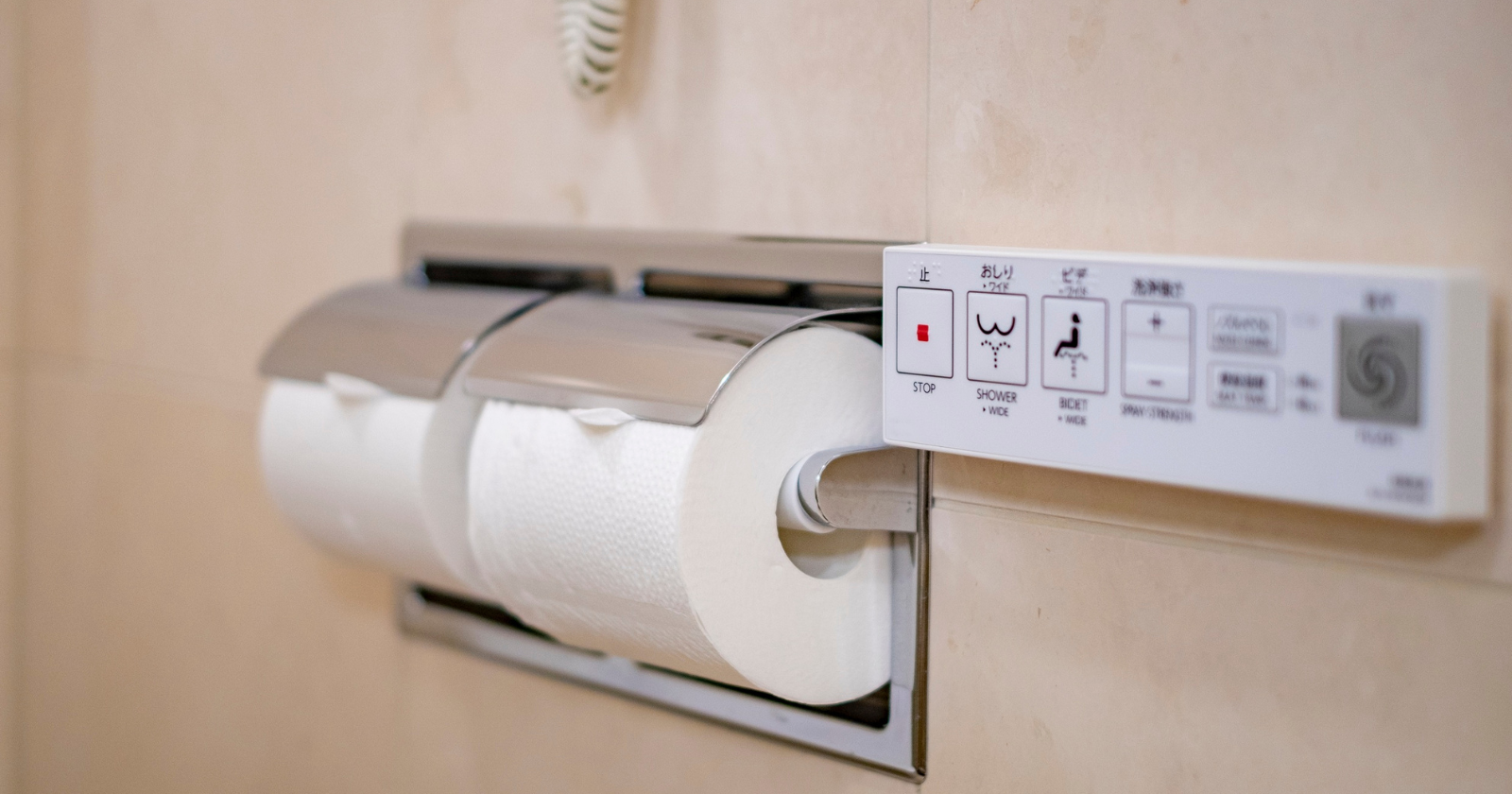
In June 1980, the Japanese sanitary-equipment manufacturer TOTO Ltd launched the Washlet — a new consumer electronic device that bolted onto the top of a standard porcelain toilet bowl and combined a warm-water cleansing spray, warm-air dryer, heated seat and side-mounted control panel in one integrated unit. TOTO had been founded in 1917 as Tōyō Tōki (“Oriental Ceramics”) to produce standardised porcelain fixtures for the modernising Japanese housing market of the early Taishō period, and had progressively become the largest manufacturer of sanitary ceramics in the world. The first commercial Washlet model — the G Series, where “G” stood for “Gorgeous” — went on sale in Japanese retailers on 1 June 1980. By 2020, roughly 80 percent of Japanese households had a Washlet or comparable electronic bidet seat, according to Nippon.com’s retrospective.
The substantially most successful single piece of consumer electronic engineering in the recorded history of the Japanese consumer bathroom industry took approximately fifteen years to reach the specific mass-adoption inflection point that would eventually transform it into a substantial universal household appliance across essentially every income demographic of the modern Japanese consumer economy. As detailed in TOTO’s own institutional corporate history of the specific development, commercial launch, and subsequent 40-year evolution of the Washlet product line, the specific initial 1980 launch of the Washlet G was, by essentially every measure of contemporary Japanese consumer electronics marketing, substantially unsuccessful. The specific engineering challenge TOTO’s development team had solved — how to reliably heat a small quantity of tap water to body temperature and deliver it under controlled pressure to the specific anatomical region required for post-defecation cleansing, while also maintaining a seat at body temperature and providing a warm-air drying option — had produced a device that worked well in initial customer installations but that developed a substantial reliability problem within three to six months of use: the specific warm-water heating element progressively failed, leaving customers with a cold-water bidet on their otherwise heated toilet seat. TOTO’s then-president Katsuji Yamada made the specific corporate decision to replace every defective unit in the field rather than attempt to repair the individual failures — a specific customer-service decision that cost the company substantial short-term profitability but that established the specific consumer-trust foundation that the Washlet product line would progressively build across the subsequent four decades.
The specific advertising campaign that eventually converted Japanese consumers from substantial skepticism about the concept of “washing not wiping” into substantial mass adoption was a 1982 television commercial featuring an actress in a pink floral dress and an updo hairstyle who dropped paint on her hand and futilely attempted to wipe it off with toilet paper, before delivering the specific tagline “Your bottom wants to be washed too” (お尻だって、洗ってほしい, oshiri datte, aratte hoshii). As reported in Nippon.com’s institutional 40-year retrospective on the Washlet’s specific cultural trajectory across Japanese consumer society between 1980 and 2020, the specific 1982 commercial was, in the specific cultural context of early 1980s Japanese primetime television, substantially transgressive — discussion of bodily functions on Japanese television at that specific moment was essentially taboo, and TOTO’s decision to run primetime advertisements explicitly acknowledging the specific bodily function the Washlet was designed to service produced substantial initial consumer complaint. The specific TOTO president overseeing the campaign, however, judged that the substantial awareness-building effect the commercial produced was worth the specific short-term controversy. Across the subsequent decade, the specific Washlet adoption curve progressively steepened — from approximately 10 percent of Japanese households in 1990, to approximately 50 percent in 2002, to approximately 80 percent by 2020, at which point the specific device had achieved the substantial demographic saturation that essentially every previous major consumer appliance (refrigerator, television, washing machine) had reached across earlier phases of Japanese post-war economic development.
What the current model actually does
The specific current 2026 Washlet product line has, across the accumulated 46 years of continuous engineering development that TOTO’s research division has conducted since the original 1980 launch, progressively accumulated a substantially expanded feature set that the specific original Washlet G would not, in essence, be recognisable as a predecessor to. Per the Kids Web Japan educational resource’s institutional summary of the specific evolution of Japanese bidet-toilet-seat technology since 1980, the specific current top-of-line Washlet Neorest model includes: automatic lid opening and closing on motion-sensor approach; a substantial deodorising system that neutralises airborne particles both before and after use; a substantial self-cleaning wand jet coated in silicone alloy and treated with electrolysed hypochlorous acid between uses; a specific “Air-In Wonder-Wave” aerated water-spray system that mixes air bubbles into the cleansing water for a specific tactile sensation TOTO’s engineering team spent approximately six years developing; a specific room-heating function that circulates warm air through the toilet enclosure during winter months; a wireless remote control replacing the original side-mounted button panel. The specific 2005 model release additionally included an MP3 audio playback function permitting the specific user to select background music during toilet use. The specific 1980s Otohime (音姫, “Sound Princess”) device — a small speaker installed in public women’s toilets that plays a recorded flushing sound at the touch of a button, developed by TOTO to eliminate the specific water-wasting practice of Japanese women continuously flushing the toilet during use to mask the sound of their own urination — is now integrated into the standard Washlet feature set.
Why the rest of the world is not there yet
The specific reason approximately 80 percent of Japanese households currently own a Washlet or comparable bidet-toilet-seat while the specific equivalent figure in the United States remains at approximately 3 percent (a level of adoption roughly equivalent to the specific Japanese level in 1985) is not, per essentially every subsequent analysis of the specific international Washlet-adoption trajectory, primarily a matter of consumer preference. As reported in Japan Today’s March 2026 summary of TOTO’s specific ongoing efforts to popularise the Washlet in North American markets, the substantial regulatory and infrastructural barriers to Washlet adoption in countries outside Japan have been substantially larger than TOTO’s original 1980s Japanese domestic marketing challenges. Essentially every Western country has building electrical codes that either prohibit or substantially restrict the specific installation of electrical outlets within a specific safety distance of bathroom water sources — meaning that essentially every Western toilet is located in a specific room without the specific electrical infrastructure a Washlet requires to operate. Electrical rules vary by jurisdiction, with bathroom zones, protected circuits and socket-location requirements limiting where a powered bidet seat can be installed. The United States permits bathroom electrical outlets but requires them to be Ground Fault Circuit Interrupter (GFCI) protected, and essentially all pre-1990 American residential construction does not include an outlet within reach of the toilet. TOTO USA, headquartered in Morrow, Georgia and operating a substantial 30-billion-yen manufacturing facility at that specific location, is currently investing in a substantial retrofit-oriented product line specifically designed to overcome the American electrical-code barrier. The specific “Washlet” designation was, per TOTO’s specific March 2026 corporate announcement, added to the 2025 Oxford English Dictionary as a proper noun — a specific institutional recognition of the substantial fact that the specific TOTO trademark has progressively become the standard English-language common noun for the specific category of consumer electronic bathroom equipment that the specific 1980 TOTO product launch initially created.