

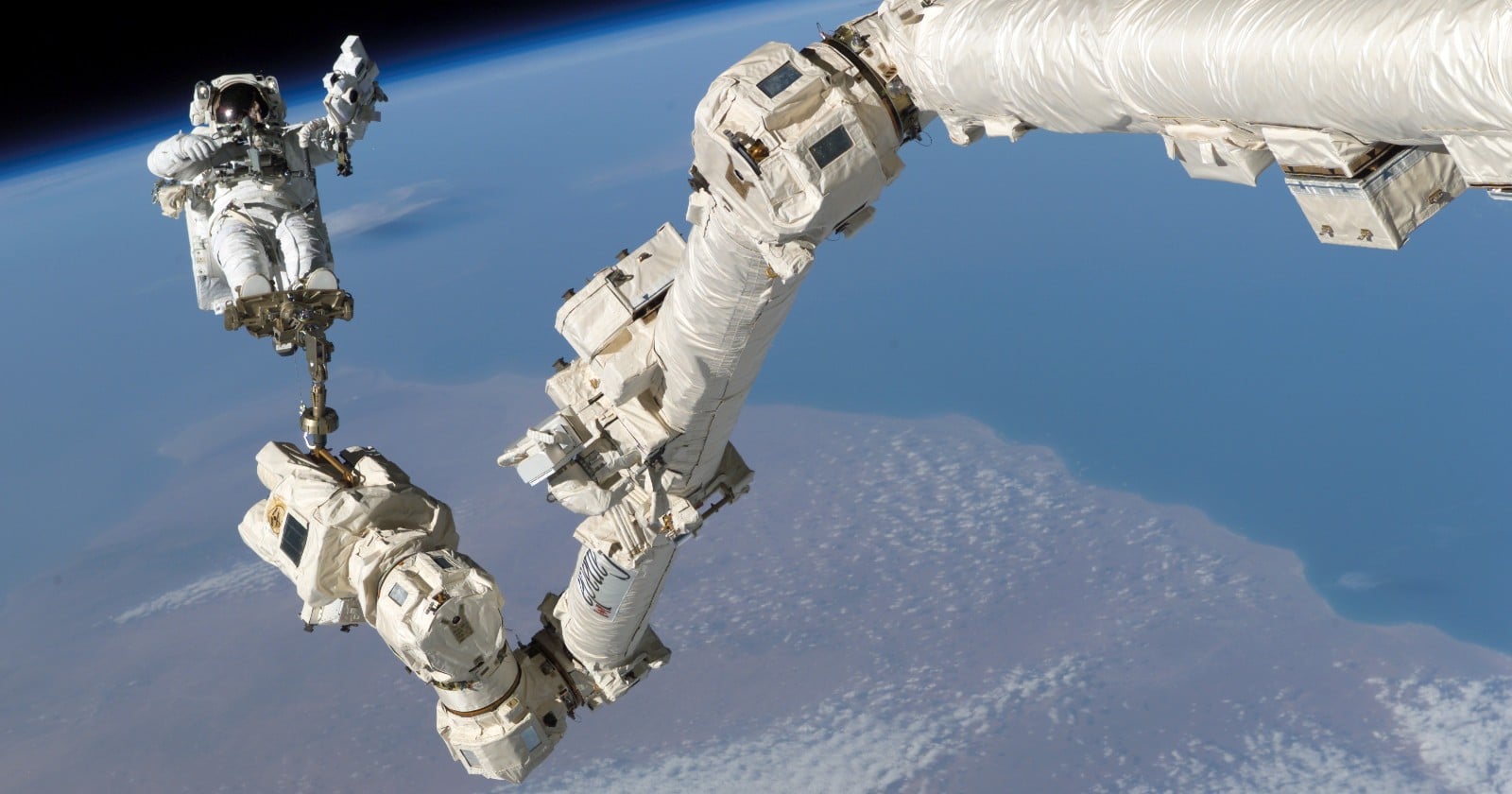
Two NASA astronauts are set to spend much of Tuesday outside the International Space Station, repairing the orbiting laboratory’s Canadarm2 robotic arm. Flight engineers Chris Williams and Jessica Meir will replace a wrist joint that malfunctioned in May, during an outing designated US Spacewalk 95 and scheduled to begin at about 8:35 a.m. EDT on June 30. NASA’s live coverage starts at 7 a.m. EDT.
The pair will work in the vacuum of space for roughly six and a half hours, exiting through the station’s Quest airlock. Williams, designated crew member 1, will wear a suit with red stripes; Meir, crew member 2, will wear an unmarked suit.
What went wrong with the arm
The wrist joint stopped working on May 27, during normal Canadarm2 operations, after the arm drew elevated motor current and did not move as expected. NASA and the Canadian Space Agency studied the fault and decided a spacewalk was needed to swap the joint for a spare already stored aboard the station.
Canadarm2 has been a fixture of the station since astronauts installed it on April 26, 2001. NASA framed the repair as routine for hardware that old: the arm was built with replaceable parts and planned maintenance in mind, and the agency called such work normal and expected after more than 25 years of continuous operations.
Why the arm matters
Canadarm2 is the station’s main robotic arm, used to capture and release visiting cargo vehicles, move large pieces of equipment, and help astronauts during assembly and maintenance. A wrist joint that will not respond limits how the arm can be positioned, so restoring its full range of motion is the point of Tuesday’s repair.
Chris Williams and Jessica Meir will not work alone. NASA’s Jack Hathaway and ESA astronaut Sophie Adenot will support the spacewalkers from inside, helping them into and out of their suits and carefully maneuvering Canadarm2 into position so the two can reach the joint.
It is familiar ground for the two of them. Williams and Meir last worked outside the station together on March 18, when they installed a solar array modification kit, and Tuesday’s outing will be their second spacewalk as a pair. NASA and the Canadian Space Agency walked through the repair tasks publicly at a June 25 preview news conference before mission managers gave the final go.
What is not yet settled
A spacewalk timeline is an estimate, not a guarantee, and a job like this can run long or be cut short. NASA and CSA have described the symptom, an arm that drew too much current and would not move, and chose to fit the spare joint rather than troubleshoot the old one in orbit. Whether anything beyond the joint itself was involved is not something the agencies have spelled out publicly, and the repair will not count as a success until the new joint is in place and the arm has been driven through its full range of motion.
If the swap goes as planned, the arm returns to full capability and the station’s near-term schedule stays on track. This will be the second spacewalk for Williams and the fifth for Meir, and the 280th conducted in support of station assembly, maintenance, and upgrades.