

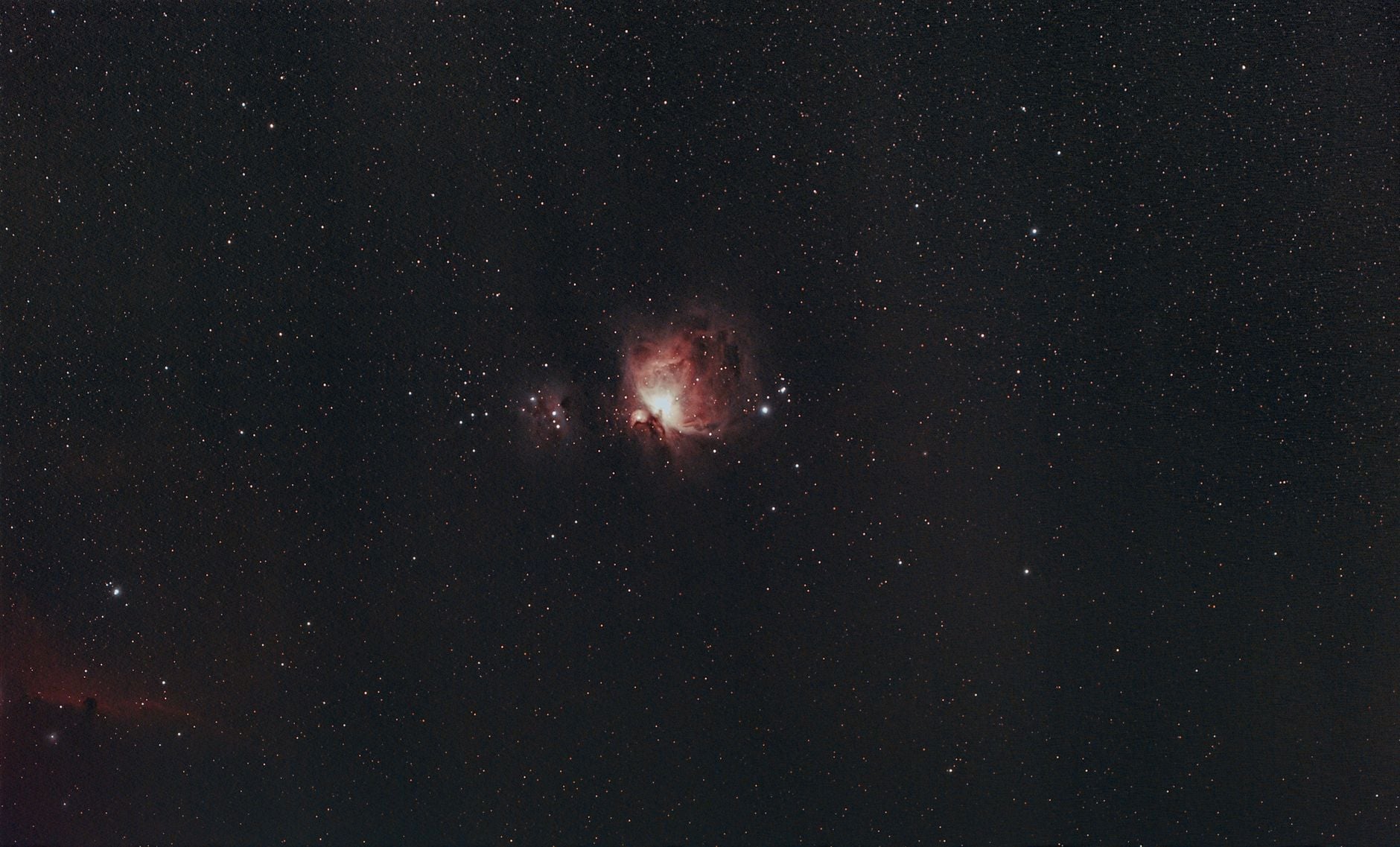
In 2025, astronomers found one of the closest molecular clouds to the Sun, and it had been sitting almost on our doorstep the whole time, unseen. Named Eos, it is a vast crescent of molecular hydrogen about 300 light-years away. On the sky it is enormous, spanning roughly 40 times the width of the full Moon, yet no one had noticed it, because it gives off no light that the eye, or the usual surveys, can catch.
What gave it away was an ultraviolet glow.
Hidden in plain sight
Molecular clouds are the cold, dense regions of gas where stars are born, and they are made mostly of molecular hydrogen. The difficulty is that hydrogen in this form is very hard to see directly. So for decades astronomers have found these clouds by looking instead for carbon monoxide, a minor ingredient that is easy to detect at radio and infrared wavelengths and usually traces the hydrogen well.
Eos broke that rule.
It is what astronomers call CO-dark: full of molecular hydrogen but containing very little carbon monoxide. To the standard surveys it was effectively invisible, which is how something so large and so near went unrecorded for so long.
Found by its ultraviolet glow
The team that found it, led by Blakesley Burkhart of Rutgers University and the Flatiron Institute, took a different route. Using data from a far-ultraviolet spectrograph called FIMS-SPEAR, they picked up the faint far-ultraviolet light that molecular hydrogen itself gives off when it fluoresces.
That is what makes the discovery more than a single cloud. It is the first time a molecular cloud has been spotted directly by the far-ultraviolet glow of its own hydrogen, rather than by a stand-in such as carbon monoxide. The work was published in Nature Astronomy, and the cloud was named Eos, after the Greek goddess of the dawn.
What it is
Eos is a crescent of gas about 300 light-years away, on the edge of the Local Bubble, the cavity of thin, hot gas that the Sun happens to sit inside. Estimates put its mass at a few thousand times that of the Sun. It is not, at present, making stars, and on current reckoning it is slowly evaporating, expected to disperse over a few million years.
Its size on the sky is the startling part. At roughly 40 full-Moon widths across, it would dominate the night sky, if only the glow it gives off were one our eyes could see.
Why it matters
The nearness is useful in itself. A molecular cloud this close is an unusually good laboratory for studying how such clouds form, change, and sometimes collapse into stars, all at a distance that is easy, by astronomical standards, to observe in detail.
The method matters more widely still. If clouds rich in hydrogen but poor in carbon monoxide can be found by their ultraviolet light, there may be more molecular gas nearby, and across the galaxy, than the carbon-monoxide surveys have ever shown. Eos would then be the first of a hidden population rather than a one-off.
What to watch
The immediate work is to pin Eos down, with better measurements of its distance, its mass, and how long it has left. The larger prospect is the search for others like it, using the same far-ultraviolet technique to find the molecular clouds the older methods could never see.