
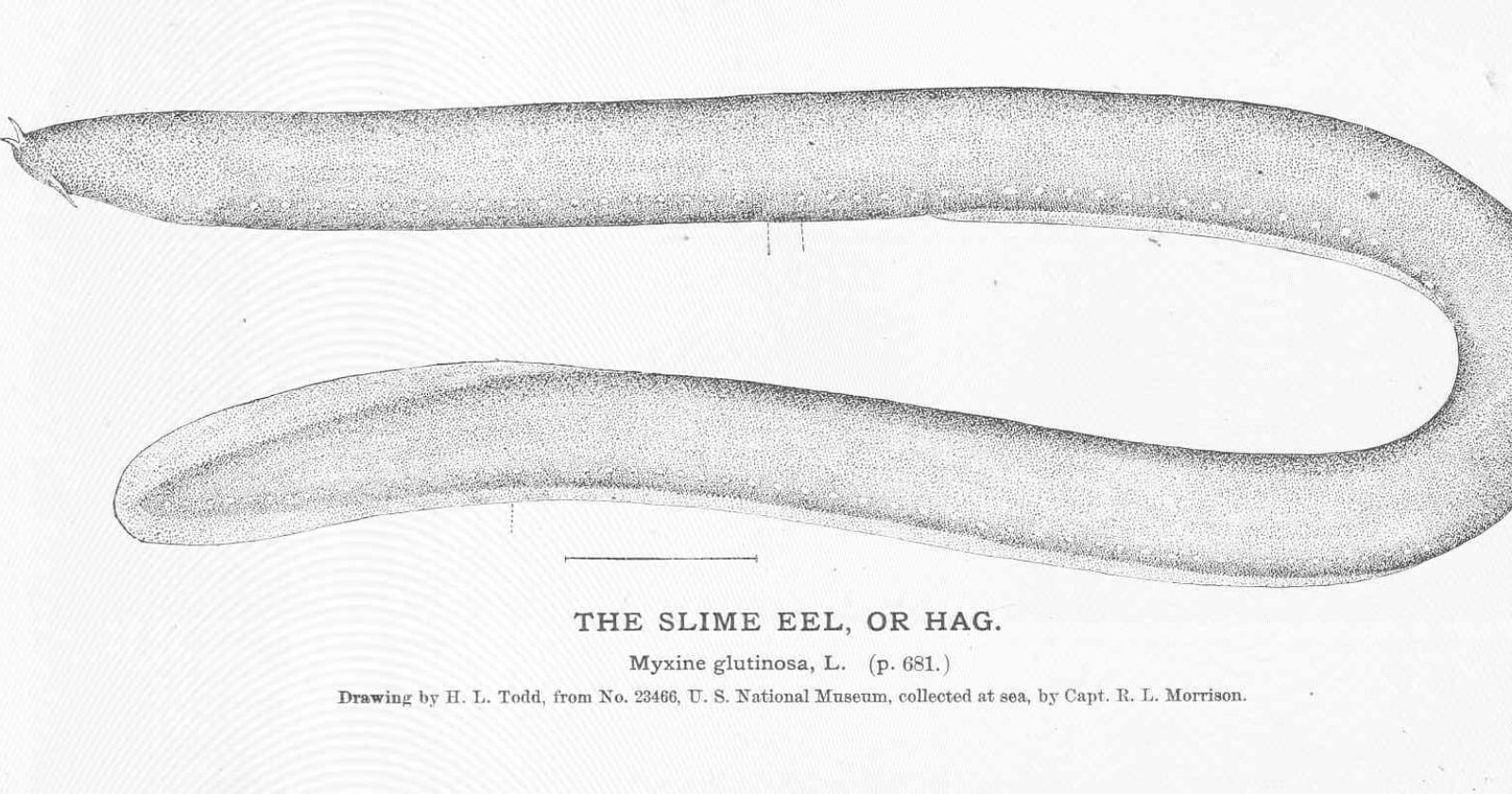
A hagfish looks like easy prey. It is a soft, eel-shaped, jawless fish with no scales, no bony armor, and no obvious way to fight back. Then a shark or a conger eel closes its mouth around one, and the water inside that mouth turns, almost instantly, into a choking mass of slime. The predator’s gills clog, it convulses and gapes in a gagging effort to clear them, and it backs off. The hagfish, usually unharmed, swims away.
For decades biologists suspected hagfish slime worked this way but had never watched it happen in the wild. Hagfish live deep and feed mostly on the carcasses that sink to the seafloor, which makes them awkward to observe. In 2011 a team led by Vincent Zintzen lowered baited cameras hundreds of meters down off New Zealand and waited. The recordings caught fourteen separate incidents in which a larger fish lunged at a hagfish and was driven off by a faceful of slime, with the hagfish appearing to escape injury each time. The footage showed the slime doing its job in a fraction of a second, fast enough to stop a predator’s bite before it could do real harm.
What the cameras also revealed was the timing. The hagfish did not slime as a predator approached or circled. The slime came only at the moment of contact, when a fish actually tried to bite or swallow it, which suggests the trigger is direct pressure on the skin rather than the mere sight of a threat. That makes it an efficient defense, held in reserve until the instant it is needed.
A defense made of two ingredients and a lot of seawater
Hagfish slime is not stored as slime. Along the sides of the body run rows of pores, each connected to a gland that holds two separate cargoes. One is packed with thread cells, each containing a single protein fiber wound up tight like a skein of yarn. The other holds mucin vesicles, tiny membrane-wrapped packets of the proteins that make mucus slippery.
When the hagfish is attacked, muscles squeeze the glands and fire this concentrated exudate into the water. Contact with seawater triggers the transformation. The mucin packets swell and burst into a web of mucus strands, and the coiled threads unravel. Each thread, balled up in a bundle a fraction of a millimeter wide, stretches out to a length of roughly ten to seventeen centimeters, according to measurements published in the Journal of Experimental Biology.
The threads give the slime a fibrous skeleton; the mucus traps water between the fibers like a fine sieve. The result is a dilute, stringy network that holds far more water than the original exudate. That is the part a predator’s gills cannot cope with.
Almost a liter, almost instantly
The speed is the most startling figure. Researchers who filmed slime forming in the lab describe the thread bundles unraveling in a fraction of a second once they hit moving seawater. There is no time for a predator to react before its mouth and gill chamber fill.
The volume is smaller than the legend suggests, but still remarkable for how little raw material it starts from. A single Pacific hagfish, fully provoked, produces on the order of nine hundred milliliters of mature slime, close to a liter, from a quantity of glandular exudate many times smaller. A trickle of cells and protein, mixed into the surrounding water, becomes a fistful of gel almost faster than the eye can follow.
Crucially, the slime targets the one thing every fish predator depends on and cannot protect: its gills. A gill-breathing attacker pushes water continuously over fine, exposed filaments to pull oxygen from it. Fill that water with sticky threads and the flow chokes off. Zintzen’s team described predators convulsing their gill arches to try to clear the slime, then giving up the attack entirely.
How the hagfish avoids choking on its own weapon
A weapon that clogs gills raises an obvious question, because the hagfish has gills too. It avoids being caught in its own slime partly because it does not breathe the way a fast-swimming fish does, and partly through a strange habit. To clean itself, a hagfish ties its body into a simple overhand knot and slides the knot from head to tail, scraping the slime off in one motion. It will also sneeze sharply to clear slime from its single nostril.
This is also why the slime is a defense against being eaten rather than a way to catch food. It buys the hagfish a few seconds and an unappetizing mouthful. It does not subdue prey, and the hagfish has to put itself back in order afterward.
What the footage does and does not settle
The 2011 video evidence settled a long-standing argument. Before it, the gill-clogging idea was a reasonable hypothesis built on the slime’s physical properties and on lab tests; the deep-sea recordings showed it actually deciding real encounters, with predators including sharks breaking off their attacks. That is a strong result.
It is worth being careful about how far it reaches. The recorded defense worked against gill-breathing fish, which is exactly the group the mechanism should defeat. It says little about predators that do not rely on gills in the same way, such as diving seabirds or seals, and there is no claim here that slime makes a hagfish untouchable. These are animals that still get eaten.
The widely repeated images also tend to inflate the numbers. Popular versions describe a hagfish filling a bucket, or turning twenty liters of water to jelly. The measured figure from controlled work is closer to a single liter per full sliming event. The slime expands dramatically relative to the exudate that produces it, which is the genuinely impressive ratio, but it does not flood the open ocean. The wonder is in the speed and the mechanism, not in an exaggerated volume.
An old animal with a fast trick
Hagfish are sometimes called living fossils, members of a lineage that has changed little over a very long stretch of evolutionary time, and the slime is part of why they have lasted. It is cheap to deploy, it regrows, and it defeats the most common kind of predator in the sea without the hagfish needing speed, teeth, or a shell.
There is a reason materials scientists keep studying those unraveling threads. The fibers are built from the same family of structural proteins, called intermediate filaments, that stiffen human skin and hair. When researchers draw a single hagfish thread out and let it dry, its strength and toughness begin to approach those of spider silk. Spider silk is one of the benchmarks engineers chase when they want a fiber that is both strong and stretchy. Studies of the threads have measured these properties directly and treated the protein as a model for new materials.
The appeal is partly that the hagfish makes the fiber from water and protein at the temperature of the deep sea, with none of the harsh chemistry an industrial process would need. A fiber that packs into a microscopic bundle and deploys into something strong and many times longer, using nothing but the surrounding water, is a hard thing to engineer. The hagfish has been doing it, in well under a second, for a very long time.
