
Space is not empty, and it is not perfectly cold. Everywhere in the universe, even in the darkest gulf between galaxies, there is a faint, even glow left over from the Big Bang, and it sets the natural background temperature of the cosmos at about 2.7 degrees above absolute zero. For decades, astronomers assumed nothing in nature could be colder than that floor.
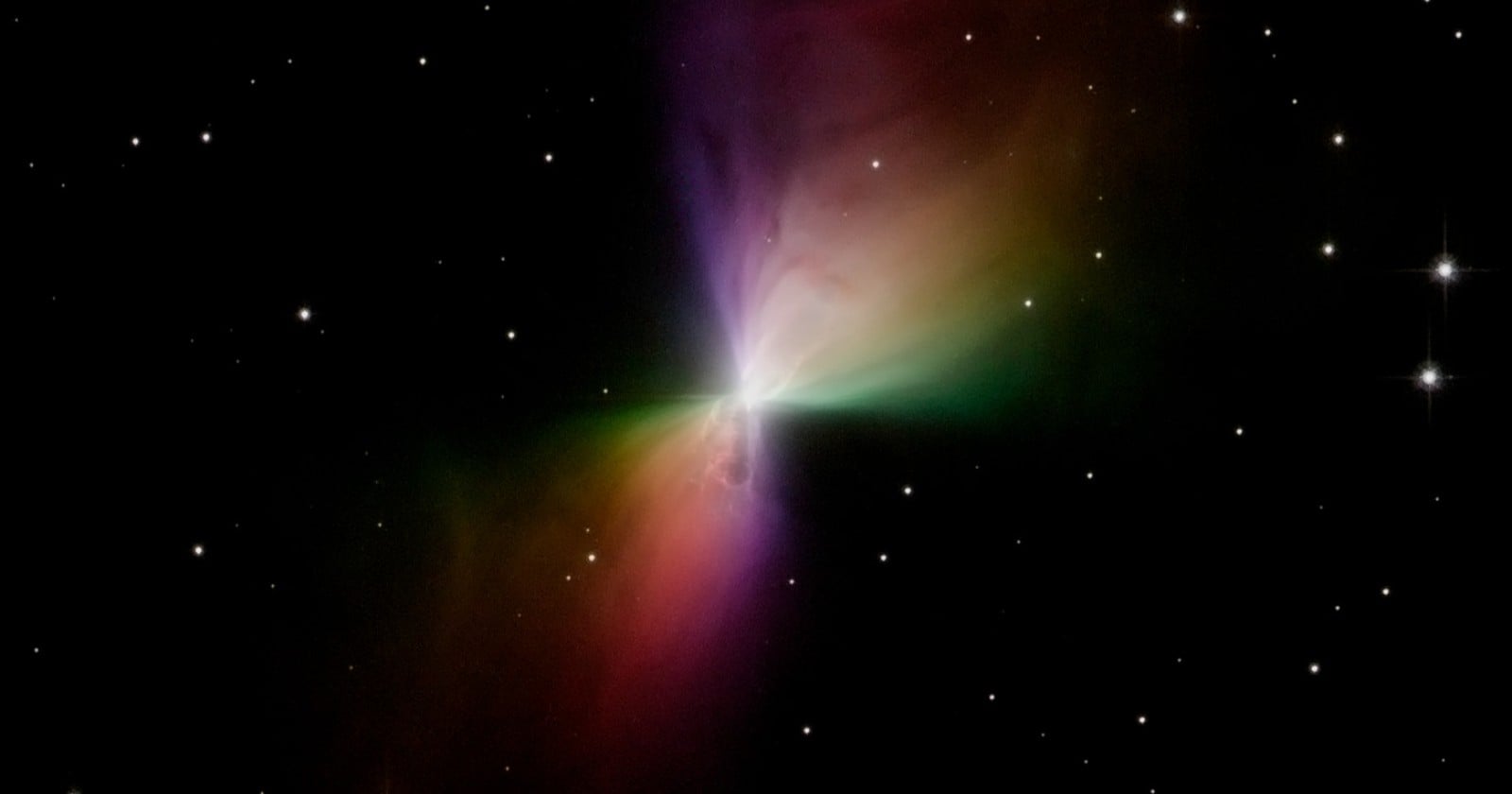
One object is. About 5,000 light-years away in the southern constellation Centaurus, a dying star is surrounded by a fast-expanding cloud of its own gas that sits at roughly one degree above absolute zero, around minus 272 degrees Celsius. That makes the Boomerang Nebula the coldest known object in the universe, and the only natural place ever found that is colder than the background glow of the Big Bang itself.
A degree above the lowest possible temperature
Absolute zero, minus 273.15 degrees Celsius, is the point at which atomic motion all but stops. Nothing can reach it. The Boomerang comes within a single degree, colder than the cosmic microwave background that bathes the rest of space.
To put that in scale, the surface of Pluto is a relatively balmy 40 degrees above absolute zero, and the background radiation that fills the rest of the cosmos sits at about 2.7. The nebula has pushed more than a degree and a half below that universal floor, into territory no other known natural object occupies.
The measurement was made in the mid-1990s by Raghvendra Sahai and Lars-Åke Nyman, using the 15-metre Swedish-ESO Submillimetre Telescope in Chile. Their result, published in 1997, identified the nebula as the coldest place found so far, a degree below the temperature of empty space. No other naturally occurring object has since been found to beat it.
Reading the temperature took an unusual trick. The gas is so cold and so quiet that it does not glow on its own at these wavelengths. Instead, astronomers watched how the gas absorbed the cosmic microwave background passing through it. A cloud colder than that background blocks some of it, casting a kind of shadow, and the depth of that shadow reveals just how cold the gas has become.
How a star makes something colder than space
The cold is not left over from anything. The nebula manufactures it, and the physics is the same as the appliance in your kitchen.
A refrigerator cools by letting a compressed gas expand. When a gas expands, its molecules spread out and slow down, and the gas gets colder. The dying star at the centre of the Boomerang is doing this on an enormous scale, flinging gas outward so quickly that the expanding cloud chills itself far below its surroundings. The team behind the radio observations describes the process as similar in principle to the way refrigerators use expanding gas to produce cold.
The speed is the key. Hubble observations attribute the nebula’s shape to a wind blowing the ultracold gas away from the central star at roughly 500,000 kilometres an hour, with the star shedding material far faster than other dying stars of its kind. That violent, sustained outflow is what lets the gas keep expanding and keep cooling, instead of settling into equilibrium with the warmth of space.
A star caught in the act of dying
The Boomerang is a preview of how a Sun-like star ends. Stars of roughly the Sun’s mass do not explode. They swell, grow unstable, and slough off their outer layers, leaving behind a hot, dense core, a white dwarf, surrounded by an expanding shell of cast-off gas. That glowing shell is called a planetary nebula, a confusing name left over from early telescopes and one that has nothing to do with planets.
The Boomerang has not quite reached that stage. It is a pre-planetary nebula, caught in the brief moment just before the central star grows hot enough to light up its surroundings. For now the star is still too cool to make the gas glow, so the nebula is visible only by starlight reflecting off its dust, which is why it appears soft and ghostly rather than brightly coloured.
Its name is older than its fame. Astronomers Keith Taylor and Mike Scarrott called it the Boomerang in 1980 after a ground-based telescope showed a faint, curved asymmetry in its lobes. When the Hubble Space Telescope imaged it sharply in the late 1990s, the curve resolved into a cleaner double-lobed, bow-tie form.
The shape was partly an illusion
In 2013, Sahai and colleagues turned the Atacama Large Millimeter/submillimeter Array on the nebula and found that even its familiar shape was misleading. By mapping the cold carbon monoxide gas, the true structure turned out to be a broad, roughly round cloud, with the tidy double lobes appearing only in the inner region.
The hourglass outline that optical telescopes had captured, it turned out, was largely a trick of the light. A dense lane of dust around the star acts as a mask, shading part of it and letting starlight escape only in two narrow, opposite directions. What looked like the nebula’s body was really where its light happened to leak out.
The same observations showed the cold will not last. The outermost fringes of the cloud have already begun to warm and are now only slightly colder than the background radiation. The deepest cold sits in the fast-moving outflow itself, a passing phase rather than a permanent state.
How sure are we that it is the coldest place?
The claim deserves a careful reading, because the popular version of it quietly overshoots.
“Coldest place in the universe” means the coldest naturally occurring place yet found. Physics laboratories on Earth routinely reach temperatures far lower, into the billionths of a degree above absolute zero, by trapping and slowing small clouds of atoms. By that standard the genuinely coldest known spots in the universe are inside human refrigerators and physics labs. The Boomerang holds the record only among natural objects, and only among those astronomers have managed to measure.
There is also the word “found.” The universe is vast and largely unsurveyed, and the nebula’s temperature was inferred from how its gas absorbs the background radiation rather than read off a thermometer. The roughly one-degree figure describes the coldest, fastest-expanding part of the outflow, not the whole nebula evenly, and as the gas spreads and slows, that record-setting chill is already fading at the edges. The honest statement is narrow and still remarkable: a particular region of one dying star’s outflow is the coldest natural place we have ever measured, briefly colder than space itself.
A cold that cannot hold
The Boomerang Nebula is colder than the sky around it because it is moving fast and falling apart, and neither of those will last. The star will keep heating, the gas will keep spreading and slowing, and within astronomical time the coldest known corner of the universe will warm back into the ordinary chill of space. For the moment, a Sun-like star, in the act of dying, has briefly built the coldest place anyone has found.
