

The story of the Taj Mahal is sometimes told as a love story, which is partly accurate; it is also a story about how the man who spent half his adult life building the most expensive monument in the recorded history of the Indian subcontinent ended up watching it from a single window for eight years, unable to walk into it, unable to govern the empire that had paid for it, kept alive only by the daughter who had chosen to be imprisoned with him. Shah Jahan was born Prince Khurram on 5 January 1592, the favoured grandson of the Mughal Emperor Akbar the Great, raised at the imperial court at Agra, and married in 1612 — at the age of 20 — to a Persian-noble girl named Arjumand Banu Begum, whose paternal aunt was the powerful Empress Nur Jahan and whose family had been senior figures of the Mughal court for two generations. The marriage was, by every available account, exceptionally close. Across the subsequent 19 years, Arjumand Banu — who would later receive the title Mumtaz Mahal upon Shah Jahan’s accession to the throne in 1628 — accompanied Shah Jahan on essentially every military campaign and administrative tour, gave birth to 14 children (of whom seven survived to adulthood), and operated as what the court historian Muhammad Amin Qazwini described as her husband’s “companion, close confidante, associate and intimate friend… in hardship and comfort, joy and grief.” She died on the night of 17 June 1631, in a tent on the banks of the Tapti River, while giving birth to her fourteenth child. Shah Jahan was 39 years old. He had lost the woman who had been at the centre of his life for nearly two decades, and he would, by every account from the period, never substantially recover.
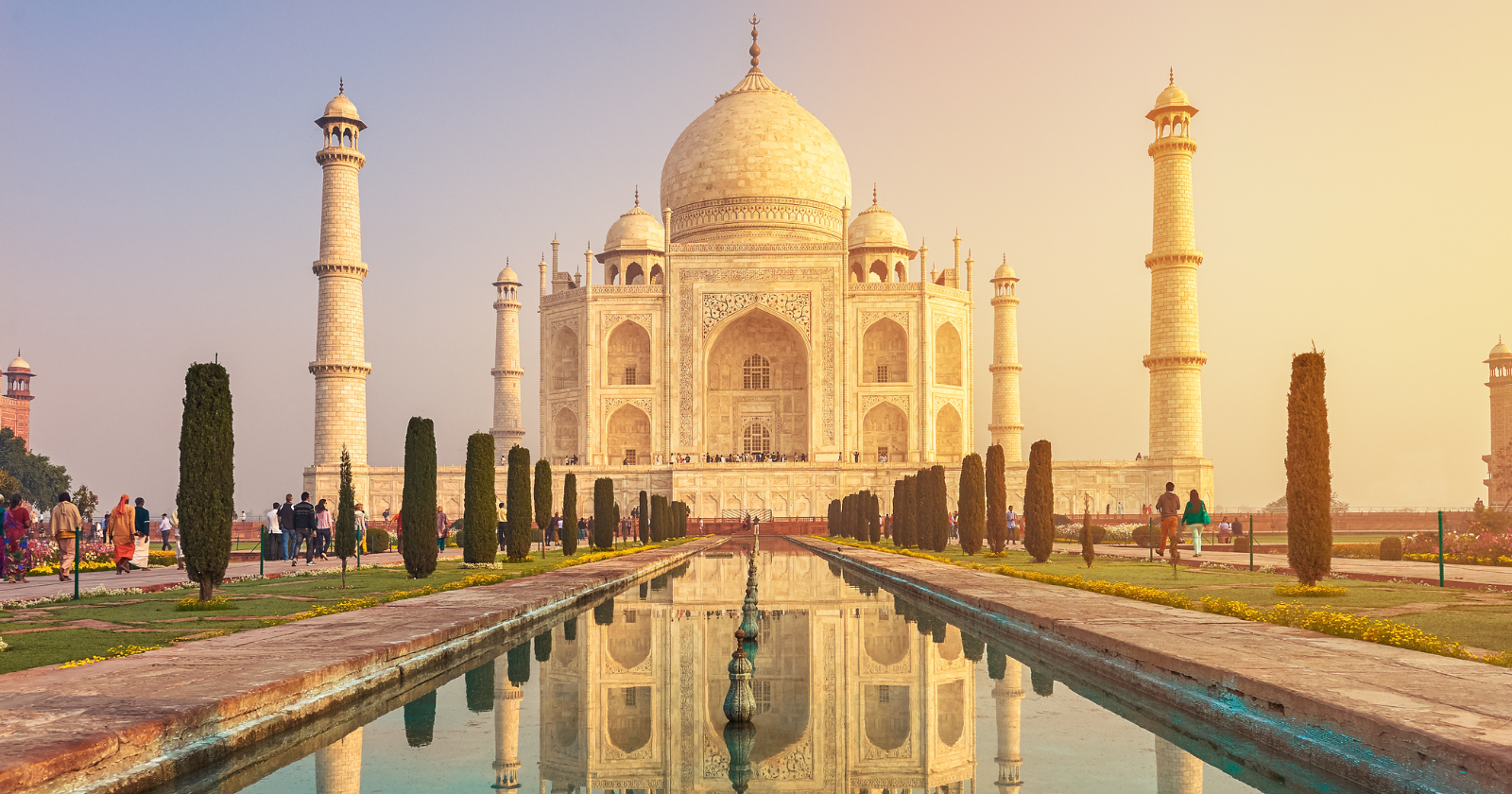
According to Britannica’s reference summary of the Taj Mahal’s commissioning, construction, and architectural design, Shah Jahan went into formal mourning for one year, during which he gave up music, fine clothing, and most royal entertainments. When he emerged, he had decided to build a mausoleum for Mumtaz Mahal of unprecedented scale and material refinement — an undertaking that would absorb approximately 22 years of Mughal imperial energy and approximately one-tenth of the empire’s annual revenue across that period. Land was selected on the south bank of the Yamuna River in Agra, at a site previously owned by the Rajput nobleman Raja Jai Singh I (who was compensated with a palace in central Agra in exchange). Mumtaz Mahal’s body, which had been temporarily interred in Burhanpur, was disinterred in December 1631 and transported in a golden casket back to Agra, where it was placed in temporary burial near the construction site. Construction began in earnest in 1632. The principal mausoleum was completed in 1648. The full complex — including the surrounding mosque, the guest house, the formal Charbagh gardens, the reflecting pool, the great gateway, and the outer wall — was completed in 1653.
What it took and what it cost
The construction was, by every reasonable measure of 17th-century imperial expenditure, extraordinary. As described in National Geographic’s reconstruction of Shah Jahan’s reign and the human and financial costs of the Taj Mahal’s construction, the project drew on approximately 20,000 skilled craftsmen working continuously across two decades. The white marble was quarried at Makrana in Rajasthan and transported approximately 250 kilometres to Agra on caravans of carts drawn (by some accounts) by approximately 1,000 elephants. The 28 varieties of precious and semi-precious stones used for the pietra dura inlay — jade from China, lapis lazuli from Afghanistan, sapphire from Sri Lanka, carnelian from Arabia, turquoise from Tibet, jasper from Punjab — were sourced through trade networks spanning essentially the entire Eurasian landmass available to the Mughals. The labour costs alone, calculated against contemporary Mughal craftsman wages, account for the substantial majority of the documented 32 million rupees of imperial expenditure. Modern estimates place the total cost at the equivalent of approximately $1 billion in current purchasing power, though every such estimate involves substantial uncertainty about the proper exchange between 1640s silver-based Mughal rupees and 21st-century dollars.
The political consequences of the expenditure were not the sole cause of Shah Jahan’s eventual deposition, but they were among the contributing factors. As detailed in the official Government of India heritage site’s account of the Taj Mahal’s history and Shah Jahan’s later imprisonment, the Mughal Empire under Shah Jahan was at the peak of its territorial and cultural reach, but the cumulative cost of multiple major architectural projects — the Red Fort at Delhi, the Jama Masjid at Delhi, the founding of the new capital at Shahjahanabad (now Old Delhi), the Shalimar Gardens at Lahore, and the Taj Mahal at Agra — had drawn substantially on the imperial treasury across a period of essentially continuous military campaigning. When Shah Jahan fell seriously ill in September 1657, the war of succession that broke out among his four surviving sons (Dara Shikoh, Shah Shuja, Aurangzeb, and Murad Bakhsh) was therefore conducted against the backdrop of a treasury that had been substantially depleted by his architectural ambitions, an empire that was increasingly difficult to administer at its expanded scale, and a religious and cultural debate (about the proper relationship between the empire’s Muslim ruling class and its Hindu majority population) that the four sons resolved in radically different directions. Aurangzeb won the resulting war militarily, killed his three brothers across the subsequent two years, and deposed his father in July 1658 — at which point Shah Jahan had recovered from his original 1657 illness and resumed governing.
The view from the tower
The conditions of Shah Jahan’s eight-year imprisonment were not, by the standards of 17th-century deposed monarchs, especially harsh. As described in Google Arts & Culture’s Sahapedia archival summary of the Taj Mahal’s history and Shah Jahan’s final years, he was confined within the Agra Fort, the substantial red-sandstone palace-fortress that he had himself substantially expanded during his reign and that sat approximately 2.5 kilometres upstream from the Taj Mahal along the same right bank of the Yamuna River. He was housed in the Musamman Burj — the Octagonal Tower of white marble that he had personally designed as a private pavilion for Mumtaz Mahal in the years before her death, and that offered, through its broad marble-screened windows, an unobstructed view eastward along the river toward the white-domed mausoleum he had spent the previous two decades constructing. His eldest daughter, Jahanara Begum — who had been his closest companion since Mumtaz Mahal’s death in 1631, who was approximately 44 years old at the time of his imprisonment, and who was the only one of his seven surviving children who had remained loyal to him through the war of succession — voluntarily joined his confinement. She remained with him in the Agra Fort for the entire eight years of his imprisonment, attending to his deteriorating health, managing his correspondence with the few external visitors Aurangzeb permitted, and providing essentially the only human company he had during the slow physical decline that progressively confined him to a single room with a single view.
Shah Jahan died on 22 January 1666, at the age of 74, after a brief final illness. Aurangzeb refused to grant his father a state funeral. The body was carried from the Agra Fort to the Taj Mahal by only two attendants in a small boat travelling downstream along the Yamuna, was interred beside Mumtaz Mahal’s tomb in the central crypt of the mausoleum with no formal ceremony, and was placed in a position that broke the otherwise perfect symmetry of the building’s interior: Mumtaz Mahal’s cenotaph occupies the precise geometric centre of the inner chamber, as the original design had placed it, while Shah Jahan’s cenotaph sits to one side, asymmetrically offset — the single deliberate violation of the mausoleum’s otherwise rigorous bilateral symmetry, generally read by subsequent architectural historians as the visible material evidence that Aurangzeb had buried his father in the Taj Mahal without the prior architectural planning that the building’s original design had contemplated. The mausoleum that Shah Jahan had constructed to honour his wife had, in its final form, become the joint tomb of both spouses. The Taj Mahal itself has, in the 359 years since Shah Jahan’s death, become one of the most photographed structures on Earth, designated a UNESCO World Heritage Site in 1983, visited annually by approximately three million tourists who arrive in Agra, walk through the marble gateway, observe the white domes reflected in the central pool, and rarely realise that the small octagonal marble pavilion visible 2.5 kilometres upstream — the window through which Shah Jahan watched his own monument for the last eight years of his life — is itself one of the more architecturally consequential rooms in 17th-century Mughal history.