
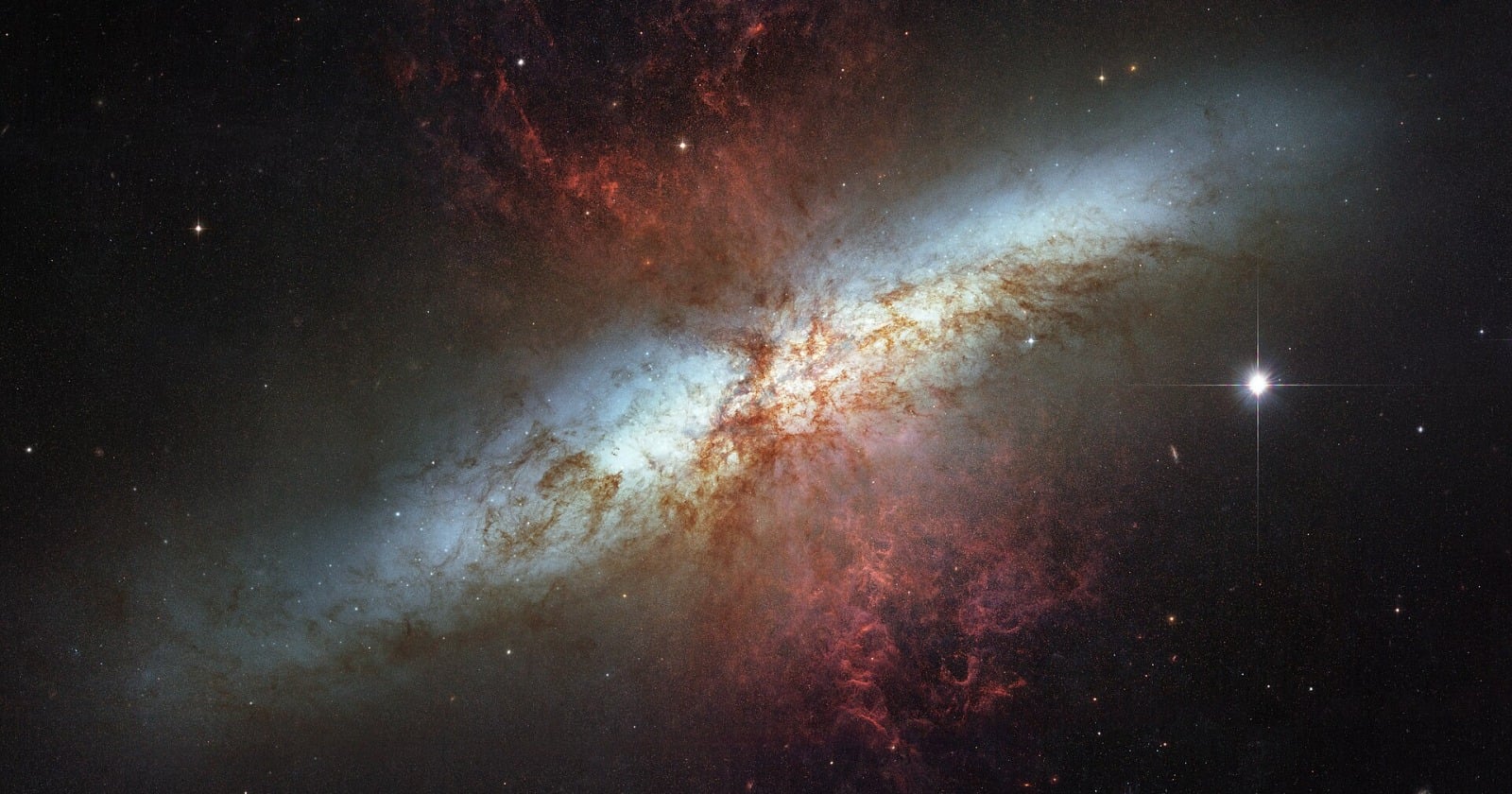
About 12 million light-years from Earth, a nearby galaxy named Messier 82 is building stars at a furious pace, and NASA’s James Webb Space Telescope has now picked out 16.5 million of them one by one. That count is not the galaxy’s full population. It is the number of individual stars Webb could resolve in a single deep image, and astronomers say it is only a small share of all the stars packed into M82, with most too faint to register.
What makes the galaxy worth 65 hours of one of the most sought-after telescopes in the world is the speed of what is happening inside it. M82, nicknamed the Cigar galaxy for its long, thin profile seen edge-on, is forming stars about ten times faster than the Milky Way does. That kind of frenzy has a built-in expiration date. The burst is estimated to last only a few hundred million years from start to finish, a brief flare on the clock of a galaxy.
Why Webb could see what other telescopes could not
M82 has been photographed many times, by Hubble and the retired Spitzer telescope among others. The problem has always been dust. The galaxy is choked with it, and that dust scatters and absorbs visible light, hiding much of what lies behind it.
Webb works in the infrared, the band of light that slips through dust most easily. Its Near-Infrared Camera collected light for a total of 65 hours in a dedicated survey of the galaxy, which the team named Cibola, and that combination of long exposure and infrared sensitivity let it pierce the dusty plane of the disk and separate the glow into millions of distinct points. Each one is a star, rendered in the published image as a fine blue-white grain.
“The sheer number of stars that we were able to resolve with Webb is incredible,” said team member Benjamin Williams of the University of Washington. “It’s a whole different world from what we’ve been able to see with other telescopes. All of these stars collectively provide a detailed fossil record of the formation and evolution of M82.”
What a starburst galaxy is
A starburst galaxy is one turning gas into stars far faster than a typical galaxy of its size. M82 is the textbook case, close enough to study in detail and extreme enough to show the process at full volume.
The reason this matters is that such intense star formation cannot sustain itself. Massive young stars pour out radiation and, when they die as supernovae, blast the surrounding gas outward. Run that process hard enough and the galaxy starts emptying the very fuel it needs to keep making stars. In M82 that self-disruption is already visible.
The galaxy is venting two enormous plumes of material, one from the top of its disk and one from the bottom, in a rough hourglass shape. Webb’s image shows the plumes are layered. Closest to the disk sits ionized gas, and farther out drift small grains of dust known as polycyclic aromatic hydrocarbons, a family of carbon-based molecules that astronomers use to trace the thin material between stars.
The clue hidden in a lopsided disk
Look closely at the disk in Webb’s view and it is not symmetric. One side extends farther than the other, and that distortion is a clue to the galaxy’s past.
A lopsided shape like this is what astronomers expect after a galaxy has had a close, violent encounter with another. M82’s runaway star formation is thought to have been triggered by such a merger or near-collision with a neighboring galaxy. Tides from that kind of encounter would have funneled gas toward M82’s center and lit the fuse.
“M82 is a mess, but it’s a beautiful mess. We don’t fully understand what’s going on, especially concerning its evolutionary history,” said principal investigator Adam Smercina, a NASA Hubble Fellow at the Space Telescope Science Institute and an incoming assistant professor at Tufts University. “What could have triggered such an elevated rate of star formation? How long has this galaxy been driving plumes of material away from its center?”
Those questions are still open. The Webb image gives astronomers the resolved stars they need to start reading the galaxy’s history, because the ages and distribution of stars across the disk act as a record of when and where star formation happened.
How much of M82 are we really seeing?
The figure of 16.5 million stars is striking, and it is easy to read it as a tally of the galaxy. It is not. NASA is explicit that this is the number of stars Webb could pull apart in this particular image, and that it represents only a small portion of the stars a galaxy like M82 actually holds. The majority are simply too faint, too crowded, or too buried in dust to separate, even for Webb. The right way to read 16.5 million is as a floor set by what the telescope can resolve, not a census of the galaxy.
The “ten times the Milky Way” comparison needs a similar caution. M82 is a smaller, less massive galaxy than the Milky Way, so the headline is not that it makes ten times as many stars in raw terms across a comparable structure, but that it is converting gas into stars at an extreme rate for its size. That intensity, relative to how much galaxy there is, is what makes it a starburst.
The merger trigger and the few-hundred-million-year lifespan are also informed estimates rather than settled facts. The distorted disk strongly suggests a past interaction, and the physics of supernova-driven outflows explains why the burst must be brief, but the precise history is exactly what this survey was designed to reconstruct. NASA’s own framing is that this image is “just one dataset” scientists will combine with others to piece the story together. The wonder here is real; it just sits one careful step away from a finished account.
Why one galaxy is worth this much telescope time
Part of the answer is luck of position. M82 is near enough that Webb can resolve its individual stars, and extreme enough that the processes driving galaxy evolution are turned up where they can be studied. Most starburst galaxies sit far too distant for that.
“At first glance, the disk of the galaxy may seem less spectacular because Webb sees through the dust,” said team member Eric Bell of the University of Michigan, in a university account of the work. “But M82 is a delightfully complex system. Webb’s observations will help us address some ongoing mysteries, such as how star formation has moved within M82 over the last few billion years.”
The full picture will take more than one telescope. The published view is itself a marriage of Webb’s infrared stars and Hubble’s visible-light map of the gas and dust, and the team expects to keep folding in other observations as the analysis continues.
“Galaxies are such intricate ecosystems that if you truly want to understand them, you have to pull datasets from different missions together,” said team member Kristen McQuinn of the Space Telescope Science Institute. “One mission cannot fully answer all of the questions we have about M82. Combining the data collected by different telescopes, like Webb and Hubble, is powerful. When you marry the datasets, you expand what you can probe, and the questions that you can pose are even more complex.”
For now, a galaxy that has spent decades as a smudge behind a curtain of dust has had 16.5 million of its stars counted out, one point of light at a time, with the rest still waiting in the haze.