
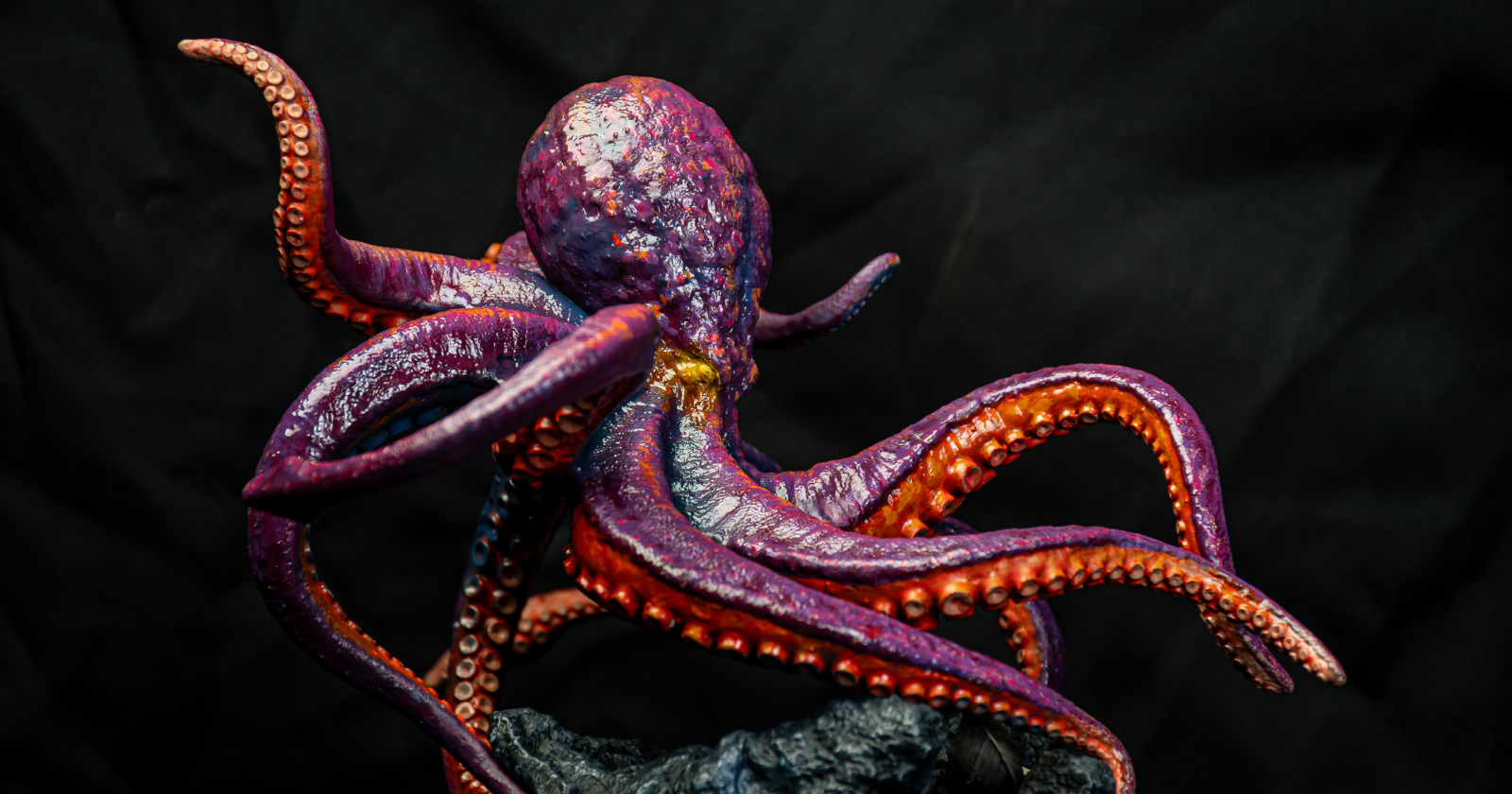
Imagine spending two years of your life and 23 separate deployments of a self-rigged underwater camera system, lowered nearly a kilometre into the deep ocean from a small fishing boat manned by two people, looking for a single animal whose existence essentially everyone in your profession already accepted but which essentially no one in your profession had ever directly observed in its actual habitat. This is what the Japanese marine zoologist Tsunemi Kubodera, of Tokyo’s National Science Museum, and his collaborator Kyoichi Mori, of the Ogasawara Whale Watching Association, did between 2002 and 2004. The species they were pursuing, Architeuthis dux, had been recognised as a real biological organism since 1857, when the Danish zoologist Japetus Steenstrup described and named the genus on the basis of specimens that had washed ashore on Danish beaches. Hundreds of dead giant squid had been recovered in the subsequent 147 years — from beaches, from the stomachs of sperm whales, from accidental captures in commercial fishing nets, from carcasses found floating at the surface. The species’ anatomy, biology, and approximate distribution had been characterised in substantial detail through the analysis of these dead specimens. What no one had managed to do, in the century and a half between Steenstrup’s 1857 description and the autumn of 2004, was observe a live one in its natural deep-sea environment.
The original kraken legends that the European seafaring tradition had passed down from Norse mythology — formalised in print by the Norwegian bishop Erik Pontoppidan in his 1752 Natural History of Norway, elaborated by Alfred Lord Tennyson in his 1830 poem “The Kraken,” dramatised by Jules Verne in his 1870 novel 20,000 Leagues Under the Sea — had described a vast tentacled creature, occasionally mistaken for an island, capable of pulling sailing ships under the surface of the sea and creating whirlpools as it submerged. The biological reality, once it had been characterised through dead specimens, turned out to be substantially less catastrophic than the mythology had suggested. Adult Architeuthis reaches a maximum length of approximately 13 metres including the long feeding tentacles, with the central mantle measuring approximately 2 metres. The animal does have the largest eyes of any known species — basketball-sized, approximately 27 centimetres in diameter — and the unusual neurological and visual capacities those eyes imply. It does not have the physical capacity to pull a ship under the surface. It does have the physical capacity to attack and consume large deep-sea fish, smaller cephalopods, and (occasionally) to engage in defensive battles with the sperm whales that are its primary natural predator. Sperm whales recovered from commercial whaling operations across the 19th and 20th centuries routinely bore circular sucker-shaped scars on their skin, indicating that these battles do happen, that giant squids fight back, and that the squids occasionally win.
How the whales led to the squid
The methodological innovation that made the 2004 photographs possible was the use of sperm whales as biological location indicators. As described in a PBS Nature reconstruction of the Kubodera-Mori expedition and the techniques they used to find their target species, the research team identified a region off the Ogasawara Islands (also known as the Bonin Islands), a Japanese archipelago approximately 1,000 kilometres south of Tokyo, where sperm whales were known to gather between September and December each year to feed at depths of approximately 1,000 metres. The whales’ diving behaviour, mapped through both contemporary observations and accumulated reports from local fishing boats and whale-watching tour operators, indicated precisely where in the water column the whales were hunting their primary prey. The assumption — straightforwardly verified by the eventual results — was that wherever the sperm whales were diving to feed, the giant squid would be there to be fed upon.
Kubodera and Mori designed a baited camera system specifically for the depth and conditions where the sperm whales had indicated giant squid presence. The system consisted of a long fishing line that descended approximately 900 metres into the deep water column, terminated in a baited hook (“jig”) armed with a small dead squid and shrimp, accompanied by a self-contained automated digital camera with a strobe light, a depth sensor, a timer, and a battery sufficient for several hours of continuous operation. The camera was programmed to photograph the bait every 30 seconds for four to five hours after activation. The two researchers deployed the system 23 separate times from their small fishing boat between 2002 and 2004 — most of those deployments producing no observable squid activity at all. The 23rd deployment, on the morning of 30 September 2004, produced the strike. An 8-metre adult Architeuthis dux attacked the bait at approximately 9:15 a.m. local time, snagged its tentacle on the hook, struggled against the line for slightly more than four hours, and was photographed by the camera over 500 times during the struggle.
What the photographs showed
The behaviour the photographs captured was, by every available account of pre-2004 scientific expectation, unexpected. As reported in Scientific American’s coverage of the original Kubodera-Mori publication and the behavioural observations it documented, the previous consensus among marine biologists had been that the giant squid, despite its size, was likely a relatively passive deep-sea drifter — an animal that conserved metabolic energy in the cold, food-scarce environment of the deep ocean by floating slowly through the water column and consuming whatever organic material happened to drift within reach of its tentacles. The photographs Kubodera and Mori produced demonstrated something substantially different. The squid attacked the bait from a horizontal position with what the authors of the resulting paper described as an aggressive hunting pattern, used its tentacles to ensnare and constrict the prey in a manner the paper compared to “a ball of tentacles,” and held the bait under active muscular tension for the full duration of the four-hour engagement. The drifter hypothesis was, by the end of the photographic sequence, no longer tenable.
The paper documenting the observations was published in the Proceedings of the Royal Society B on 22 December 2005, fifteen months after the photographs had been taken, with the title “First-ever observations of a live giant squid in the wild.” As detailed in the Smithsonian Ocean’s archival summary of the photographs and the techniques that produced them, the images and the accompanying behavioural data fundamentally transformed the scientific community’s working model of the species. Kubodera himself returned to the same waters with refined techniques in subsequent years; in December 2006, he succeeded in bringing a live giant squid briefly to the surface alive, where it was filmed before being released back to the deep. In 2012, Kubodera was part of a joint NHK/Discovery Channel expedition that, using a manned submersible called Triton, produced the first video footage of a live giant squid in its natural deep-sea environment. The species itself — the actual biological organism whose existence had been folded into the kraken mythology of European maritime culture for several centuries — has, since 2004, been one of the most photographed previously-mythological animals in the recorded history of marine biology. Hundreds of additional photographs and video sequences exist. The 5.5-metre severed tentacle that remained on Kubodera and Mori’s fishing line on the morning of 30 September 2004 is, as of this writing, preserved at the National Museum of Nature and Science in Tokyo, the institution where Kubodera spent his career — a physical artefact of the moment when the kraken finally stopped being a legend.
