

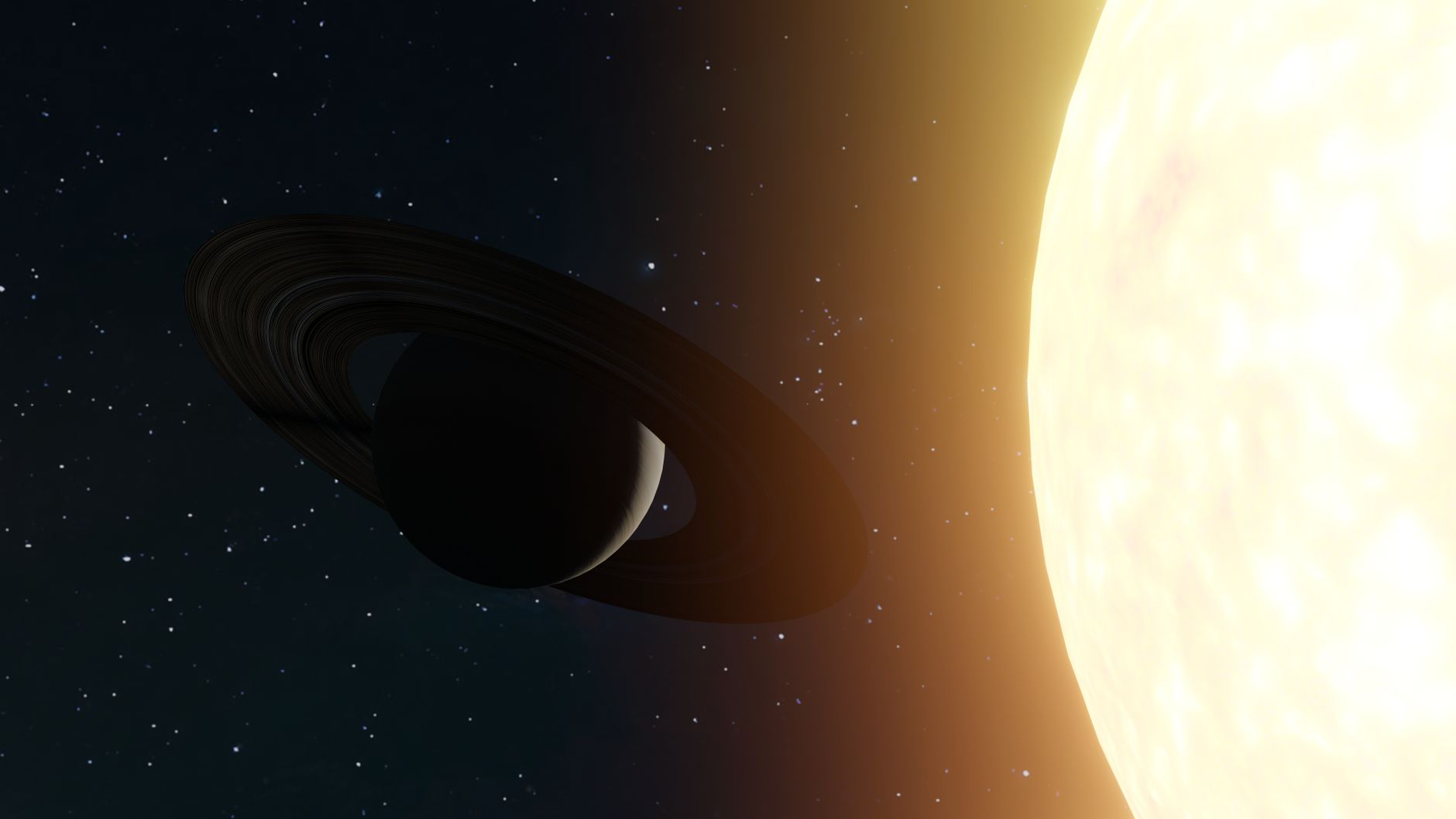
The search for life beyond the Solar System often sounds impossibly remote. Many promising planets orbit stars so far away, or so close to their stars in the sky, that even knowing they exist is a technical achievement. GJ 251 c is different in one important respect. It is nearby.
In a paper accepted for The Astronomical Journal, Corey Beard and colleagues report the discovery of GJ 251 c, a candidate super-Earth orbiting in the habitable zone of a red dwarf star about 5.5 parsecs away. That is roughly 18 light-years, close enough that the planet may become one of the best northern-sky targets for future direct imaging of a potentially rocky world in a temperate orbit.
The finding is worth taking seriously, but it should not be read as the final word. The planet is a candidate detected through radial-velocity measurements, not a world that has been photographed. Its radius is not known. Its atmosphere, if it has one, has not been detected. No one has found water, air or biology there. What the paper shows is that a planet-like signal sits in the right orbital region around a nearby small star, with a minimum mass that places it in a plausible terrestrial regime.
Why distance changes the problem
Eighteen light-years is still far beyond any spacecraft journey now imaginable. But for telescopes, distance matters differently. A nearby planetary system appears more spread out on the sky than an identical system farther away. That angular separation can make the difference between a planet lost in the glare of its star and a planet that a future telescope might separate from that glare.
GJ 251 is a red dwarf, much smaller and cooler than the Sun. Its habitable zone sits closer in, because the star gives off less energy. That usually makes direct imaging harder, because the planet appears close to the star. But the system’s proximity helps. The discovery team argues that next-generation 30-metre-class telescopes will likely be able to image terrestrial planets in the habitable zone of GJ 251, and that GJ 251 c is currently the best candidate for terrestrial habitable-zone planet imaging in the northern sky.
That claim is not a promise of a photograph tomorrow. It is a statement about geometry, contrast and future instrumentation. The star is close. The planet’s orbit is wide enough in apparent separation to be interesting. The planet may be massive enough to be detectable. Those are the ingredients that put it on a short list.
How the planet was found
GJ 251 c was not seen crossing in front of its star. It was inferred from the star’s motion. The discovery used radial-velocity measurements, the method that detects a planet by the small gravitational tug it exerts on its host star. As a planet orbits, the star moves slightly toward and away from Earth, shifting its spectrum by a tiny amount.
The team combined high-precision measurements from the Habitable-zone Planet Finder and NEID with archival data from HIRES, CARMENES and SPIRou. That long baseline matters because red dwarfs are not quiet measuring rods. Starspots, rotation and magnetic activity can create signals that imitate or distort planetary signatures.
The authors therefore compared more than 50 models describing planets and star activity. They also used colour-dependent analysis, because activity signals can change with wavelength in ways real planetary motion should not. This is one reason the paper uses careful language. GJ 251 c is presented as a candidate whose signal survives detailed activity checks, not as a world whose every property is already known.
The reported period is 53.647 days. The minimum mass is 3.84 Earth masses, with an uncertainty of 0.75 Earth masses. Minimum mass is a radial-velocity term. Because the orbit’s tilt relative to Earth is not known, the true mass could be higher. Still, the measured value is small enough that the planet could plausibly be rocky rather than a Neptune-like world with a thick envelope.
What “super-Earth” does and does not mean
The term super-Earth often causes trouble. It does not mean Earth-like. It means more massive than Earth but smaller than the ice giants, or at least in the mass range commonly associated with such planets. A super-Earth can be rocky, water-rich, volatile-rich, airless, frozen, overheated or geologically unlike Earth in many ways.
For GJ 251 c, the radius is unknown because the planet has not been observed transiting its star. Without a radius, researchers cannot calculate density. Without density, they cannot say whether it is definitely rocky. The minimum mass is encouraging, but it is not a composition measurement.
The habitable-zone label also needs care. A habitable zone is an orbital region where, under some atmospheric conditions, liquid water could exist on a planet’s surface. It is not a guarantee of lakes, clouds or life. A planet can sit in the habitable zone and still be sterile, airless, tidally locked in a harmful way, stripped by its star, or locked under ice.
GJ 251 c receives less starlight than Earth receives from the Sun, according to the discovery analysis. Whether that becomes a frozen surface, a temperate surface or something else depends on the planet’s atmosphere, rotation, clouds, composition and geologic history. Those are precisely the unknowns future observations would try to reduce.
Why red dwarfs are both useful and difficult
Red dwarfs are attractive in the search for small planets because their low masses make planetary signals easier to detect. A terrestrial planet tugs more noticeably on a small star than on a Sun-like star. The habitable zone is also closer in, giving shorter orbital periods and more opportunities to measure the planet’s effect.
But red dwarfs bring complications. Many are magnetically active, especially when young. Flares and high-energy radiation can erode atmospheres or change atmospheric chemistry. A planet in a close habitable-zone orbit may also be tidally locked, with one side facing the star for long periods while the other remains in darkness. Climate models show that such planets are not automatically uninhabitable, but the problem is more complex than putting Earth at a smaller orbit.
GJ 251 is useful because it is close, relatively well studied and quiet enough for radial-velocity work to be possible. Even so, activity mitigation is a central part of the discovery paper. The authors had to separate the planet-like signal from the star’s own behaviour. That is a recurring challenge in red-dwarf planet hunting.
What direct imaging could reveal
Direct imaging would be a different kind of evidence. Instead of inferring the planet from its tug on the star, a telescope would separate the planet’s light from the star’s light. For a small temperate planet, that is extremely difficult. The star is much brighter, the planet is close to it in the sky, and Earth’s atmosphere adds its own complications for ground-based telescopes.
Future giant telescopes may be able to do enough to make GJ 251 c a real test case. A first direct detection could constrain the orbit and brightness. Repeated observations could help determine phase, reflectivity and perhaps broad colour information. Spectroscopy, if possible, would be the deeper prize because it could search for atmospheric molecules.
That is where the language of water, air and biology enters the story. A spectrum can, in principle, reveal gases such as water vapour, carbon dioxide, methane, oxygen or ozone, depending on wavelength, instrument sensitivity and the planet’s atmosphere. NASA’s emerging Habitable Worlds Observatory planning literature frames this broader goal as direct spectroscopic characterization of temperate rocky planets, with the long-term prospect of detecting signs of habitability or life.
But one gas is not a verdict. Oxygen can have non-biological sources. Methane can be geological. Water vapour does not mean oceans. Biology would require a careful pattern of evidence, including planetary context and false-positive checks. GJ 251 c may eventually become a target for that kind of work, but it is not there yet.
The planet is interesting because it is testable
The strongest reason to care about GJ 251 c is not that it is certainly habitable. It is that it may be testable. Many habitable-zone candidates are compelling on paper but hard to follow up. They are too far away, too faint, too close to their stars in apparent separation, or detectable only through signals that do not easily lead to atmospheric study.
GJ 251 c sits in a more useful category. It is nearby. It orbits a small star. Its inferred orbit lies in the habitable zone. Its minimum mass is in the super-Earth range. The discovery team argues that it may be one of the best targets for future northern direct-imaging campaigns.
That does not make it Earth 2.0. The phrase would be premature. What the current evidence supports is a more measured claim: this is a nearby candidate planet whose basic geometry and mass make it unusually attractive for the next stage of exoplanet observation.
A nearby question mark
Exoplanet science has moved through several stages. First came proof that planets around other stars exist. Then came statistics showing that planets are common. Then came the search for small worlds in temperate orbits. The next step is harder: studying individual rocky planets well enough to ask what they are actually like.
GJ 251 c belongs to that next step. The planet has not been imaged. Its atmosphere has not been measured. Its surface, if it has one, remains unknown. But its closeness turns it from a point in a catalogue into a possible future target.
That is why an 18-light-year distance matters. It is not close for travel, but it is close for light. Future telescopes may be able to separate that light from the star beside it, then test whether this candidate super-Earth has an atmosphere, whether water-related features are present, and whether any chemical pattern deserves the much harder word: life.