

The economic case for South Korea’s hopelessness was, in 1953, structurally compelling. The Korean Peninsula had been a single country until 1945, when the defeat of Imperial Japan resulted in its partition along the 38th parallel between Soviet and American zones of occupation. The partition had divided the peninsula’s economy along functional rather than equitable lines. Almost all of the heavy industry — mines, chemical plants, hydroelectric facilities, steel mills, industrial coal — had been concentrated in the northern half of the peninsula, in what became North Korea. The southern half had been primarily agricultural under Japanese colonial rule, and it remained primarily agricultural in 1953, with the additional disadvantage that the war had destroyed most of its limited industrial infrastructure and depopulated significant portions of its rural workforce through combat casualties, displacement, and famine. Four to five million people had died across the peninsula during the three years of active fighting — approximately one-fifth of the prewar Korean population. South Korea, in 1953, did not have a substantial industrial base, did not have a literate workforce, did not have natural resources of any significance, did not have foreign exchange, did not have functioning institutions of any maturity, and did not have any obvious path to recovery beyond continued dependence on American aid.
According to the Centre for Economics and Business Research’s 2023 analysis of South Korea’s economic transformation and its projected continued growth, the divergence between North and South Korea — which had been comparable in living standards as recently as the early 1970s — has produced one of the more dramatic single comparisons available in the modern economic record. South Korean GDP per capita is currently approximately 30 times higher than North Korean GDP per capita. The two populations descend from the same ethnic group, speak the same language, occupied identical economic positions at the moment of partition in 1945 and at the armistice in 1953, and have produced economic outcomes so divergent that they constitute, in essential respects, the closest thing to a controlled experiment that the discipline of development economics has ever conducted on the question of how much institutional and policy choices matter relative to underlying structural conditions. The answer, on the available evidence, is: substantially more than economists prior to the 1980s would have estimated.
What the transformation actually required
The substantive economic reorganisation of South Korea began in 1961, eight years after the armistice. As detailed in a National Bureau of Economic Research working paper analysing the policy mechanics of the South Korean economic transition, the decade following the war had not been a period of significant economic growth. The Syngman Rhee government, which had ruled South Korea from 1948 to 1960, had pursued an import-substitution industrial strategy of limited ambition, had been substantially corrupt, and had presided over an economy whose 1960 per-capita GNP of approximately $72 was, on a comparable basis, lower than North Korea’s. The decisive change came on 16 May 1961, when a 44-year-old major general named Park Chung-hee led a military coup against the elected government of Chang Myon. Park’s first major policy initiative was the establishment of an Economic Planning Board staffed primarily by civilian technocrats rather than military officers, with a mandate to design and execute a sequence of Five-Year Economic Development Plans. The First Plan (1962-1966) focused on light manufacturing, infrastructure construction, and agricultural modernisation. The Second Plan (1967-1971) shifted toward heavy and chemical industries — steel, petrochemicals, shipbuilding, automotive manufacturing — that the conventional development economics of the period considered inappropriate for a country at South Korea’s stage of development. The conventional development economics was, in retrospect, wrong.
The instruments of the transformation were three interrelated policy choices, each of which was at the time substantially controversial and each of which subsequent economic literature has analysed extensively. First, the government adopted an export-oriented industrial strategy rather than the import-substitution model that most postwar developing economies were pursuing — which exposed Korean manufacturers to global price competition and forced rapid productivity improvements. Second, the government directed credit through the state-controlled banking sector to a small number of family-owned conglomerates known as chaebol — Samsung, Hyundai, LG, SK, Lotte — that became the operational instruments of the industrial policy. Third, the government invested unusually heavily, relative to per-capita income, in mass education, achieving essentially universal primary literacy by the late 1960s and universal secondary education by the 1980s. The chaebols grew. The exports grew. The educated workforce grew. The South Korean economy averaged approximately 8 percent annual growth for thirty consecutive years between 1960 and 1990, an extended growth rate that essentially no other large economy has matched in the same period.
From light manufacturing to memory chips
The trajectory across the subsequent decades carried South Korea progressively up the technology value chain. Per a Kellogg Institute analysis of the Korean economic miracle and its policy mechanics, the share of mining and manufacturing in Korean GDP rose from approximately 12 percent in 1954 to approximately 30 percent by 1986, while agriculture’s share fell from approximately 45 percent to approximately 14 percent across the same period. The composition of manufacturing shifted from textiles and light consumer goods in the 1960s, to steel and shipbuilding in the 1970s, to consumer electronics and automobiles in the 1980s, to semiconductors and information technology from the 1990s onward. The Samsung Group’s 1983 decision to enter the dynamic random-access memory (DRAM) market — under the personal direction of founder Lee Byung-chul, who reportedly committed approximately $400 million of the chaebol’s reserves to the new business line over the objections of essentially all of his senior executives — was, in retrospect, one of the more consequential single business decisions of the late 20th century. By 1992, Samsung had become the world’s largest DRAM producer. By the early 21st century, the combination of Samsung and the smaller SK Hynix had captured approximately 70 percent of the global memory chip market. The chips manufactured in Korean fabrication facilities today serve as the storage and working memory of essentially every smartphone, every personal computer, every data center, and every artificial-intelligence training cluster operating anywhere in the world.
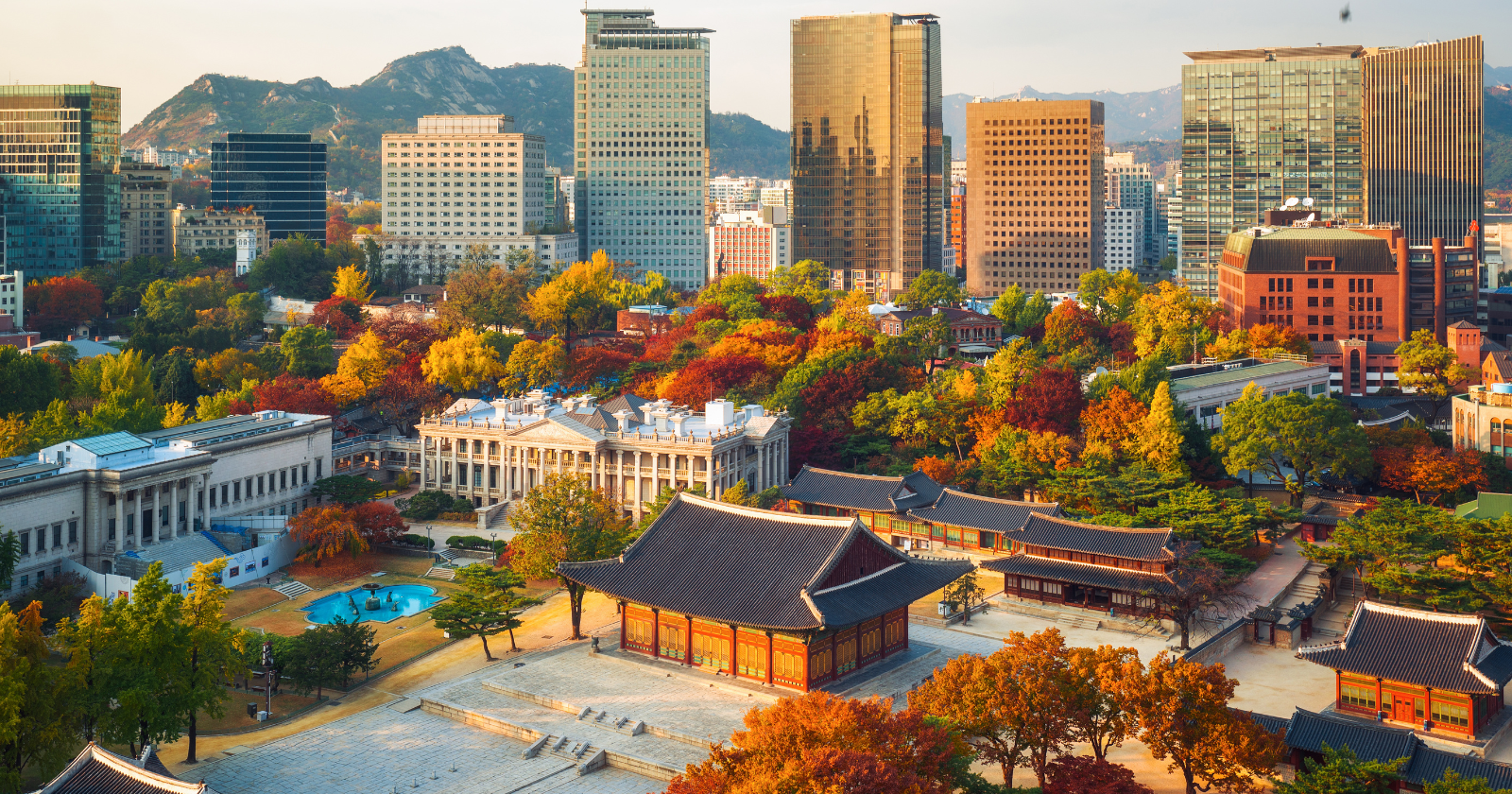
The current South Korean economy, as detailed by a Korea Society educational summary of the broader trajectory of South Korean economic development, has a GDP per capita of approximately $36,000, higher than that of Italy, Spain, or Portugal, and roughly comparable to the average of the European Union. South Korea ranks between the 10th and 13th largest economy in the world, depending on the specific measurement methodology used. It is the world’s largest shipbuilder, the world’s largest memory chip producer, one of the top three smartphone manufacturers, one of the top five automobile producers, and a substantial exporter of cultural content — K-pop, K-drama, Korean cinema — that has reached global audiences on a scale that the country’s economic planners of the 1960s would have found essentially incomprehensible. The film Parasite became the first non-English-language production to win the Academy Award for Best Picture in 2020. The musical group BTS became the first Asian act in modern recorded-music history to reach the top of the Billboard 200. The 70 years between the per-capita GNP of $67 in 1953 and the current GDP per capita of $36,000 represent, by every available measure of national economic transformation, the fastest sustained shift from poverty to prosperity in the modern historical record. The costs — substantial wealth concentration in the chaebol families, severe demographic pressures from a birth rate that has fallen below 0.8 children per woman, the lingering political legacies of three decades of authoritarian developmental rule before the transition to democracy in 1987 — are real and continue to shape current Korean political debates. The economic achievement, against the structural conditions of 1953, remains essentially without modern parallel.