
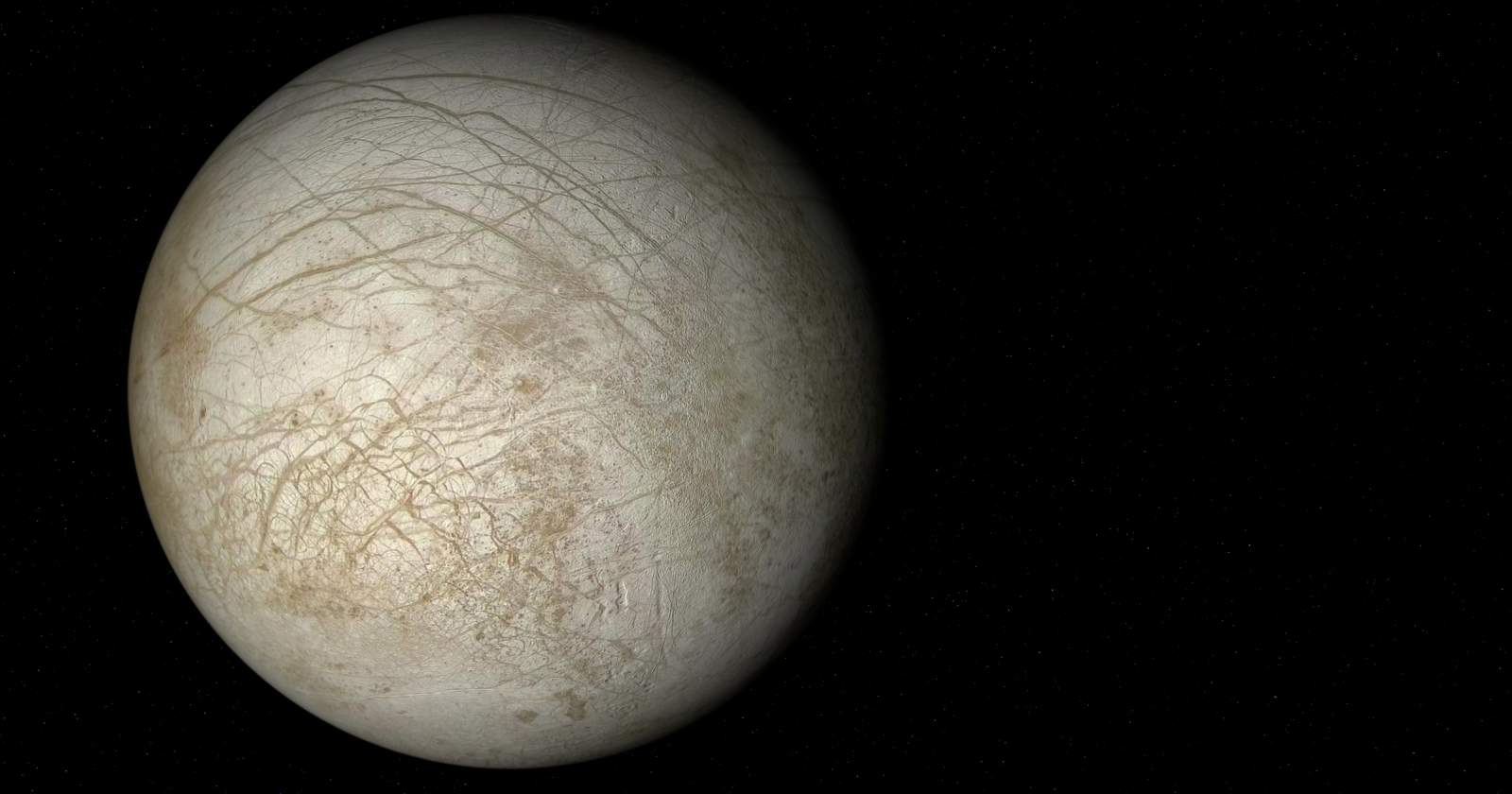
Europa’s habitability problem has always had two directions. The moon likely has a deep ocean beneath its ice shell, but the chemistry that might help life is not produced only in that ocean. Some of it may be made at the surface, where Jupiter’s radiation breaks and reshapes molecules in the ice.
That creates a difficult question. If oxidants and other reactive chemicals are made near the surface, how do they reach the hidden ocean below? Europa’s ice shell may be many kilometres thick. A surface rich in useful chemistry does not automatically feed an ocean sealed beneath ice.
In 2026, researchers linked to Washington State University proposed a possible answer. In a paper published in The Planetary Science Journal, reported by Space.com and associated with lead author Austin Green, the team modelled whether salty, oxidant-rich surface ice could become dense and weak enough to detach and slowly sink through Europa’s ice shell. Under the most favourable model conditions, the process could begin in as little as 30,000 years.
This is one study, not settled consensus. It is a numerical model of a possible transport mechanism, not a direct observation of ice sinking on Europa. The useful point is narrower: if the model is right, Europa may have a way to move surface chemistry downward without relying only on cracks, impacts or wholesale overturning of the ice shell.
The surface makes chemistry the ocean may need
Europa orbits inside Jupiter’s intense radiation environment. Charged particles strike the moon’s surface and alter the ice and salts exposed there. This radiation can produce oxidants, including oxygen-bearing compounds that could act as chemical energy sources if they reach liquid water.
That matters because Europa’s ocean, if habitable, would not be sunlit. Photosynthesis is not available beneath an ice shell. Any biology there would need chemical disequilibria: combinations of materials that can react and release usable energy. Surface oxidants are one possible half of that energy story, provided they can be delivered downward.
NASA’s Europa Clipper mission overview frames the mission around this larger question. The spacecraft’s main science goal is to determine whether there are places below Europa’s surface that could support life. It will study the ice shell, the ocean beneath it, the moon’s composition and its geology through nearly 50 close flybys after arriving in the Jupiter system in 2030.
The 2026 foundering model fits into that context. It does not claim to detect life. It does not even claim to prove ocean delivery. It asks whether Europa’s ice shell could behave in a way that lets surface-modified material move downward over geologic time.
Why sinking ice is not as odd as it sounds
The process being proposed is lithospheric foundering. On Earth, the phrase describes dense or weakened parts of the outer shell sinking into hotter material below. The Europa version is not identical, because the material is ice rather than rock and the environment is an icy moon rather than a planet with a silicate mantle. But the basic instability is similar: a denser, weaker layer can detach and sink.
On Europa, the key ingredient is not ordinary clean ice. It is salty ice. Adding salts and radiation products can change both the density and the mechanical strength of surface material. If a patch of near-surface ice becomes denser than the cleaner ice beneath and weak enough to deform, gravity can begin to pull it downward.
That motion would be slow by human standards. The word “sink” can make the process sound like a stone dropping through water. A better image is a cold, viscous drip. The material deforms, detaches and descends through a much larger ice shell over thousands to millions of years.
That timescale is still short in planetary terms. Europa’s surface is thought to be geologically young, and the moon has been shaped by tidal flexing over long periods. A process that can move surface material downward in tens of thousands to millions of years could matter for ocean chemistry if it occurs often enough.
The 30,000-year number is the fastest case
The number in the headline needs the caveat attached to it. The researchers did not say all salty surface ice reaches the ocean in 30,000 years. According to the Space.com report, the team modelled a roughly 30-kilometre ice shell across six scenarios. In all of those cases, surface material from the upper 300 metres descended toward the base of the shell.
In some simulations, the sinking began only after 1 to 3 million years and reached the base after 5 to 10 million years. In the most favourable cases, where the ice shell was more heavily damaged or weakened, sinking began after as little as 30,000 years.
That distinction matters. The fast case depends on model conditions. It is not a universal clock for Europa. If the ice is colder, stronger, less damaged or differently layered than assumed, the process could be slower or less effective. If salts and weakening are concentrated in the right places, it could be more efficient.
The model’s value is therefore not that it gives one definitive timescale. It gives a mechanism that can be tested against future data: surface composition, shell structure, thermal anomalies, radar layering and the distribution of geologically disrupted terrain.
Why vertical transport has been such a hard problem
Europa’s surface is fractured, ridged and geologically active, but much of that activity may move material sideways rather than downward. If surface plates slide, stretch or crack without deeply recycling, oxidants can remain trapped near the top. A stagnant upper lid would make the problem worse by keeping surface material isolated from the ocean.
There are other proposed routes. Large impacts could punch material downward. Chaos terrain may involve partial melting or exchange between shallower water pockets and the surface. Cracks and ridges may move brines upward or downward under some conditions. Plumes, if confirmed and persistent, could connect subsurface reservoirs to space. But each route has uncertainties.
Lithospheric foundering offers a different kind of pathway. It does not require the whole shell to overturn at once. It does not require a permanent open conduit to the ocean. It only requires patches of salty surface ice to become unstable enough to detach and descend.
If that happens, the surface becomes less like a sealed roof and more like a slow chemical exchange system. Not fast, not simple, and not necessarily continuous, but capable of moving altered material from the radiation-processed surface toward the ocean below.
What Europa Clipper could add
Europa Clipper will not land, drill or directly watch a salty ice blob sink through the shell. Its role is different. It will use radar, imaging, spectroscopy, magnetic and gravity measurements, and particle instruments to build a much better picture of the moon’s ice shell and surface composition.
That matters for the foundering idea because the model depends on the ice shell’s thickness, temperature, strength, damage state and composition. Radar could reveal layering or structures inside the shell. Spectrometers can map salts and other surface materials. Thermal measurements may identify warmer regions. Gravity and magnetic data can refine understanding of the ocean and ice shell.
The mission could therefore help determine whether Europa has the kind of damaged, compositionally variable ice shell in which foundering is plausible. It may also show whether surface chemistry is arranged in ways that match potential sinking regions.
A useful future test would not be a single confirmation. Planetary science rarely works that cleanly. It would be a convergence of evidence: salty or oxidant-rich terrains, signs of weak or disrupted ice, internal structures consistent with downward transport, and models that reproduce the observed geology without requiring unrealistic conditions.
Life-supporting chemistry is not life
The tempting overstatement is obvious. Surface chemistry reaches the ocean, therefore Europa is alive. The model does not show that. It addresses one ingredient in a chain of habitability, not the entire chain.
For life as we understand it, Europa would need liquid water, suitable chemistry, usable energy, long-term stability and conditions that do not destroy complex molecules faster than they can be used. A transport mechanism for oxidants could help with the energy part, but it does not answer whether the ocean contains the right mix of reductants, nutrients, pH, salinity or environments where biology could persist.
There is also a balance problem. Oxidants can support energy metabolism, but too much oxidative chemistry can be damaging. Habitability depends on gradients and reactions, not simply on more oxidants being better. A conveyor of surface material would be important only in the context of the ocean’s broader chemistry.
That is why the proposed mechanism should be treated as a pathway, not a verdict. It may help solve the delivery problem. It does not settle the life problem.
A slow route through the ice
The appeal of the 2026 model is that it turns Europa’s surface from a passive shell into a possible participant in ocean chemistry. Radiation makes oxidants near the top. Salts and damage change the density and strength of ice. Under favourable conditions, patches of that material detach and sink. Over time, chemistry made at the surface may be carried toward the ocean.
That is a quiet idea, but a consequential one. Europa’s ocean is hidden, and no mission has sampled it directly. For now, habitability has to be inferred from the ice shell, the surface and the physics that might connect them.
If salty, oxidant-rich ice can sink through Europa’s shell, then the boundary between surface and ocean may be less absolute than it appears. The route would be slow, model-dependent and still unobserved. But in a moon where the ocean is sealed beneath kilometres of ice, even a slow route matters.
