
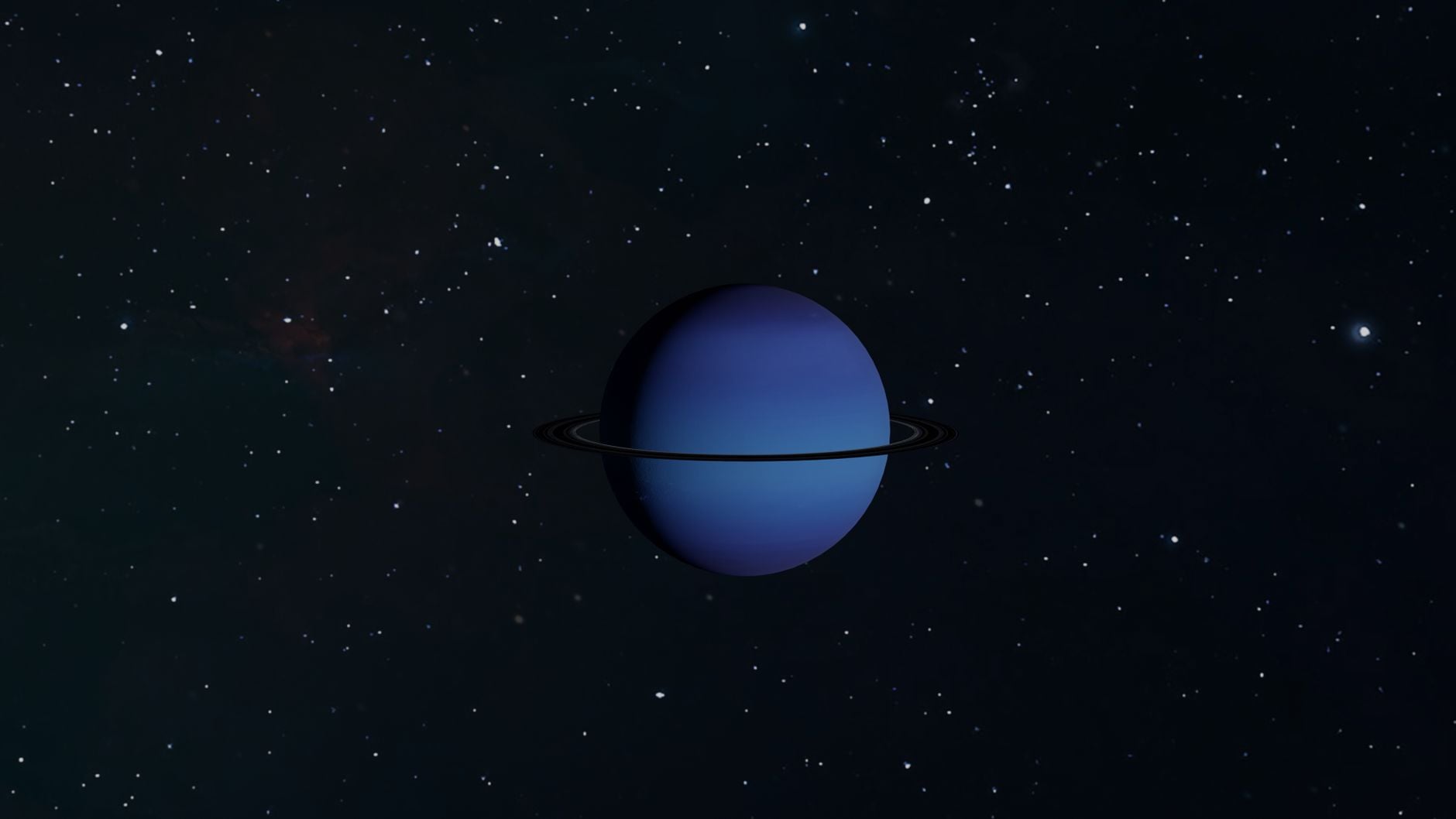
The strangest thing about Uranus and Neptune is not that they are distant. It is that, for all the images, models and telescope campaigns built around them, both planets are still anchored to one brief spacecraft visit.
NASA’s Voyager 2 mission page states the point plainly: Voyager 2 is the only spacecraft to visit Uranus and Neptune. It flew past Uranus on Jan. 24, 1986, then reached Neptune on Aug. 25, 1989. Those encounters turned two faint outer planets into worlds with rings, weather, moons, magnetic fields and unresolved internal structures. Then the spacecraft moved on.
Nearly four decades later, no mission has returned. Telescopes on Earth and in space have improved enormously since the 1980s, and they have added important observations. But telescopes cannot replace an orbiter, a probe, repeated close passes through a planet’s magnetic environment, or sustained mapping of moons and rings from inside the system. For Uranus and Neptune, planetary science is still working from a pair of fast flybys.
Voyager 2 gave the first close look, not the last word
Voyager 2 was built for a rare alignment of the outer planets. After Jupiter and Saturn, its path carried it onward to the two ice giants. The spacecraft had no possibility of stopping. At each planet, it had hours to days of close science, not years of orbital work.
That limitation matters. A flyby can reveal a world. It cannot watch it through seasons, map every moon, repeatedly sample the magnetic field from different angles, or measure the gravity field with the precision an orbiter can provide. The data are invaluable, but they are thin in time.
At Uranus, NASA notes that Voyager 2 discovered 10 new moons, two new rings and a magnetic field stronger than Saturn’s. It returned images and measurements that still support new work today. But the encounter happened under unusual viewing conditions. Uranus was near southern summer solstice, with one pole tilted toward the Sun. Much of the northern hemisphere was in darkness from Voyager’s point of view, and the planet’s weather appeared unusually quiet in visible images.
At Neptune, Voyager 2 found a more active world than many expected. NASA’s Neptune page records the 1989 flyby as the only spacecraft visit to the planet. Voyager 2 discovered moons and rings, imaged large atmospheric features, and passed close to Triton, Neptune’s largest moon. But again, the visit was brief. It was a close look at one moment in a system that changes over time.
The interiors remain difficult to read
Uranus and Neptune are often called ice giants, but the phrase can give a false sense of certainty. The “ice” refers to volatile compounds such as water, ammonia and methane that were incorporated into the planets during formation. Inside the planets today, those materials are not simple blocks of ice. They are compressed into extreme states under pressures and temperatures that are difficult to reproduce and interpret.
The basic question is still open: how are the interiors arranged? Do the planets have distinct layers, with rock, water-rich material and hydrogen-helium envelopes separated in a relatively clean structure? Or are they more mixed, with gradual compositional transitions? Why does Uranus emit so little internal heat compared with Neptune? What does that difference say about their formation, impacts and long-term cooling?
Voyager 2 measured masses, radii, gravity harmonics and magnetic fields, but a single flyby gives limited constraints. Interior models can fit the same sparse data in different ways. A future orbiter could use repeated gravity measurements, magnetic mapping and atmospheric data to narrow those possibilities.
This is one reason the outer planets matter beyond the Solar System. Many known exoplanets fall into size ranges closer to Uranus and Neptune than to Jupiter. Yet the two local examples we can study most directly remain underexplored. Understanding them better would help interpret a broad class of planets around other stars.
The magnetic fields are not simple dipoles
One of Voyager’s most important findings was that Uranus and Neptune have unusual magnetic fields. They are not neatly aligned with the planets’ rotation axes, and they are offset from the centres of the planets. That geometry is different from the relatively familiar picture of a bar-magnet-like field roughly aligned with a planet’s spin.
At Uranus, the geometry becomes even harder to visualise because the planet itself rotates on its side. Its magnetic field is tilted relative to its rotation axis, while the rotation axis is already tilted almost into the plane of its orbit. As the planet turns, its magnetic environment is dragged into a changing shape. Voyager saw only a slice of that system.
Neptune’s magnetic field is also tilted and offset. Together, the two planets suggest that ice-giant dynamos may operate in electrically conducting layers that differ from the deep metallic hydrogen regions thought to generate the fields of Jupiter and Saturn. But the details depend on what materials exist inside the planets and how they move.
A return mission could map those fields over time and from multiple positions. That would matter not only for planetary interiors, but also for the moons and rings that move through these magnetospheres. Charged particles can weather surfaces, darken ring material and alter the environments around small bodies.
The rings are still under-sampled
Both Uranus and Neptune have ring systems, but they are not Saturn-like in brightness or scale. They are darker, narrower and more difficult to study from Earth. Voyager 2 showed that these systems were real, structured and connected to small moons, but it could not turn them into fully mapped environments.
Uranus has narrow rings and small inner moons whose orbits and interactions may help maintain ring structure. Neptune has rings and ring arcs, including material that appears clumped rather than evenly spread around the planet. These structures raise basic dynamical questions: how old are the rings, what supplies them, how are they confined, and what do they say about small moons that may be colliding, shedding material or migrating?
Rings are not just decorative. Around Saturn, ring observations have become a tool for probing planetary interiors and system evolution. For Uranus and Neptune, similar possibilities remain much less developed because there has been no long-lived spacecraft in orbit to watch the rings closely, measure their particles and track their changes.
The moons may be the largest missed story
Voyager 2 also revealed that the ice giants’ moons deserve far more attention than a flyby could provide. Uranus has five major moons: Miranda, Ariel, Umbriel, Titania and Oberon. Voyager imaged them with uneven coverage and lighting. Some surfaces showed fractures, canyons and signs of past geological activity, especially Miranda. But large regions were poorly seen or not seen at all.
That leaves open questions about whether any Uranian moons could have had, or may still have, internal oceans. Recent modelling and telescope work have kept that possibility alive for some of the larger moons, but only a dedicated spacecraft could test it properly through gravity measurements, magnetic induction studies and detailed surface mapping.
Neptune’s largest moon, Triton, may be even more compelling. Voyager 2 saw a young surface, a thin nitrogen atmosphere and active plumes. Triton also orbits Neptune in a retrograde direction, which strongly suggests it was captured rather than formed in place. That makes it a close relative of Kuiper Belt objects such as Pluto, but one that has been reshaped by life around a giant planet.
A Neptune mission could study Triton as a world in its own right. A Uranus mission could determine whether its major moons are old frozen relics, once-active bodies, or possible ocean worlds. In both cases, the moon systems are not side issues. They are part of the reason the ice giants remain scientifically unfinished.
Why Uranus became the priority
The need for a return is not only a familiar complaint among outer-planet researchers. It has been formalised in the United States’ planetary-science planning. In 2022, the National Academies’ decadal survey report identified the Uranus Orbiter and Probe as the highest-priority new large mission. The proposed mission would conduct a multiyear orbital tour and deliver an atmospheric probe.
That recommendation does not mean a spacecraft is already on its way. Large planetary missions take money, hardware, launch opportunities, power systems and political commitment. Even under an optimistic path, a spacecraft launched in the 2030s would not arrive quickly. The outer Solar System keeps its own schedule.
Uranus was favoured over Neptune in part because the trajectory and mission design are more practical within the planning window. Neptune remains scientifically important, especially because of Triton, but a Neptune orbiter is harder to deliver under the same constraints. This is not a case of one planet being interesting and the other not. It is a case of choosing where a feasible flagship mission can do the most.
One spacecraft is not enough for two planets
Voyager 2’s achievement is difficult to overstate without turning it into nostalgia. It visited all four giant planets, sent back data from worlds nobody had seen close up, and is now in interstellar space. But the Uranus and Neptune flybys were beginnings.
The unresolved questions are not small. What are the planets made of inside? Why is Uranus so cold compared with Neptune? How do their tilted, offset magnetic fields work? How old are the rings? What shaped the moons? Could any of those moons hide internal oceans? How does Triton fit into the story of captured dwarf planets and the outer Solar System?
Those questions persist because the evidence is still limited. A flyby can transform ignorance into a first map. It cannot turn an ice-giant system into a fully observed world.
That is the quiet consequence of the Voyager gap. Humanity has sent orbiters to Jupiter and Saturn, rovers to Mars, landers to comets and asteroids, and telescopes that can study planets around other stars. But Uranus and Neptune still sit largely on the far side of one spacecraft’s path through the 1980s. Until another mission returns, the two outer planets remain less like solved worlds than unfinished encounters.
