

The original wallpaper concept was, by every available account from the period, a perfectly reasonable mid-century product idea. The American post-war housing boom had produced a substantial market for interior design innovations. The Beat generation and its broader cultural ecosystem — beatniks, jazz clubs, abstract expressionist art, modernist architecture — was creating consumer demand for visual aesthetics that broke from the floral patterns and pastel colours of pre-war interior design. Three-dimensional textured wallcoverings, made from new post-war synthetic materials and offering geometric or organic patterns that conventional paper wallcoverings could not produce, seemed like the natural next step. Chavannes, who had been working on the technology of embossing thermoplastic film since approximately 1948 and had filed his first relevant patent in November of that year, had developed a method for producing decorative plastic sheets with raised three-dimensional patterns. His collaboration with Fielding was an attempt to commercialise the technology in the wallpaper market.
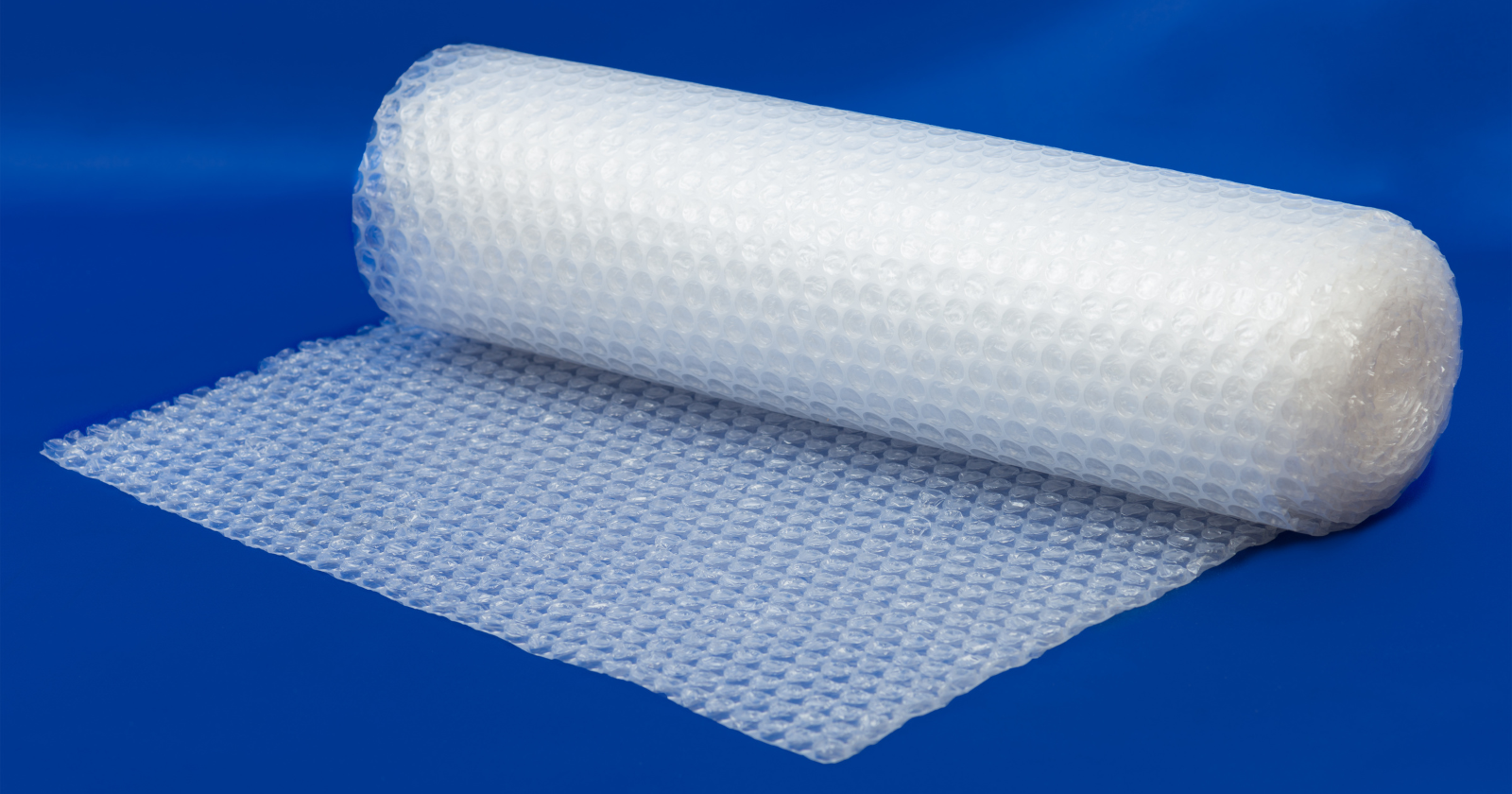
The collaboration did not produce wallpaper. According to the official archival history of bubble wrap maintained by the H.W. Fielding company founded by Alfred Fielding’s family, what the machine actually produced when Fielding and Chavannes ran shower curtains through their heat-sealer was a sheet of plastic with a regular array of small air bubbles trapped between two layers of film — interesting as a structural artefact, but not what the engineers had been trying to make. The intended embossed pattern had failed to form correctly. The two sheets had instead bonded around isolated pockets of trapped air, producing the now-familiar regular grid of small inflated hemispherical cells. The pattern was visually unusual but not, by 1957 American interior design standards, particularly appealing as a wall covering. The plastic was floppy. The bubbles felt strange to the touch. The aesthetic, presented to early focus groups, did not resonate. The wallpaper concept failed almost immediately upon attempted commercialisation.
The greenhouse insulation pivot
The second commercial application Fielding and Chavannes attempted was greenhouse insulation. The reasoning was that the trapped air bubbles, in principle, should provide thermal insulation in the same general manner as the trapped air pockets in double-glazed windows or in fibreglass batting — and the agricultural greenhouse industry was, in the late 1950s, an active market for innovative insulation materials that could reduce the heating costs of winter greenhouse operations. The hypothesis had a plausible engineering basis. The execution, when actually tested in working greenhouses, did not produce the expected results. As detailed in Smithsonian Magazine’s account of the accidental invention of bubble wrap and the long path to its eventual commercial application, the bubbles did provide some thermal resistance, but not enough to compete with the established greenhouse insulation alternatives of the period. The product was, in technical terms, an inferior insulator. The market did not adopt it. The second commercial application failed.
Fielding and Chavannes continued patenting their process across the late 1950s and early 1960s — filing applications in 1957, 1959, and 1960 covering various aspects of the machinery, the lamination process, and the manufacturing techniques required to produce sheets of cellular plastic at industrial scale — and in 1960 incorporated the Sealed Air Corporation to commercialise whatever applications they could find for the material. The product was branded “Bubble Wrap” (originally “Air Cap”). The corporate strategy at that point was, in essential respects, a brute-force search through possible applications: the two inventors are reported to have considered more than 400 separate potential uses for their product, ranging from packaging materials through swimming-pool covers through agricultural mulch through various forms of insulation. None of these applications had, by mid-1961, produced any substantial commercial revenue. The Sealed Air Corporation was, by every available measure, struggling.
The IBM 1401
The intervention that saved the company was an essentially fortuitous combination of timing, marketing initiative, and a single specific computing-industry product. As reported by a packaging-industry history of bubble wrap and the IBM partnership that launched the protective-packaging industry, the IBM 1401 mainframe computer was announced by IBM on 5 October 1959 and began shipping to commercial customers in 1960. The 1401 was not IBM’s first mainframe — the company had been producing large business computers since the early 1950s — but it was the first IBM mainframe priced and configured to serve as a viable purchase for medium-sized American businesses rather than only Fortune 500 corporations and government agencies. The 1401 cost approximately $150,000 (equivalent to roughly $1.5 million in 2026 purchasing power) or could be leased for approximately $2,500 per month. It eventually sold approximately 12,000 units across its production run — a quantity that was, by the standards of the mainframe market of the early 1960s, extraordinary. The 1401 was, by general industry consensus, the first commercially successful mainframe in American business history, sometimes referred to as “the Model T of the computer industry” for its role in introducing computing to small and medium-sized businesses for the first time.
The problem with the IBM 1401, from the perspective of IBM’s logistics and shipping operations, was that the computer was simultaneously expensive, fragile, and being shipped to thousands of customers across the United States during 1960 and 1961. The standard protective packaging materials of the era — crumpled newspaper, sawdust, horse hair, wood shavings — were inadequate for protecting precision electronic equipment of the 1401’s complexity, value, and shock-sensitivity. IBM’s shipping department was, by all subsequent accounts, actively looking for alternative cushioning materials in 1961. A Sealed Air marketer named Frederick W. Bowers, having read about the 1401’s commercial introduction, pitched bubble wrap to IBM’s packaging engineers as a possible solution. As detailed in a Back Then History overview of bubble wrap’s accidental commercial breakthrough and the broader trajectory of the Sealed Air Corporation, IBM’s engineering team tested the product, found it superior to the alternatives, and adopted it as standard packing material for 1401 shipments. The commercial relationship between Sealed Air and IBM, which began in 1961, was sufficient on its own to keep the company solvent and to demonstrate the broader market opportunity that the protective-packaging application represented.
Other shippers, observing the IBM adoption, began ordering bubble wrap for their own fragile products through the early and mid-1960s. The transition from sawdust-and-newspaper packaging to plastic-cushioned packaging proceeded across approximately a decade, with bubble wrap progressively becoming the default protective material for essentially any fragile object shipped by a commercial enterprise. The Sealed Air Corporation, which had been on the edge of failure in 1961, grew across the subsequent six decades into a Fortune 500 company with operations in 122 countries and annual revenues in the billions. The original 1960 Bubble Wrap sample now sits in the permanent collection of the Museum of Modern Art in New York. Alfred Fielding’s five-year-old son Howard became, according to family lore, the first human being to deliberately pop a piece of bubble wrap for entertainment — a recreational application that has, over the subsequent 65 years, generated an entire popular-culture genre of stress-relief packaging that the original inventors could not have anticipated when they were trying to sell decorative plastic to beatniks.