

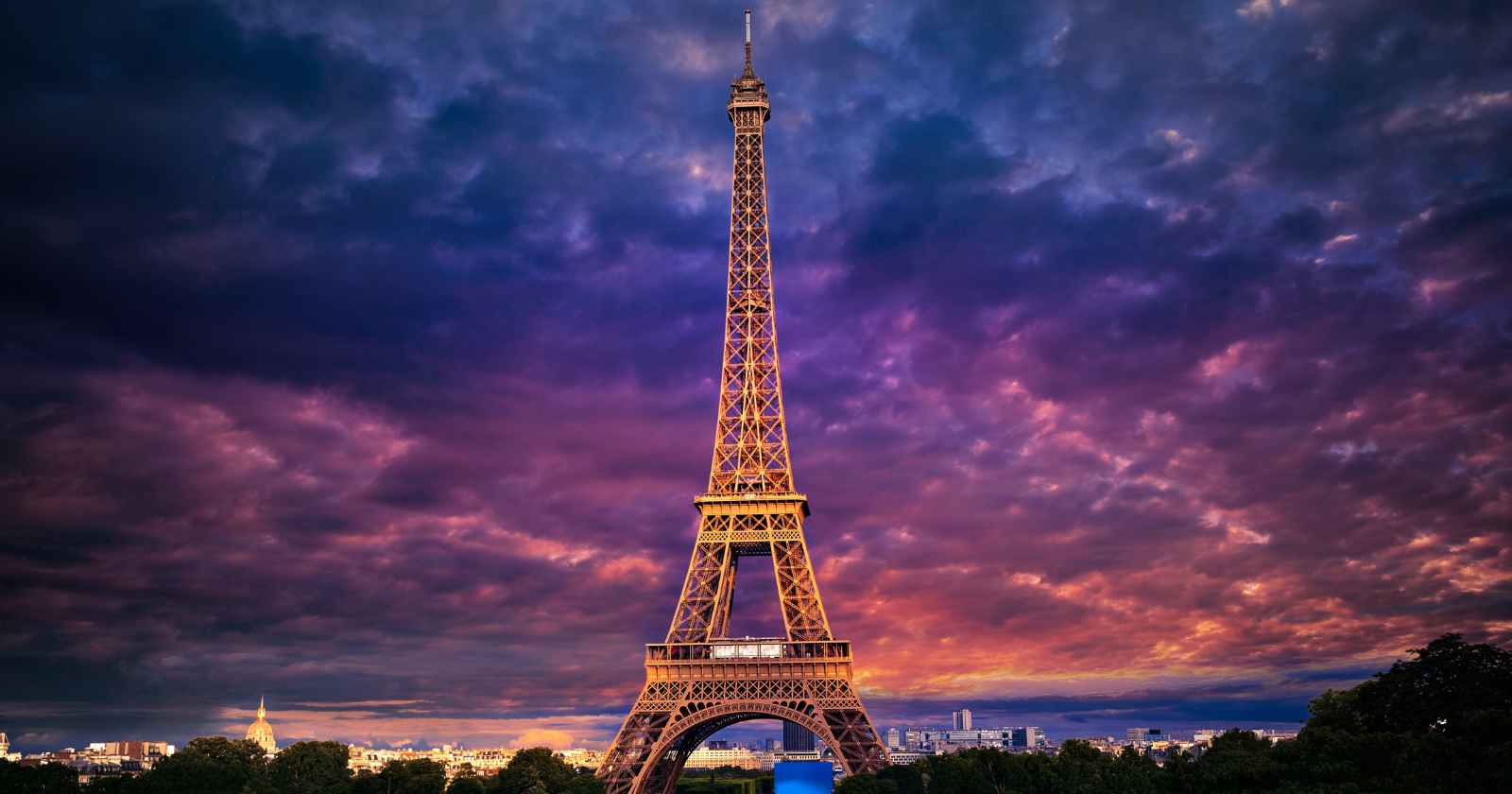
The Eiffel Tower’s existence, in its original 1880s context, was a deeply contested proposition. The design itself had emerged from Eiffel’s engineering company, drafted in June 1884 by two of his employees — the structural engineers Maurice Koechlin and Émile Nouguier — and refined by the architect Stephen Sauvestre to give the structure its characteristic curved silhouette. The proposal won an 1886 competition among more than 100 submissions for a centerpiece structure for the 1889 fair. The construction proceeded between January 1887 and March 1889 — two years, two months, and five days — using approximately 18,000 individual pieces of puddle iron joined by 2.5 million rivets and assembled by several hundred workers, none of whom died during construction, which was, by the engineering and labour-safety standards of the 1880s, itself a remarkable achievement. The completed tower stood 300 metres tall, making it the tallest human-built structure in the world (a distinction it would hold until the completion of New York’s Chrysler Building in 1930), and was, in March 1889, opened to the visiting public as the monumental gateway to the Exposition Universelle.
The Parisian artistic establishment hated it. Approximately three hundred prominent artists, writers, and intellectuals — including the novelist Guy de Maupassant, the composer Charles Gounod, the playwright Alexandre Dumas the younger, the architect Charles Garnier (who had designed the Paris Opera), and the poet Sully Prudhomme — published an open letter of protest in the newspaper Le Temps on 14 February 1887, while the tower was still under construction. The letter described the planned structure as “a tragic street lamp,” “a gigantic black smokestack,” and “the dishonor of Paris.” It demanded the project’s cancellation. Maupassant, who continued to oppose the tower for the rest of his life, famously dined at the tower’s restaurant on a regular basis after its completion — explaining, by his own account, that it was the only restaurant in Paris from which he could not see the Eiffel Tower. The 20-year demolition clause was, in this context, not entirely a temporary architectural inconvenience. It was a meaningful concession to the substantial portion of Parisian cultural opinion that wanted the tower removed.
How Eiffel saved his own tower
Gustave Eiffel was, by all available accounts of his temperament, a strategic and patient person. He understood by approximately the early 1900s — the tower having been a successful tourist attraction during the 1889 Fair (2 million visitors) but having lost much of its commercial draw during the 1900 Paris Exposition — that the City of Paris was unlikely to extend the concession voluntarily, and that the precedent set by the imminent 1909-1910 demolition of the 1889 Fair’s Gallery of Machines (the world’s largest building at the time of its construction, condemned to demolition by 1906 City Council vote because the city could not find a permanent use for it) meant that monumental Exposition structures were genuinely at risk of demolition once their original purpose had expired. According to the official Eiffel Tower’s archival history of the tower’s scientific applications and Gustave Eiffel’s strategic preservation efforts, Eiffel’s response was to deliberately and progressively convert the tower into something that the City of Paris and the French government would be reluctant to destroy — a working laboratory for scientific and military experimentation that would, by virtue of its specific physical characteristics (height, accessibility, structural rigidity), be difficult to replace.
The scientific programme began essentially on the day the tower opened. Eiffel installed a meteorological station on the third floor in 1889. He set up an astronomy office for his own use. He installed gravity-measurement instruments between 1903 and 1905. He built a wind tunnel at the base of the tower in 1909 and conducted approximately 5,000 aerodynamic trials between August 1909 and December 1911, producing data that contributed substantially to early French aviation engineering. The German physicist Theodor Wulf, working at the tower in 1910 with an electrometer, measured higher levels of radiation at the top than at the base of the structure — a discrepancy that contributed directly to the eventual identification of cosmic rays as a distinct phenomenon by the Austrian physicist Victor Hess in 1912. The tower was, by the eve of the 1910 concession expiration, no longer merely a tourist attraction. It was a functioning scientific instrument with multiple ongoing research programmes that would be substantially disrupted by its demolition.
The wireless application that actually saved it
The decisive intervention, however, was the wireless telegraphy programme. As described by the official Eiffel Tower’s account of how radio saved the structure from destruction, the first wireless telegraphy experiments using the tower had been conducted as early as 5 November 1898, when the inventor Eugène Ducretet successfully transmitted signals between the tower’s summit and the Panthéon approximately four kilometres away. The success suggested a substantial application for the tower’s height. In 1903, Eiffel formally offered the tower to Captain (later General) Gustave Ferrié, an army officer who was at the time responsible for the French military’s research into wireless military communications. Eiffel personally financed the installation of an antenna stand at the tower’s summit and the cabling that ran down to a research shack Ferrié had set up at the base of the south pillar. The military signed on. The collaboration proceeded.
The technical results across the subsequent five years were transformative. By 1904, Ferrié had established wireless communication between the tower and French military forts approximately 400 kilometres away to the east. By 1907, he had reached the French naval base at Bizerte in Tunisia — approximately 1,500 kilometres distant. By 1908, the tower was transmitting and receiving signals at a range of approximately 6,000 kilometres, making it the longest-range wireless telegraphy installation in the world. As reported by a History.com analysis of the Eiffel Tower’s near-demolition in 1909 and the radio-transmission programme that ultimately preserved it, the French military had, by 1909, integrated the tower into its strategic communications infrastructure to a sufficient extent that demolishing it would have created a significant operational problem for national defence. A permanent military radiotelegraphy station was constructed underneath the Champ de Mars in 1909. The strategic case for preservation was, by that point, essentially decided. The City of Paris extended Eiffel’s concession on 1 January 1910 — not for another 20 years but for 70.
The subsequent operational history vindicated the preservation decision in concrete terms. The tower’s wireless station was the source of the radio intercept that, in early September 1914, alerted French military command to administrative difficulties affecting General Georg von der Marwitz’s German cavalry corps and contributed to the French victory at the First Battle of the Marne — the battle that stopped the German advance on Paris and substantially shaped the trajectory of the First World War. The tower survived German occupation during the Second World War (Hitler ordered its demolition in 1944; the order was never carried out; French Resistance fighters cut the elevator cables to force occupying Nazi soldiers to climb the stairs). The wireless function transitioned across the 20th century from telegraphy to radio broadcasting to television transmission to the contemporary mix of digital broadcasting and mobile telecommunications relay that the tower still provides today. Gustave Eiffel himself lived to see the concession extension granted, dying in December 1923 at the age of 91, approximately 13 years after his strategic preservation campaign had succeeded. The tower he had built as a temporary advertisement for French industrial achievement — and had then deliberately re-engineered into a working scientific instrument to prevent its demolition — has now stood on the Champ de Mars for 137 years. It is photographed, by current estimates, more often than any other single human-built structure on the planet. It was, by every reasonable measure of the original 1889 concession terms, never supposed to be there.