
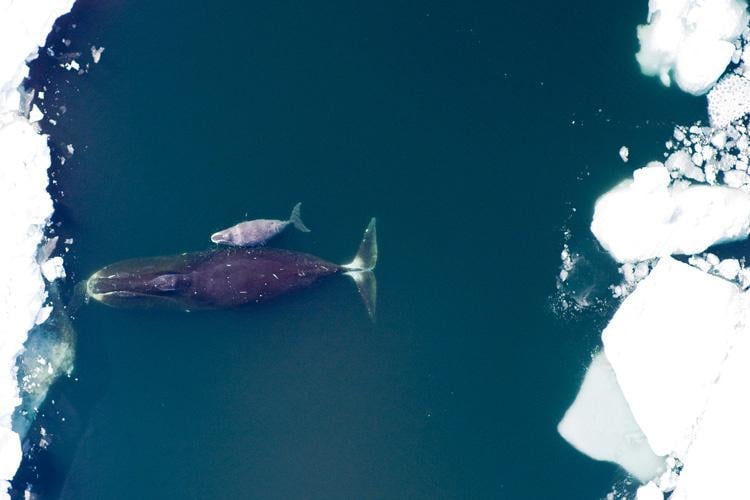
The bowhead whale is a biological contradiction on a massive scale. It can weigh tens of tonnes, carry far more cells than a human body, and live for more than 200 years. In ordinary cancer arithmetic, that should be dangerous. More cells mean more cell divisions. More divisions mean more chances for DNA copying errors. More decades mean more time for damage to accumulate.
Yet bowhead whales do not appear to pay the cancer penalty that their size and lifespan seem to predict. That does not mean they never develop cancer, or that they are immune to aging. It means they sit at the centre of one of biology’s most useful puzzles: how can a huge, long-lived mammal keep its cells working for so long without being overwhelmed by tumors or age-related failure?
NOAA Fisheries describes bowhead whales as Arctic and subarctic specialists and notes that evidence suggests they can live over 200 years. These are not animals that merely survive a long time in captivity. They are wild mammals adapted to cold, ice-covered waters, with life histories stretched across centuries.
The scientific reason this matters is Peto’s paradox. If cancer risk were simply a matter of body size and lifespan, elephants and whales should be far more cancer-prone than mice or humans. They are not. Large, long-lived animals must therefore have evolved additional ways to suppress cancer, repair damage, remove risky cells, or prevent dangerous mutations from building up in the first place.
The bowhead whale is now one of the most serious models for that question. A 2015 Cell Reports genome study compared the bowhead genome with other mammals and identified changes in genes linked to DNA repair, cell-cycle control, cancer, and aging. More recent cell work has pushed the story further, pointing to enhanced repair of some of the most dangerous forms of DNA damage.
The whale that makes Peto’s paradox visible
Peto’s paradox is named after epidemiologist Richard Peto, who drew attention to a simple mismatch. Cancer begins when cells acquire changes that let them grow when they should not. A large animal has more cells than a small animal. A long-lived animal gives those cells more years in which to acquire harmful changes.
By that logic, a whale should be a cancer factory. A bowhead whale can be roughly a thousand times heavier than a human and may live more than twice as long as the longest-lived people. If every cell in every mammal faced the same risk, bowheads would be in trouble.
Instead, nature appears to have solved the problem more than once. Elephants have extra copies of a key tumor-suppressor gene. Naked mole-rats show unusual resistance to tumor formation through different cellular mechanisms. Bowhead whales appear to have taken another path, with genome maintenance and DNA repair playing a central role.
This is why the bowhead is not just a curiosity. It is a natural experiment. Evolution has already tested a body plan that is huge, warm-blooded, and long-lived. The whale’s cells carry the record of whatever solutions made that possible.
What the genome suggested
The 2015 bowhead genome study did not announce a single “longevity gene.” Aging is not that simple. Instead, the researchers found patterns suggesting that the species has changes in biological pathways connected with DNA repair, cell division, metabolism, and disease resistance.
That matters because DNA damage is a constant background problem for living cells. Radiation, chemical reactions inside the body, copying errors, inflammation, and ordinary metabolism can all damage DNA. Cells have repair systems, but those systems are not perfect. Over time, unrepaired or misrepaired damage can contribute to cancer, tissue decline, and aging.
In bowheads, the genome study highlighted genes including ERCC1 and PCNA, both involved in DNA repair and genome maintenance. The finding did not prove that these genes explain the animal’s lifespan by themselves. It gave researchers plausible targets and reinforced the idea that the whale’s longevity may depend partly on keeping DNA damage under unusually good control.
That is a different strategy from simply tolerating damage. A cell can respond to danger by dying, stopping division, or repairing the problem. In a long-lived animal, the balance between these choices has to be carefully tuned. Too little repair invites mutations. Too much survival of damaged cells invites cancer. Too much cell death can damage tissues. The bowhead seems to be worth studying because it may have found a durable balance.
The newer repair clue
More recent research has made the bowhead story sharper. According to The Guardian’s report on a Nature study led by Vera Gorbunova and colleagues, bowhead cells are especially good at repairing DNA double-strand breaks, a severe form of damage in which both strands of the DNA helix are cut.
Double-strand breaks are dangerous because the cell has to restore continuity without scrambling genetic information. If the repair is inaccurate, the result can be mutations, rearrangements, or genome instability. Those are exactly the kinds of errors that can drive cancer or weaken cells over time.
The newer work points to a protein called CIRBP, short for cold-inducible RNA-binding protein. Bowhead whales reportedly produce far higher levels of CIRBP than humans. The research found that raising CIRBP levels improved repair of double-strand breaks in human cells and, in fruit flies, increased lifespan and resilience to radiation.
That does not mean cold showers will make humans live for 200 years. It means a pathway worth studying exists. In the bowhead, a protein associated with cold response also appears tied to genome maintenance. That is plausible for an animal that spends its life in Arctic waters, but the connection still needs careful testing in mammals that can be studied experimentally.
Why repair matters for aging
Aging is not one process. It is a collection of changes: DNA damage, protein damage, altered metabolism, stem cell exhaustion, inflammation, epigenetic drift, cellular senescence, and many other shifts. No single whale protein will explain all of it.
But DNA repair is a central piece because genetic damage can affect so many downstream systems. If a cell’s instructions become corrupted, the cell may malfunction, stop dividing, die, or become dangerous. In tissues that must last for decades, the cost of poor repair accumulates.
This is especially relevant for large animals. A whale cannot simply build a huge body and hope cancer does not appear. Its cells must be unusually good at prevention, repair, surveillance, or containment. The bowhead’s long life suggests that genome maintenance is not merely adequate. It may be part of the animal’s defining biology.
That is why researchers care about bowhead cells, not just bowhead genes. A genome can suggest possibilities, but cells reveal behaviour. Do they repair damage faster? More accurately? Do they choose different repair pathways? Do they remove damaged cells differently? Do they avoid accumulating mutations in the first place?
A model, not a miracle
The bowhead whale is a serious aging model precisely because it is not a laboratory shortcut. It is an evolved animal with a full-body solution to longevity. Its biology includes cold adaptation, slow life history, massive size, unusual metabolism, immune function, DNA repair, cancer suppression, and tissue maintenance. Pulling one thread will not explain the whole fabric.
That complexity is a strength. Laboratory models such as mice are useful because they are fast and controllable. Bowheads are useful for the opposite reason: they show what is possible in a mammal that has already solved problems mice never faced.
A mouse does not need to maintain a hundred-tonne body for two centuries. A bowhead does. That makes it a different kind of evidence. It cannot be bred quickly in a lab, and researchers cannot test every hypothesis directly. But tissue samples, genomes, cell cultures, and comparative biology can still reveal principles.
The most important principle may be that long life is not just about slowing damage. It is also about maintaining repair. An old whale is not a passive survivor. Its cells must keep making decisions, correcting errors, and preventing runaway growth decade after decade.
The human question
Whenever a long-lived animal is linked to aging research, the public question arrives quickly: can this help humans live longer? The honest answer is maybe, but not simply.
Humans and bowhead whales are separated by tens of millions of years of evolution. A pathway that helps a whale may not behave the same way in human tissue. Increasing DNA repair sounds obviously good, but biology rarely offers free upgrades. Repair pathways interact with cell division, immune surveillance, cancer suppression, fertility, inflammation, and tissue renewal.
Still, the bowhead results matter because they challenge a quiet assumption: that human DNA repair is already near the best a mammal can do. If bowhead cells repair some damage more accurately or efficiently, then mammalian cells can apparently operate at a different level of genome maintenance.
That does not create an immediate therapy. It creates a research direction. Scientists can test whether CIRBP or related pathways improve repair safely in human cells, mice, organ models, or disease contexts. They can ask whether better repair slows age-linked decline or simply changes which risks appear.
The goal is not to turn people into whales. It is to understand how evolution made a mammal that can stay alive and functional across a span longer than many human nations have existed.
The Arctic as a biology lab
There is also an environmental lesson hidden inside the molecular one. Bowhead whales are not abstract cell lines. They are Arctic animals shaped by sea ice, cold water, migration routes, food webs, and centuries of human hunting pressure. Their biology cannot be separated entirely from their habitat.
NOAA notes that bowheads are among the few whale species living almost exclusively in Arctic and subarctic waters. Their adaptations include extreme blubber thickness, ice-breaking anatomy, and a life history tuned to a slow, cold world. The same cold environment that shaped their bodies may also have influenced molecular systems such as CIRBP.
That makes the animal doubly valuable. It is a key species for conservation and a key species for aging biology. Losing old individuals from long-lived populations does not merely reduce numbers. It erases living records of survival across decades of changing conditions.
For aging science, the bowhead whale is a reminder that some answers are already alive in the world. They are not always in petri dishes or gene-editing experiments. Sometimes they are moving under Arctic ice, carrying genomes that have been stress-tested by time.
The whale’s lesson is not immortality. It is maintenance. A body can be enormous, warm-blooded, and more than 200 years old if it has the right systems for preserving cellular order. Understanding those systems may not make humans live like bowheads, but it could help explain why aging happens at different speeds in different mammals.
That is enough to make the bowhead whale more than an Arctic giant. It is one of the clearest living arguments that cancer resistance and long life can evolve together, and that the machinery of DNA repair may be one of the places where aging begins to give up some of its secrets.
