
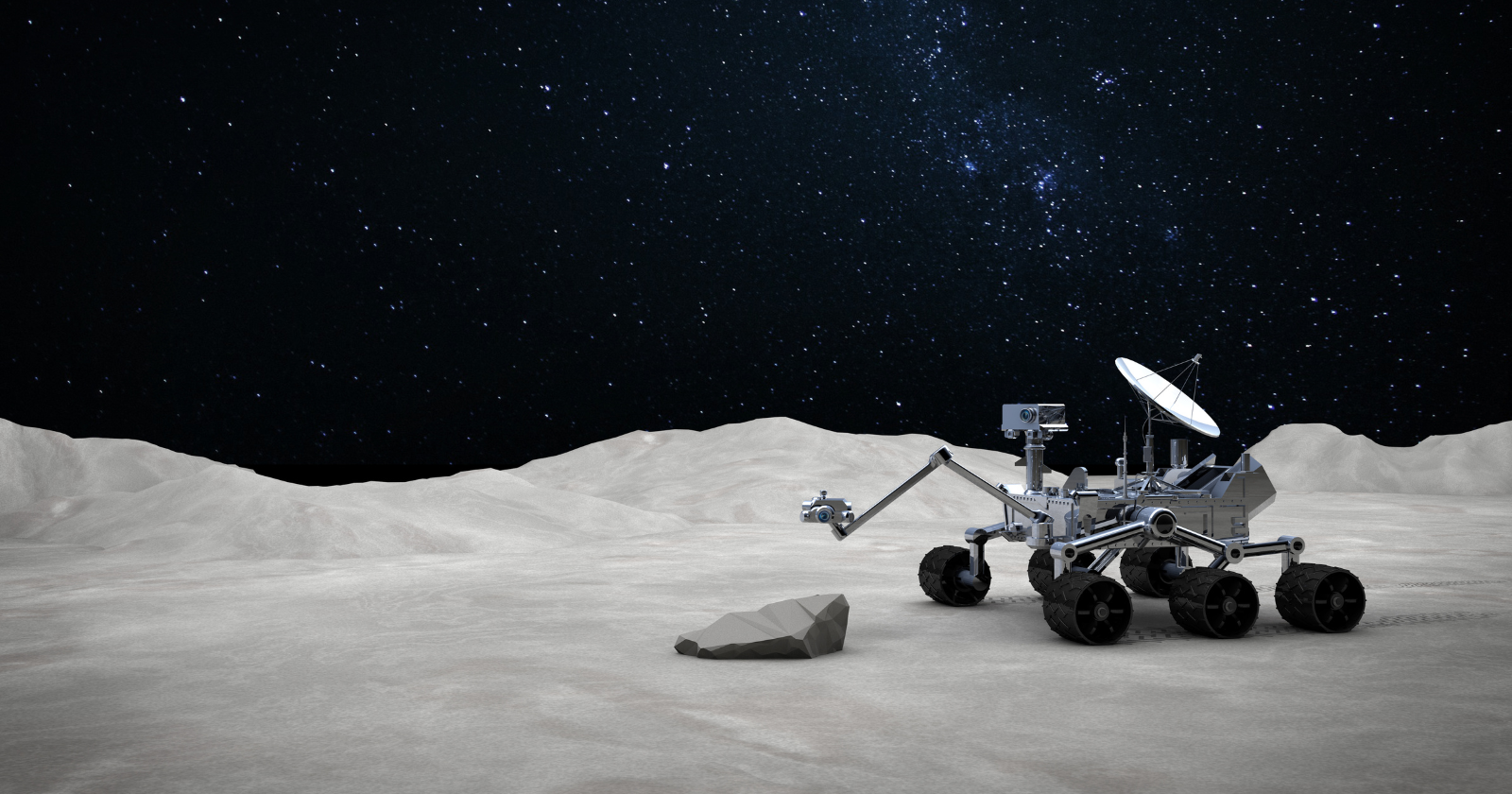
For nearly forty years, one of the Moon’s most useful mirrors sat in silence. It was not broken. It had not been buried by design. It was simply too hard to find.
The mirror belonged to Lunokhod 1, the Soviet rover delivered to the Moon by Luna 17 in November 1970. The rover carried a French-built laser retroreflector, an array designed to send incoming light back in the direction from which it came. In principle, scientists on Earth could fire a short laser pulse at the Moon, catch the tiny returning flash, and use the round-trip travel time to measure the Earth-Moon distance with remarkable precision.
In practice, Lunokhod 1 became an awkward problem. A few early range measurements were made within months of landing, but they were not available in the modern record. After that, the reflector was effectively lost to lunar laser ranging. Scientists knew roughly where the rover had been, but “roughly” is not enough when a laser beam has to find a small array more than 380,000 kilometres away.
The turnaround came in 2010. NASA’s Lunar Reconnaissance Orbiter photographed Luna 17 on Mare Imbrium, the plain where it had landed decades earlier. The image, catalogued as PIA12967, shows the lander still on the lunar surface where it delivered Lunokhod 1 in November 1970. Those new orbital views helped researchers narrow the rover’s location enough for a laser ranging attempt.
In the paper Laser Ranging to the Lost Lunokhod 1 Reflector, Thomas Murphy Jr. and colleagues reported that LRO images in March 2010 positively identified the rover and fixed its coordinates to within about 100 metres. That was good enough for the Apache Point Observatory Lunar Laser-ranging Operation, known as APOLLO, to acquire a signal quickly.
A mirror left on the Moon
A lunar retroreflector is a beautifully simple object. It contains corner-cube prisms that return light toward its source, even if the light arrives from a slightly different direction. On Earth, observatories send laser pulses toward reflectors left on the Moon by Apollo astronauts and Soviet rovers. A small fraction of the light comes back, and the timing reveals the distance.
That distance is not just a number for a textbook. Lunar laser ranging has helped scientists test gravity, refine the Moon’s orbit, study Earth’s rotation, and investigate the Moon’s interior. Over decades, repeated measurements become a record of how the Earth-Moon system behaves.
The Apollo 11, Apollo 14, and Apollo 15 missions left reflector arrays on the lunar surface. The Soviet Lunokhod 2 rover also carried one. Lunokhod 1 had one as well, but its usefulness was interrupted by geography and uncertainty. Without a reliable final position, a reflector is almost like a lock without an address.
Lunokhod 1 itself was a major achievement. It was the first successful robotic rover to operate on another world, driving across the Moon months before any modern planetary rover existed. It moved on eight wheels, survived lunar nights, and returned images and soil measurements. But by the time laser ranging teams wanted its reflector as part of a high-precision network, its exact location had become the missing piece.
Why the reflector was lost
The word “lost” can sound strange when the object in question was sitting in plain view on the Moon. But in laser ranging, lost means something practical. The Moon is far away, the return signal is tiny, and the beam has to be aimed with enough accuracy that photons reach the reflector and then make the long return trip back to a telescope on Earth.
Old mission tracking and surface maps were not precise enough. Lunokhod 1 also ended its mission after months of driving, not right next to the Luna 17 lander. By the time direct contact ended, the rover’s final parking spot was not known to the accuracy needed for modern ranging.
Researchers could aim lasers at the region, but a missed return does not tell you much. It might mean the reflector is damaged. It might mean the coordinates are wrong. It might mean the reflector is tilted unfavourably. It might mean too little light made the trip. Each failure leaves several explanations open.
The Apollo reflectors continued to serve science, but Lunokhod 1 remained out of the network. For decades, it was a piece of functioning hardware that could not be used because the Moon had hidden the address.
LRO changed the search
The Lunar Reconnaissance Orbiter was launched in 2009 to map the Moon in detail. Its camera system could resolve small features on the surface, including landing sites, tracks, and hardware left by earlier missions. For Lunokhod 1, that mattered because the rover and its lander were not only historical artifacts. They were clues in a measurement problem.
Once LRO imagery identified the hardware, the APOLLO team could stop searching a broad region and begin aiming at a much better location. The Murphy paper says the LRO coordinates had uncertainties of about 100 metres. On lunar terms, that is close. For laser ranging, it was close enough to try.
The result was immediate. In April 2010, APOLLO sent pulses toward the newly identified position and received returns from the reflector. The paper describes the reflector as being in excellent condition and returning a signal roughly four times stronger than the Lunokhod 2 reflector.
That last point surprised researchers. A device that had been unusable for decades turned out not only to be alive, but valuable. It had survived the lunar environment better than its absence from ranging records might have suggested.
The first strong return
The phrase “a pulse bounced straight back” captures the drama, but the physics is quieter. An observatory sends many photons toward the Moon. Most never return to the detector. The atmosphere, beam spread, lunar distance, reflector size, and receiver sensitivity all make the signal faint. A successful ranging session is not like shining a flashlight into a mirror across a room. It is an exercise in timing and statistics.
That is why a strong return mattered. Lunokhod 1 was not merely detected. It was bright enough to become a serious ranging target. The Murphy team reported that the reflector delivered a stronger signal than Lunokhod 2 and could be used during lunar day, a useful feature because some other reflectors perform worse when sunlit.
The team later refined the reflector’s position to centimetre-level accuracy. That was not only a satisfying end to a long search. It improved the geometry of the lunar reflector network. Lunokhod 1 sits closer to the lunar limb, the apparent edge of the Moon as seen from Earth, than the other reflectors. That makes it useful for certain measurements of lunar rotation and orientation.
In other words, the rediscovery added a new lever arm to a decades-long experiment. The reflector was not just a recovered curiosity. It became part of the working apparatus scientists use to measure the Moon.
What laser ranging tells us
Lunar laser ranging depends on a simple fact: light travels at a known speed. If a laser pulse leaves Earth, reaches a reflector on the Moon, and returns, the elapsed time gives the distance. The round trip takes a little over two and a half seconds.
The challenge is that the distance is always changing. Earth rotates. The Moon moves in an elliptical orbit. Tides shift mass. The observatory moves with its tectonic plate. The Moon itself wobbles slightly. Every precise range measurement has to be interpreted through a model of those motions.
That is exactly why decades of measurements matter. They let scientists test whether the models hold up, whether gravity behaves as expected, and how energy is dissipated in the Earth-Moon system. The Moon is not just a target in the sky. It is a moving reference body with reflectors fixed to its surface.
A new reflector position helps because it adds another point on that body. The more widely separated the reflectors are, the better scientists can constrain the Moon’s orientation. Lunokhod 1’s position near the limb made it especially useful once it could be ranged reliably.
A machine that waited
There is a pleasing inversion in the Lunokhod 1 story. The rover was built for mobility, but its scientific second life depended on stillness. Once it stopped on the Moon, the reflector became a fixed point. Its value came from remaining exactly where it was.
The lunar surface helped preserve it. There is no wind, no rain, no vegetation, and no ordinary weather to corrode machinery in the terrestrial sense. The environment is harsh in other ways, with radiation, micrometeorites, thermal cycling, and dust, but a passive reflector can survive in ways an active rover cannot.
That is why the 2010 return felt less like a repair than a reunion. Nobody restarted Lunokhod 1. Nobody drove it again. Scientists simply found it accurately enough to ask whether one small optical device still worked. It answered by sending photons home.
The story also shows the odd continuity of lunar exploration. A Soviet rover from 1970, a French reflector, a NASA orbiter from 2009, and a laser ranging station in New Mexico all became part of the same chain. The hardware came from different eras and different countries, but the measurement joined them.
For nearly forty years, Lunokhod 1’s reflector was silent because we did not know how to speak to it precisely enough. In 2010, new images supplied the missing address. A laser pulse crossed the distance, struck a device left in lunar dust, and a tiny signal returned to Earth from a rover that had been waiting the whole time.
