
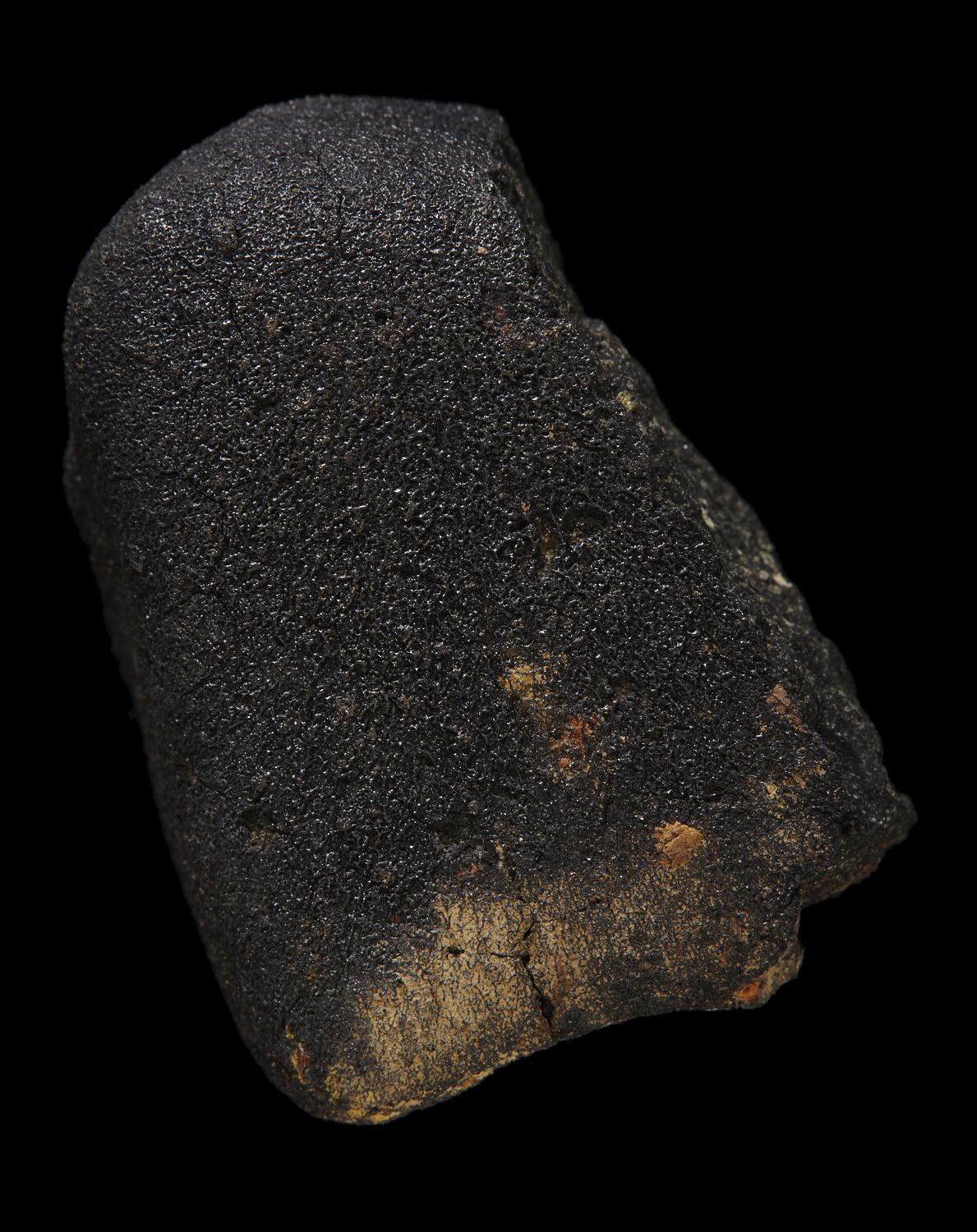
On the morning of 28 September 1969, people near Murchison in Victoria saw a bright fireball cross the sky and break apart. What followed looked, at first, like a local event: dark stones fell across roads, fields, and farm buildings around a small town in northern Victoria. Some were collected quickly, before rain and soil could do much to alter them.
The event became much larger than its geography. Murchison is now one of the most studied meteorites on Earth, partly because it was an observed fall and partly because its chemistry is unusually rich. It is a carbonaceous chondrite, a primitive type of meteorite that preserves material from the early Solar System. In the case of Murchison, it also preserves something older still.
The Meteoritical Bulletin entry records the fall near Murchison, Victoria, on 28 September 1969, between 10:45 and 11:00 local time. It describes a fireball that split into three pieces, a smoke cloud, a tremor heard about 30 seconds later, and stones recovered from the surrounding area. Museums Victoria lists one Murchison specimen as a CM2 carbonaceous chondrite and gives the date of fall as 28 September 1969.
Half a century later, researchers studying tiny grains from that meteorite reported an age that pushed the story beyond the birth of Earth. In a 2020 Proceedings of the National Academy of Sciences paper, a team led by Philipp Heck measured presolar silicon carbide grains from Murchison. The Field Museum summary of the work says some of the grains formed 5 to 7 billion years ago, making them the oldest solid material yet found on Earth.
The stone was young compared with its dust
The most important distinction is easy to miss. The Murchison meteorite itself is not 7 billion years old in the same way a rock from Earth or Mars might be dated. Like other primitive meteorites, it is mostly a relic of the early Solar System, which formed about 4.6 billion years ago. The older material is embedded inside it as microscopic grains.
Those grains are called presolar grains because they formed before the Sun existed. They were made around earlier generations of stars, released into interstellar space, and later mixed into the cloud of gas and dust that collapsed to form the Sun, planets, asteroids, and meteorite parent bodies.
That makes Murchison a container of two histories at once. Most of the rock belongs to the earliest chapter of the Solar System. Some of the grains inside it belong to an earlier chapter of the galaxy. The stone fell into an Australian farming district in 1969, but parts of it had already crossed a chain of star births and star deaths before Earth existed.
Why Murchison mattered so quickly
Meteorites that are seen falling are especially valuable because scientists know when they reached Earth and can often recover them before long exposure to weather and soil contamination. Murchison was also large by meteorite standards. More than 100 kilograms of material has been reported from the fall in later catalogues and museum records, giving laboratories around the world enough sample material to study different questions without exhausting the object.
Its dark, carbon-rich nature made it especially useful for chemistry. Murchison has been studied for amino acids, organic molecules, water-altered minerals, and other compounds that help researchers reconstruct conditions in primitive Solar System bodies. It is not evidence of life from space. It is evidence that complex chemistry can be preserved in ancient extraterrestrial material.
That is why the meteorite has become a reference object in astrobiology and cosmochemistry. It lets researchers ask what molecules were available in the young Solar System, what chemical pathways were already operating before planets finished forming, and how much material from older stars survived the violent process of building a new planetary system.
How scientists date dust older than the Sun
Dating a tiny presolar grain is not like reading tree rings. The grains studied in the 2020 work were silicon carbide particles, minerals that can survive harsh chemical treatment. Scientists first had to isolate them from crushed meteorite material, a process the Field Museum account describes as reducing the meteorite to powder and dissolving away other components until the resistant presolar grains remained.
The dating method used the effects of high-energy particles moving through interstellar space. Those particles strike grains and gradually produce new atoms inside them. The longer a grain spends exposed to those particles, the more of those products can build up. By measuring certain isotopes, researchers can estimate how long the grains travelled through space before being incorporated into the material that became the Solar System.
The Field Museum summary reports that many grains in the study were between 4.6 and 4.9 billion years old, already older than Earth. Some were older than 5.5 billion years, with the oldest reaching roughly 7 billion years. The PNAS paper frames the work as a way to estimate the lifetimes of interstellar dust and to use laboratory grains as evidence for star formation history.
What the grains say about stars
Presolar grains are not just old. They are chemically distinctive. Their isotope patterns do not match the average material of the Solar System, which is why scientists can identify them as outsiders from earlier star systems. Some carry signatures consistent with dust formed around aging stars, where elements produced inside the star can condense into tiny mineral particles and flow outward into space.
When those particles entered the cloud that formed the Solar System, most were destroyed, mixed, or diluted beyond recognition. A few survived inside primitive meteorites. Murchison is valuable because it contains enough of them for detailed laboratory work. A grain far smaller than a speck of dust can become a physical sample of a star that died before the Sun was born.
The 2020 study also suggested that many of the grains may reflect an episode of enhanced star formation before the Solar System formed. That does not mean the meteorite contains a neat record of one single ancient event. It means that the ages of the grains, taken together, appear to preserve information about how many stars were forming in the Milky Way several billion years before the Sun appeared.
The oldest material in human hands
Earth has very old rocks, and lunar samples collected by Apollo astronauts are older still than most terrestrial crust. But presolar grains are in a different category. They are not merely early Solar System material. They predate the Solar System itself.
That is why the phrase “oldest solid material” is so striking and also why it needs precision. The claim belongs to the grains, not to every gram of the meteorite. A person holding a Murchison specimen is holding a rock assembled in the early Solar System. Hidden within it, in quantities too small to see without specialized tools, are mineral grains that formed around earlier stars up to about 7 billion years ago.
The contrast is part of the power of the story. The fall was local, audible, and physical. A fireball broke apart over a farming town, a tremor followed, and black stones landed in paddocks and buildings. Decades later, those stones gave scientists evidence of matter made before the Sun, before Earth, before any familiar planetary landscape existed.
Murchison shows that the Solar System did not begin from a clean slate. It began from recycled material, some newly condensed, some chemically altered, and some inherited from stars that had already lived and died. A small town in Victoria became connected to that older history because its residents and scientists recovered the stones quickly enough for laboratories to read what they carried.
The meteorite is famous for its organic chemistry, but its presolar grains may be its most direct link to deep time. They are not metaphors for ancient starlight. They are physical minerals made before the Sun existed, later trapped in a meteorite, then scattered across the ground on a spring morning in 1969. In that sense, Murchison did more than fall to Earth. It delivered pieces of an older galaxy into human hands.
