

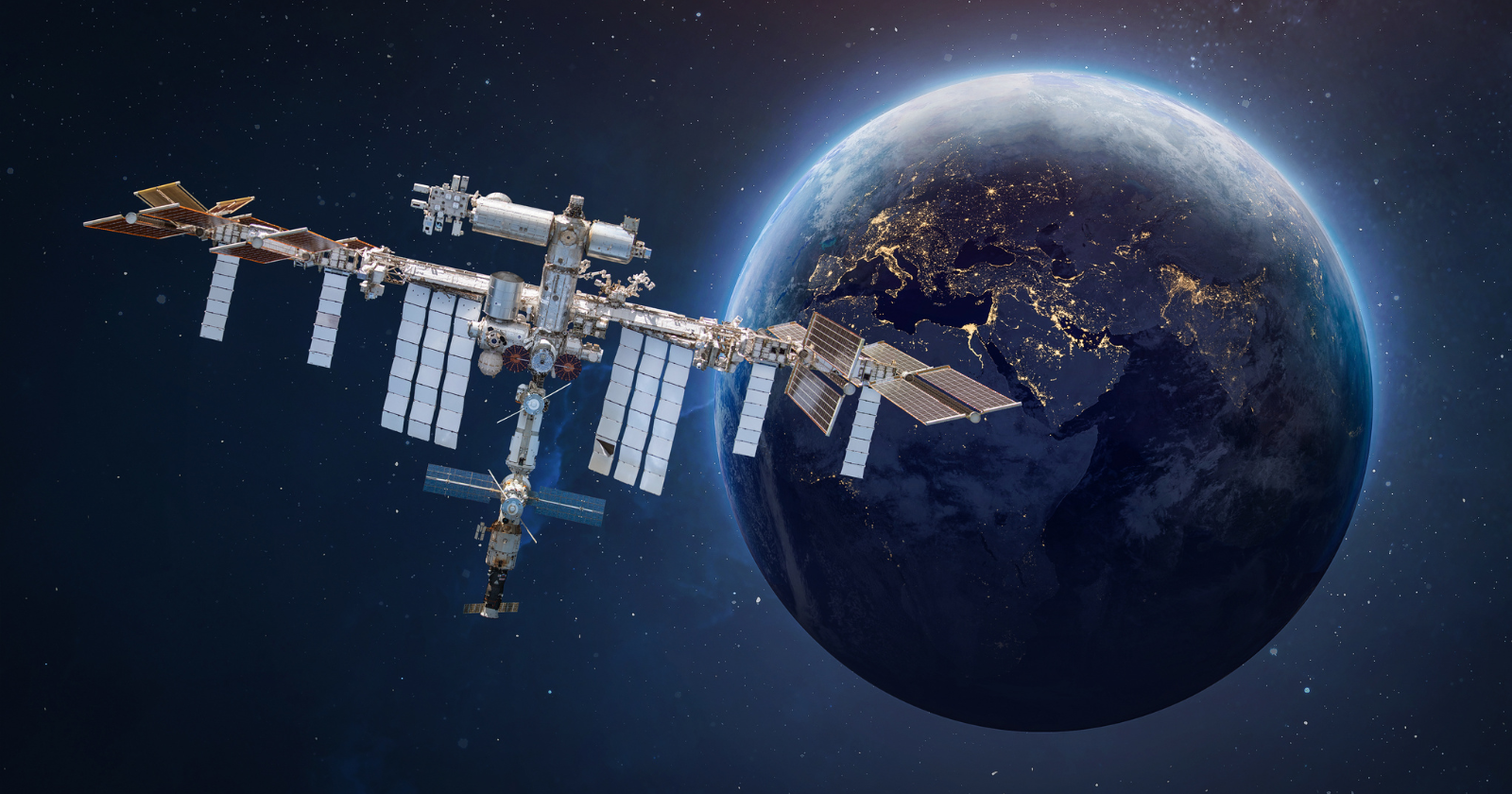
The International Space Station is gliding 250 miles overhead right now at 17,500 miles per hour, a pressurized laboratory the length of an American football field, weighing roughly 420 tons, and assembled in orbit one module at a time across 42 separate launches from 1998 to 2011. NASA puts the lifetime cost at around $150 billion when you tally up the contributions of all five partner space agencies, a figure that makes it the single most expensive object human beings have ever built — more than the Apollo program in inflation-adjusted dollars, more than the Large Hadron Collider, more than any aircraft carrier ever floated.
It is also, by a wide margin, the largest pressurized volume ever placed in orbit. The habitable interior runs to about 13,696 cubic feet, roughly the size of a six-bedroom house, and there is always someone home.
An object the size of a football field, moving faster than a rifle bullet
The station’s main truss stretches 357.5 feet from end to end, just slightly longer than an NFL field including the end zones. Eight enormous solar arrays unfold from that truss, each one 112 feet long, together covering more than an acre of photovoltaic surface and generating up to 120 kilowatts of electricity. That is enough to power about 40 average American homes, except the homes in question are flying through hard vacuum at five miles per second.
At that speed the ISS circles Earth every 92 minutes. The crew sees 16 sunrises and 16 sunsets every day. The orbit is tilted at 51.6 degrees to the equator, which lets it pass over roughly 90 percent of the populated land surface of the planet, and which is also the lowest inclination a Soyuz rocket launched from Baikonur in Kazakhstan can reach without dropping a spent stage on China or Mongolia. Geography drove the geometry.
How the $150 billion price tag was actually spent
The number is not a single contract. It is an accumulation. NASA’s own accounting from a 2014 inspector general audit pegged the U.S. share at roughly $75 billion through that year, with annual operating costs near $3 billion. Russia spent an estimated $12 billion through Roscosmos. The European Space Agency contributed about $5 billion, largely through the Columbus laboratory module. Japan’s JAXA added roughly $5 billion, mostly for the Kibo module, the largest single pressurized room on the station. The Canadian Space Agency built the robotic arm Canadarm2 and its mobile base for around $2 billion. The remainder is shuttle flights, Soyuz seats, cargo missions, and three decades of ground operations across mission control centers in Houston, Moscow, Munich, Tsukuba, and Montreal.
Thirty-six Space Shuttle missions did the heavy lifting between 1998 and 2011, each one costing roughly $1.5 billion to fly. That alone accounts for more than a third of the total bill. The Canadarm2 robotic arm that pulled most of those modules out of the shuttle’s payload bay and bolted them together is still working — though as a wrist joint installed in 2001 is finally being replaced this month after a quarter-century of use.
Assembled like a model kit, in vacuum, with gloves on
The first piece, the Russian-built Zarya control module, launched on a Proton rocket from Baikonur on November 20, 1998. Two weeks later the shuttle Endeavour carried up the American Unity node and bolted it on. For more than two years the partial station flew empty, visited only briefly by shuttle crews, until the Expedition 1 crew of Bill Shepherd, Yuri Gidzenko, and Sergei Krikalev moved in on November 2, 2000. There has been at least one human aboard every single day since. As of this summer that streak is approaching 26 continuous years — the longest unbroken human presence in space in history.
Building it required more than 200 spacewalks totaling well over 1,300 hours of astronaut time outside the airlock. Astronauts torqued bolts wearing pressurized gloves that have the dexterity of welding mitts. They installed wiring harnesses and ammonia coolant lines while moving at orbital velocity. Several spacewalkers later described the work as the hardest physical labor they had ever done.
What it is actually for
The station is, formally, a microgravity research laboratory. More than 3,000 experiments from researchers in 108 countries have run aboard it. Crews have grown protein crystals that cannot form properly under Earth’s gravity, including ones used to design a recent monoclonal antibody drug for Duchenne muscular dystrophy. They have studied how flames burn in weightlessness (they form spheres, not teardrops), how plant roots find “down” without gravity to tell them, and how the human body decays in orbit — bone density loss of about 1 to 1.5 percent per month in the hips and lower spine, muscle atrophy, fluid shifts that reshape the eyeball and degrade vision in a syndrome NASA flight surgeons now call SANS.
Cargo flows up roughly every two months. SpaceX Dragon, Northrop Grumman Cygnus, Russian Progress, and Japanese HTV-X freighters take turns delivering food, water, spare parts, and experiments. A recent SpaceX Dragon resupply mission carried 6,500 pounds of supplies, including nearly a ton of research gear alone. The crew unpacks it like a Christmas morning that never ends, then sends the trash back down to burn up in the atmosphere.
The view from the Cupola
Bolted to the Earth-facing side of the Tranquility node is a small dome of seven windows called the Cupola, installed in February 2010. It is the most photographed room on the station, and almost every astronaut who has lived aboard describes it as where they spent their off-hours. The central window is 31.5 inches across, the largest ever flown in space. Through it the planet rolls past at five miles a second, close enough to pick out individual storm cells, the wakes of container ships, the orange glow of cities at night, lightning flickering between cloud tops without any thunder you can hear.
The crew of Artemis II became the first humans to watch a total solar eclipse from deep space in April 2026, and their accounts echo what ISS crews have been reporting from the Cupola for fifteen years: that watching the Earth from outside it does something to a person that no briefing prepares them for. The psychologist Dacher Keltner, who runs the Greater Good Science Center at UC Berkeley, has spent two decades studying the response and concluded that awe is fundamentally a response to mystery — to encountering something whose scale your mind cannot quite hold. The Cupola is an awe machine. Many astronauts describe a lingering shift in perspective that follows them home for months.
The cost of staying up there
Running the station costs NASA about $3 billion a year, or roughly a third of the agency’s human spaceflight budget. Some of that money pays for the cargo flights. Some pays for the ground teams in Houston that monitor every valve, gyroscope, and ammonia loop around the clock. Some pays for replacement parts — solar array batteries, water recyclers, computers, toilets — that wear out faster than anyone expected because nothing in microgravity ages the way the engineering models predicted.
The orbit itself decays. At 250 miles altitude there is still enough wisp of atmosphere to drag the station downward by about 300 feet per day. Visiting cargo ships fire their thrusters to boost it back up every few weeks. Without those reboosts the station would re-enter the atmosphere within a year or two.
The ending already on the calendar
NASA has committed to operating the ISS through 2030. After that, the agency has contracted SpaceX to build a U.S. Deorbit Vehicle — a modified Dragon trunk with extra propellant — that will dock to the station and push it down into the Pacific Ocean, into the stretch of empty water southeast of New Zealand known as Point Nemo, where decommissioned spacecraft go to drown. The contract is worth up to $843 million. The descent will take about a year of careful orbit lowering, and the actual breakup will last roughly an hour. Most of the 420 tons will burn up. The denser pieces — truss segments, docking adapters, the Cupola — will hit the water in pieces.
The replacement, if it arrives on schedule, will be a constellation of smaller commercial stations: Axiom, Orbital Reef, Starlab, Vast’s Haven-1. None will be as large. None will have taken 13 nations and three decades to build. The ISS, in retrospect, may turn out to be a singular object — the last thing humanity assembles in orbit by sheer collective will rather than by competing private contract.
For now it is still up there, the brightest moving object in the night sky after the Moon, easy to see with the naked eye if you know when to look. It crosses overhead in about four minutes, a steady white point traveling west to east, carrying seven people, a six-bedroom house worth of pressurized air, an acre of solar panels, and roughly $150 billion of welded aluminum and hope, doing 17,500 miles per hour, sixteen times a day.