

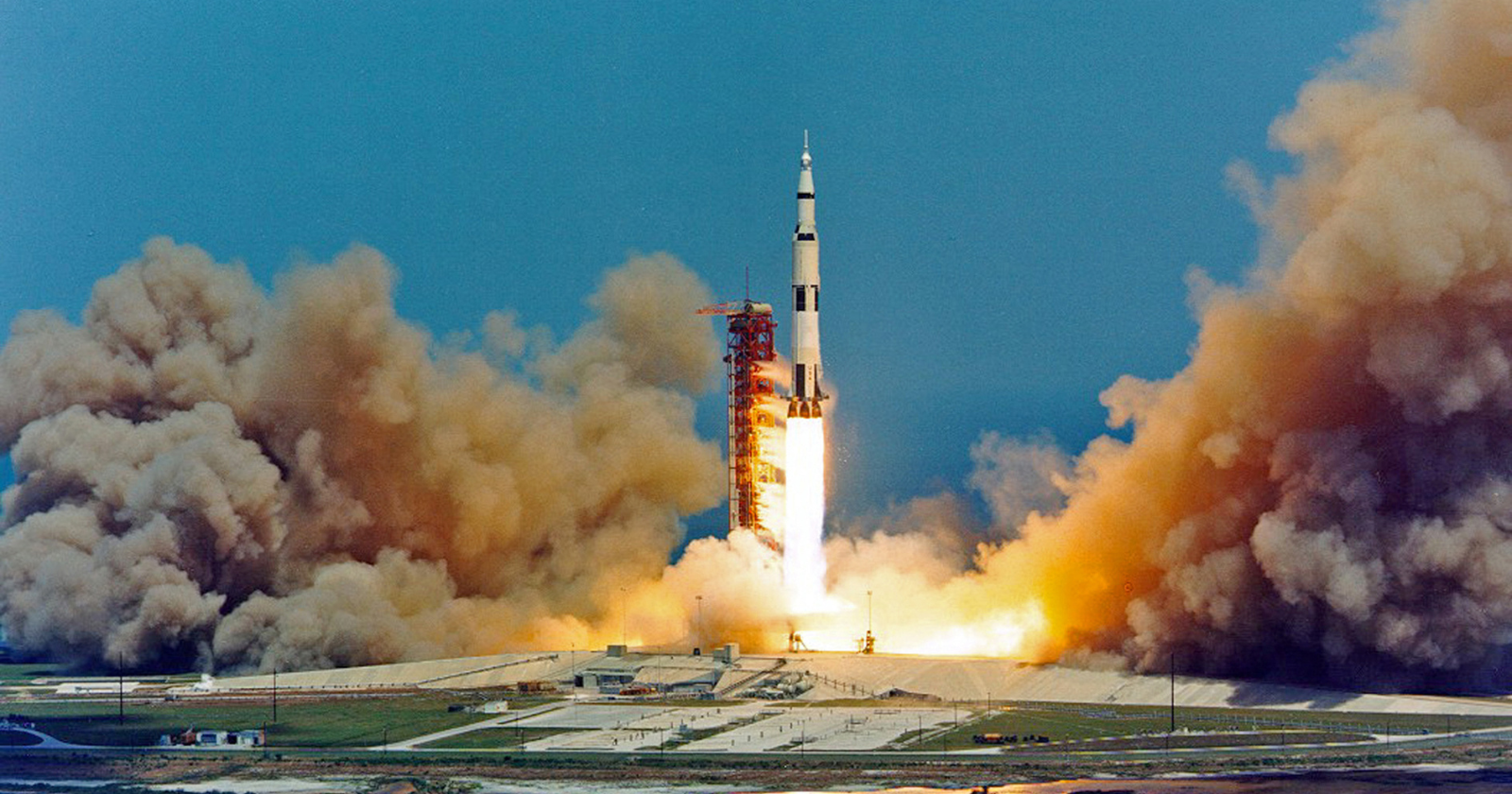
Apollo 13 had been launched four and a half days into a planned ten-day mission that would, if everything had proceeded as designed, have landed Lovell and Haise on the Fra Mauro highlands of the Moon on 15 April, conducted approximately 33 hours of scientific exploration of the lunar surface, and returned all three astronauts safely to Earth on 21 April. The mission was supposed to be the third human lunar landing, following Apollo 11 in July 1969 and Apollo 12 in November of the same year. Public interest in Apollo missions had, by April 1970, declined substantially from the saturation coverage of the original Moon landing. The live television broadcast Lovell, Swigert, and Haise had transmitted from approximately 320,000 kilometres out, shortly before the explosion, was not carried by any of the three major American networks. The mission was, by NASA’s own internal accounting, going routinely. Nothing about it was supposed to be interesting.
According to NASA’s official mission details for Apollo 13 and the cascade of failures that followed the explosion, the immediate cause of the disaster was a routine procedure called a “cryo stir” — switching on fans inside the spacecraft’s two liquid-oxygen tanks to circulate the contents and provide accurate pressure readings. The fans inside oxygen tank No. 2 had, unknown to anyone, been operating with electrical wiring whose Teflon insulation had been damaged five years earlier by a sequence of small mistakes that nobody had recognised as catastrophic at the time: a change in the design voltage from 28 to 65 volts DC that was not propagated through to the tank’s thermostatic switches; an accidental two-inch drop during a transfer from Apollo 10 in 1968; an 8-hour heater run during a 1970 pre-launch test that had overheated the tank to an estimated 1,000°F and welded the thermostats shut. By the time tank No. 2 reached orbit aboard Apollo 13, it was, in retrospect, a bomb waiting for an electrical trigger. The stir command Swigert flipped at 21:08 on 13 April was the trigger. The tank exploded approximately ninety seconds later, blew an entire panel off the service module, ruptured the line feeding the other oxygen tank, and left the spacecraft venting both oxygen and electrical power into deep space.
The lifeboat
The decision that ultimately saved the crew was made within approximately one hour of the explosion. As reported by the Planetary Society’s reconstruction of the Apollo 13 crisis and the engineering response that followed, Flight Director Gene Kranz, working from mission control in Houston, ordered the crew to power down the command module Odyssey (which was rapidly losing electrical power as its fuel cells starved for oxygen) and move into the lunar module Aquarius, which was still attached to the front of the spacecraft and which had its own independent supply of oxygen, electricity, and water intended for the planned Moon landing. The lunar module had been designed to support two astronauts for approximately 45 hours on the lunar surface. It would now have to support three astronauts for approximately 87 hours through deep space, around the Moon, and back to Earth. The consumables — oxygen, water, electricity, lithium hydroxide for removing carbon dioxide from the cabin air — were stretched, conserved, rationed, and supplemented through a sequence of improvisations that NASA’s engineering culture would subsequently treat as one of the foundational achievements of the agency’s history.
The most famous of those improvisations was the carbon dioxide scrubber adapter, which the NASA engineering team built in approximately one hour using only materials available aboard the spacecraft. The lunar module’s lithium hydroxide canisters, designed to absorb the CO2 that astronauts exhale, were nearly exhausted after several days supporting three crew members rather than two. The command module had additional canisters, but they were square; the lunar module’s filter slots were round, and the canisters were not interchangeable. An engineer named Ed Smylie led a team that designed, in real time, a makeshift adapter using a plastic bag torn from a procedure manual, the cardboard cover of a flight plan, a hose from one of the spacesuits, and duct tape. The instructions for building it were read up to Swigert and Haise by capsule communicator Joseph Kerwin over the course of approximately one hour. The astronauts followed the instructions exactly. The contraption — referred to by mission control as “the mailbox” — was attached to the lunar module’s environmental system. Carbon dioxide levels began dropping immediately.
What the slide rules actually did
The slide rule angle, which has become one of the more popular details in subsequent retellings of the Apollo 13 story, is real but more specific than the general framing suggests. Per Britannica’s account of the Apollo 13 mission and the engineering calculations that determined the return trajectory, the substantive computational work of getting the spacecraft home was performed by a combination of NASA’s IBM 360 mainframe computers at the Manned Spacecraft Center in Houston and the slide rules carried as backup by individual engineers and astronauts. The mainframes did the primary trajectory calculations. The slide rules were used for cross-checking, for quick estimates, and for the kind of manual verification that engineers of the era used as a routine check against computational error. Multiple NASA engineers, working in parallel on different aspects of the return trajectory — the free-return burn that would slingshot the spacecraft around the Moon, the PC+2 burn two hours after the lunar flyby that would shorten the return journey by nine hours, the final reentry attitude calculations — relied substantially on slide rules as part of a workflow that combined computer calculation with manual verification. The “saved by slide rules” framing is partly true, partly compressed, and partly a romantic reduction of a process that involved many people, many tools, and many parallel calculations carried out under extreme time pressure across approximately four days.
The crew survived. As detailed in NASA’s history of the Apollo 13 Review Board and its subsequent findings on the cause of the accident, the spacecraft completed its slingshot around the Moon on 14 April, made the PC+2 burn that shortened the return trip, executed the final correction burns using the lunar module’s descent engine and reaction control thrusters, jettisoned the service module (revealing the extent of the damage for the first time when the crew photographed it), jettisoned the lunar module that had served as their lifeboat, and re-entered the Earth’s atmosphere aboard the command module Odyssey at 12:07 Central Standard Time on 17 April 1970. The splashdown occurred less than a mile from the recovery ship USS Iwo Jima, in the South Pacific south of American Samoa. Lovell, Swigert, and Haise were recovered alive and physically intact, approximately 87 hours after the explosion that had nearly killed them. The subsequent investigation identified the design flaws in the oxygen tank, redesigned the system for Apollo 14 (which would launch successfully nine months later), and produced one of the most exhaustively documented engineering case studies in the history of human spaceflight. The Apollo 13 mission patch carries the motto Ex Luna, Scientia — “From the Moon, knowledge.” The Moon landing the patch had been designed for never happened. The knowledge produced by the failed mission about how human beings, working under pressure with finite resources at substantial distances from any possibility of physical rescue, can keep each other alive — has been part of the foundational engineering culture of NASA, of every subsequent crewed space programme, and of essentially every high-stakes engineering enterprise that has had to recover from catastrophic failure ever since.