

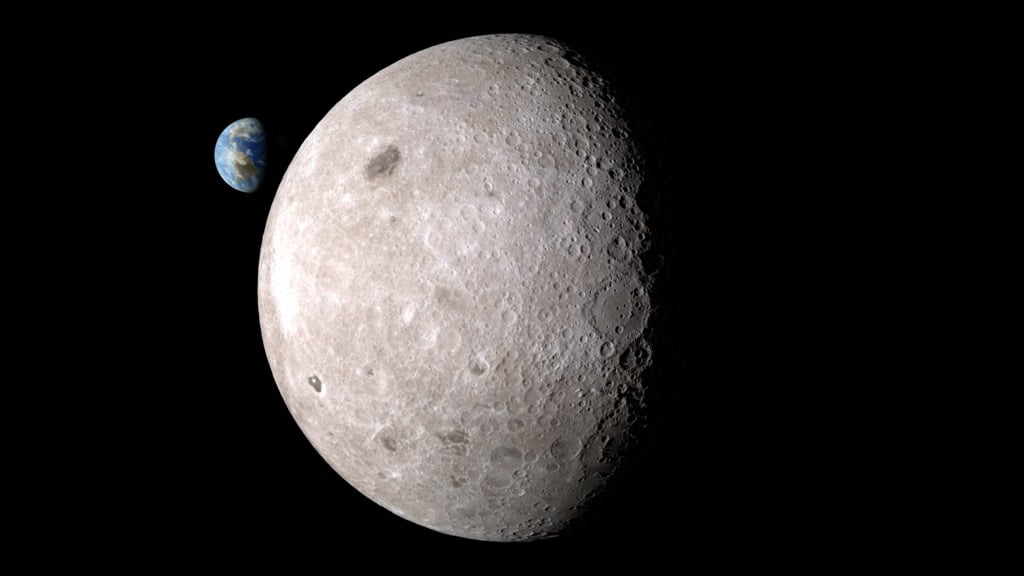
The phrase “dark side of the Moon” is one of those expressions that sounds right until the geometry is put back in. There is a far side of the Moon, but there is no permanent night-side hidden from the Sun.
The side we do not see from Earth gets sunlight just as the familiar near side does. It has mornings, noons, evenings, and long lunar nights. The reason it stayed hidden from human eyes for most of history is not darkness. It is rotation.
NASA’s Moon Facts page states the matter directly: the Moon rotates at the same rate that it revolves around Earth, so the same hemisphere faces us all the time. NASA calls the common phrase “dark side” misleading, because different parts of the Moon are in sunlight or darkness at different times.
The far side is a viewing problem
From Earth, the Moon appears to keep the same face turned toward us. The broad dark lava plains that make up the familiar lunar pattern remain on the near side. The opposite hemisphere, the far side, is mostly out of our direct view.
That does not mean the Moon is not spinning. It means the spin and orbit are matched. As the Moon travels around Earth, it also turns once on its axis in about the same amount of time. The result is synchronous rotation, often called tidal locking.
A simple thought experiment helps. Hold a ball in front of you and walk around a chair while keeping the same mark on the ball facing the chair at all times. To someone sitting in the chair, the same mark is always visible. But from above, the ball has turned during the walk. If it had not turned, every side of the ball would eventually face the chair.
The Moon works in that paired way. Its rotation is not absent. It is coordinated with its orbital motion around Earth. That coordination is why the near side remains near, and the far side remains far.
What sunlight is doing
The Sun is not fixed over Earth’s side of the Moon. As the Moon orbits Earth, sunlight sweeps across the lunar surface. The changing angle of sunlight is what produces lunar phases as seen from Earth.
At full moon, the side facing Earth is broadly illuminated by the Sun. At new moon, the side facing Earth is mostly in its lunar night, while the far side is receiving full sunlight. That is the cleanest correction to the old phrase: when the Moon is new to us, the hidden side is the bright one.
The lunar day is long by Earth standards. A full cycle of sunlight and darkness at a given place on the Moon takes about 29.5 Earth days. That means roughly two Earth weeks of daylight followed by roughly two Earth weeks of night at many locations, depending on local terrain and latitude.
Near the poles, the geometry becomes more complicated. Some crater floors remain in permanent shadow because sunlight never reaches down into them, while nearby ridges can receive long periods of illumination. Those permanently shadowed regions are real, and they matter for lunar ice studies. But they are local polar shadows, not an entire dark hemisphere.
Why the same face stays turned to Earth
Tidal locking is a gravitational outcome. Early in the Moon’s history, it almost certainly rotated at a different rate. Earth’s gravity raised tidal distortions in the young Moon. Over long timescales, friction inside the Moon dissipated rotational energy, slowing its spin until it settled into the present one-to-one relationship between rotation and orbit.
The locked state is not perfectly rigid in the way a diagram can make it seem. The Moon’s orbit is slightly elliptical, and its axis and orbital plane are not arranged in a perfectly simple line. Because of this, observers on Earth can see a little around the edges over time, an effect called libration. Across repeated observations, a bit more than half of the lunar surface becomes visible from Earth.
Still, most of the far side could not be seen directly until spacecraft arrived. The first images came from the Soviet Luna 3 probe in October 1959. Before that, the far side was not dark in the physical sense. It was dark in the older meaning of the word: unknown.
The far side is different, not darker
When spacecraft finally saw the hidden hemisphere, it did not look like a shadow version of the near side. It looked geologically different. The far side has fewer of the broad dark maria that dominate the near side and many more densely packed craters.
NASA’s Scientific Visualization Studio made this contrast visible in its 2015 animation “Moon Phase and Libration, from the Other Side”. The page notes that the far side goes through a complete cycle of phases, just like the near side, while showing a rougher, crater-crowded terrain. The visualization uses detailed maps built from Lunar Reconnaissance Orbiter data.
That is a useful distinction. The far side is not a place where sunlight fails. It is a place where Earth is absent from the sky, direct radio contact with Earth can be blocked, and the landscape differs from the lunar face humans have watched for millennia.
This is why the far side is scientifically valuable. Its radio quiet, especially shielded from Earth’s transmissions, has made it attractive for future low-frequency radio astronomy. Its geology also preserves a different record of lunar history, including the enormous South Pole-Aitken basin.
A better phrase changes the picture
The old phrase survives because it is memorable. It also captures something real about human perspective: for most of our history, one side of the Moon was inaccessible to sight. But as a physical description, it misleads.
“Far side” is better because it says what is actually happening. The hemisphere is turned away from Earth. It is not permanently turned away from the Sun.
That correction is small, but it changes the mental image. The Moon is not half familiar and half condemned to darkness. It is a rotating world locked in a gravitational relationship with Earth, carrying its long days and nights around us. We see one face because of orbital timing. The other face has been there all along, lit and unlit in turn, waiting for spacecraft to show us what our viewpoint kept hidden.