
The year an American president signs a major infrastructure bill, a Chinese provincial governor breaks ground on three high-speed rail lines in the same week. The asymmetry is structural, the pace is sustained, and the cumulative result, after roughly 17 years, is a national rail network of a size and density that has no precedent in the history of transportation. The first revenue-earning Chinese high-speed rail line opened on 1 August 2008, exactly one week before the Beijing Summer Olympics. It was 117 kilometres long. It ran from Beijing to the port city of Tianjin. It used trains imported from Japan and Germany under licensing agreements that were already being quietly modified by Chinese engineers who would, within five years, be producing entirely indigenous variants without further input from their foreign partners. The line had been designed and built in approximately three years, primarily as an Olympic prestige project, and was treated by international observers at the time as an interesting but localised infrastructure achievement comparable to the high-speed rail networks of France, Germany, or Japan, which between them had been building and operating such systems for several decades. The line was, in retrospect, the start of something on a scale that none of those countries had ever attempted.
According to a comprehensive reference summary of the development of China’s high-speed rail network, the trajectory of construction over the subsequent 17 years has been the most aggressive infrastructure expansion programme of the early 21st century, possibly the most aggressive transport infrastructure expansion of any kind in modern history. The network grew from approximately 117 kilometres in 2008 to approximately 9,000 kilometres by the end of 2012. It reached 22,000 kilometres by the end of 2016, 35,000 kilometres by the end of 2019, and 37,900 kilometres by the end of 2020. The pace then accelerated rather than slowed: an additional 12,500 kilometres was added between the start of 2021 and the close of 2025, with the symbolic 50,000-kilometre threshold crossed in late December 2025 with the opening of the Xi’an–Yan’an line connecting the Shaanxi provincial capital to the northern revolutionary heritage city of Yan’an. By the standard measurement methodology, the global combined high-speed rail mileage outside China currently totals approximately 21,000 to 25,000 kilometres. China alone now operates more than twice that.
What the network actually connects
The geographical coverage of the network is the easier number to underestimate from the outside. As reported by Global Times’s coverage of the 50,000-kilometre milestone and the network’s role in regional development, the Chinese HSR system now extends to 33 of China’s 34 provincial-level administrative divisions, with the only exception being the Macau Special Administrative Region. Hong Kong was connected in 2018. The autonomous regions of Tibet, Xinjiang, and Inner Mongolia are all integrated into the national grid. The southwestern province of Yunnan is connected via the Shanghai–Kunming high-speed line. The far-northern Heilongjiang province has been linked via the Harbin–Dalian line since 2012. The result of this geographic distribution is that any two major Chinese cities within 500 kilometres of each other are now generally within a one-to-two-hour HSR journey of each other, any two within 1,000 kilometres are within approximately four hours, and same-day round trips between cities approximately 2,000 kilometres apart are now routinely possible — equivalent to a one-day return trip between, in American terms, Chicago and Los Angeles.
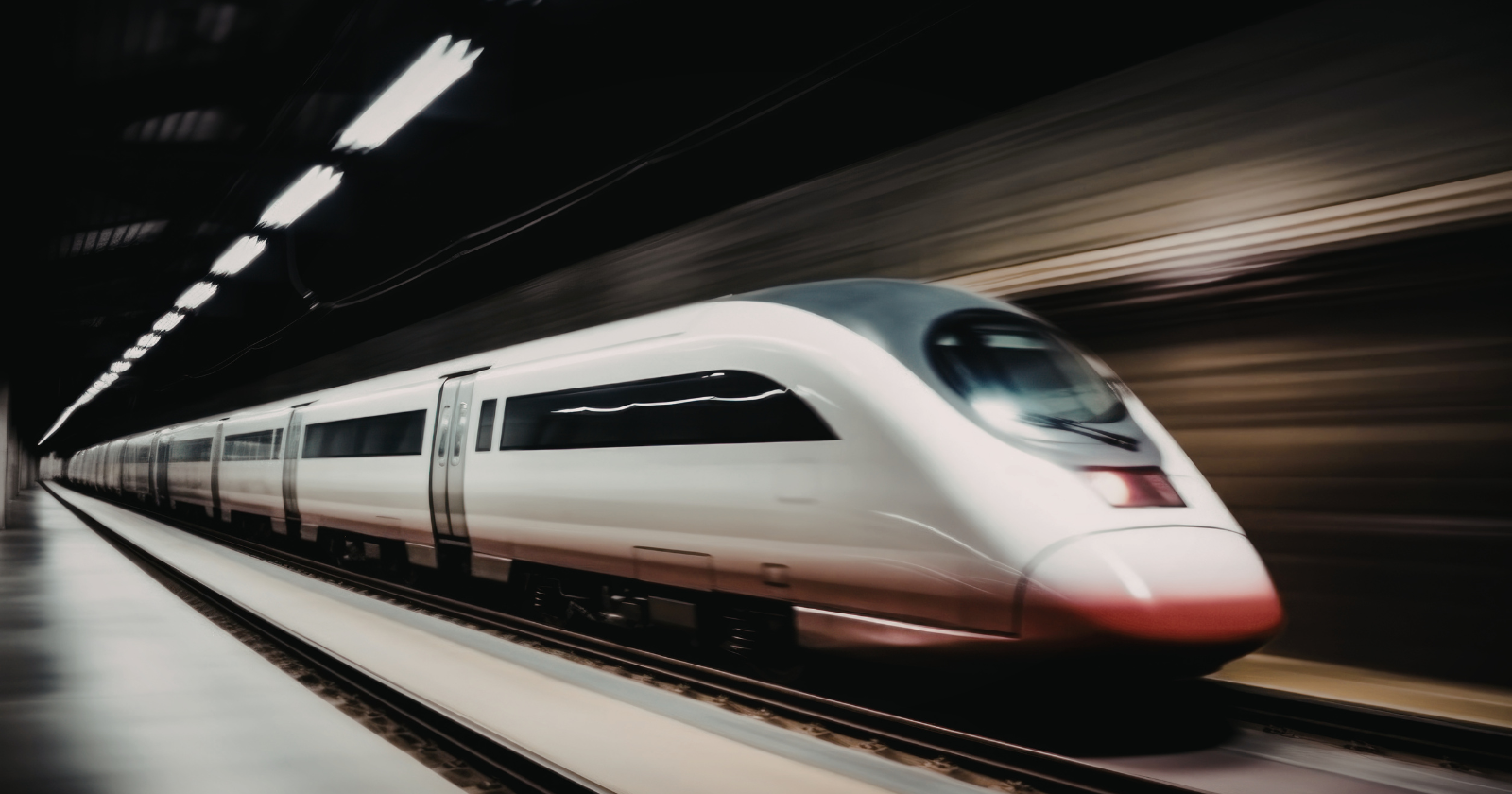
The trains themselves have evolved across several generations. The current backbone of the network is the Fuxing (“Rejuvenation”) series, introduced in 2017, which operates at routine commercial speeds of 350 kilometres per hour across approximately 6,000 kilometres of the highest-grade passenger-dedicated lines. The successor generation, the CR450, has been in testing since 2023 with a designed commercial speed of 400 kilometres per hour and a tested maximum single-train speed of approximately 453 kilometres per hour. In June 2023, two CR450 prototypes passing each other in opposite directions on the Meizhou Bay cross-sea bridge in Fujian set a world record for relative closing speed at approximately 891 kilometres per hour — the fastest closing speed ever recorded between two trains passing each other on a steel rail. The most recent single-train 450 km/h test was conducted on the Shanghai–Chongqing–Chengdu high-speed line on 21 October 2025, with commercial entry to service expected by 2026. A separate maglev development programme, operating on different physics (electromagnetic suspension rather than steel-on-steel contact), produced a 600 kilometres-per-hour maglev train that was formally unveiled at the UIC World Congress on High-Speed Rail in Beijing in July 2025, with the stated goal of bridging the operational gap between conventional high-speed rail and commercial air travel.
What the system cost
The financial dimension is the part of the story that receives less coverage but is increasingly relevant to Chinese transport policy. Per Newsweek’s analysis of the scale of China’s high-speed rail expansion and its underlying drivers, the total construction cost of the system to date is estimated at approximately $300 billion. The 2009 single-year investment figure was approximately $50 billion. The 2025 figure was approximately 901.5 billion yuan, or about $129 billion. The unit construction cost per kilometre of 350 km/h passenger-dedicated line, in the Chinese case, has ranged between 94 and 183 million yuan, depending on terrain — substantially lower than the equivalent unit costs for high-speed rail construction in Europe (approximately $25 to $39 million per kilometre) or the United States (approximately $52 million per kilometre for the partially-completed California system). The cost advantage is attributed to economies of scale across the unusually large construction programme, standardised line and station designs, lower labour costs, vertically integrated state-owned construction enterprises, and the absence of the property-rights and environmental-review processes that typically extend construction timelines in other jurisdictions.
The accumulated debt of China State Railway Group, the state-owned operator that owns and operates the network, stood at approximately $839 billion at the end of 2023, by the corporation’s own published figures. The debt is real and is a non-trivial component of the broader fiscal picture facing Chinese local and central governments. Whether the network will continue to be expanded at the pace of the past 17 years, or whether the 15th Five-Year Plan (covering 2026 to 2030) will mark a transition to a slower, more financially conservative growth path, is one of the open policy questions currently being negotiated within the Chinese government. The current official target is to reach 60,000 kilometres of high-speed rail by 2030 — an additional 10,000 kilometres of new construction over the next five years, which would, in any other country, be a complete national high-speed rail programme in its own right. In China, it represents a deceleration. As described by Global Times’s coverage of the total network’s end-of-2025 status and the 15th Five-Year Plan, the country’s broader railway network (including conventional rail) reached 165,000 kilometres by the end of 2025, with the high-speed rail portion of approximately 50,400 kilometres representing roughly 30 percent of the total. The system is, by every available measure, the largest single transport infrastructure programme in modern history. The 17 years of construction that produced it have, in proportional terms, no precedent.
