

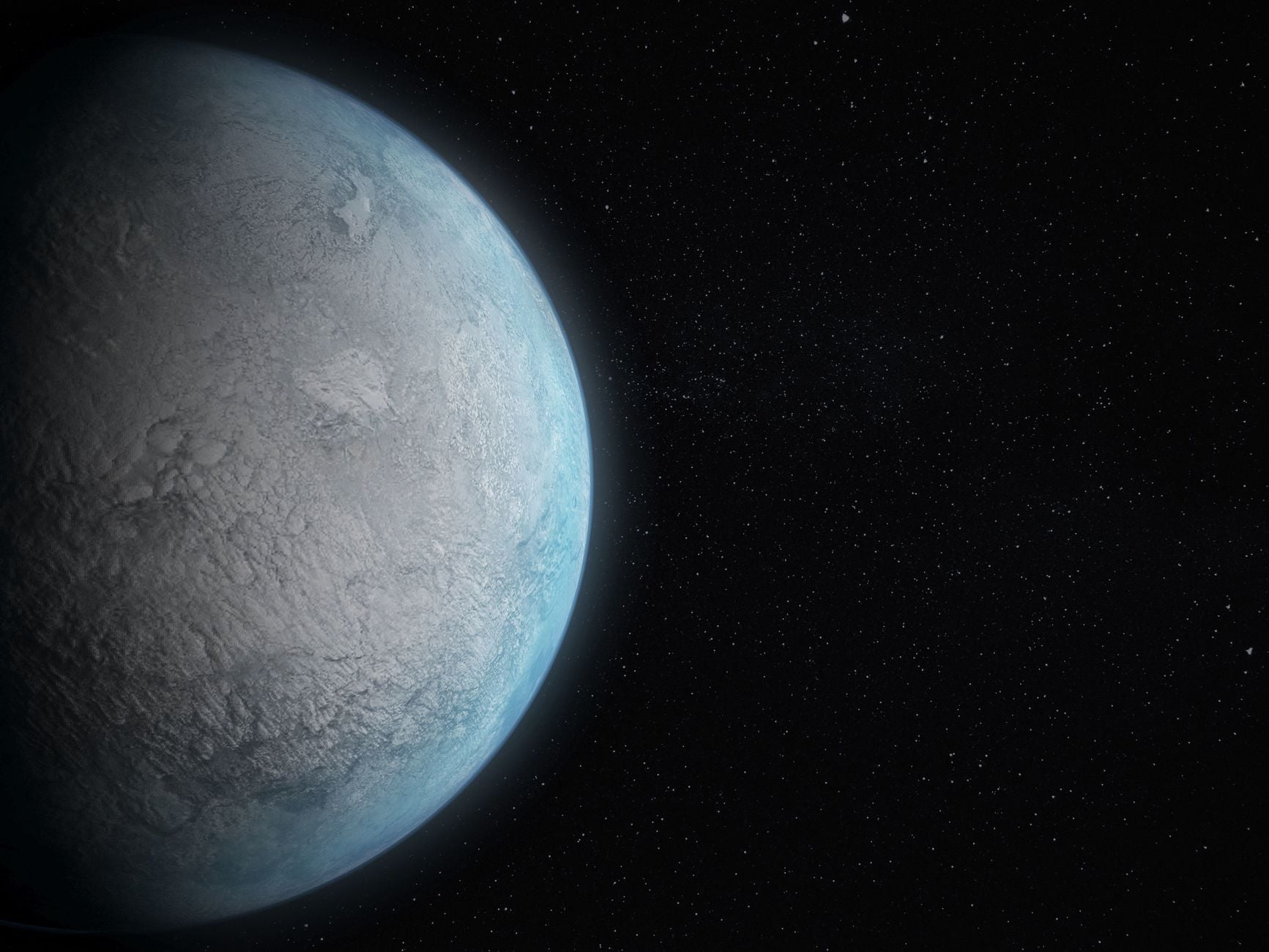
Europa, the ice-covered moon of Jupiter, has a problem that turns out to be a clue. Almost nothing has left a lasting mark on it. In a Solar System that has been pelting its planets and moons with rock and ice for four and a half billion years, an old surface should be crowded with impact craters. Europa’s is nearly bare.
That absence is the whole story. If the craters are not there, the simplest reason is that the surface has not been around long enough to collect them. Something keeps wiping it clean.
What the missing craters mean
Counting craters is one of the few ways to date a surface from a distance. Ground exposed for a long time gathers many impacts; a fresh surface has few. By that measure Europa is strikingly young. Estimates from Galileo spacecraft imagery put the average age of its surface at only tens of millions of years, somewhere around 30 to 90 million, against a Solar System that is roughly 4.5 billion years old.
The exact figure carries a wide margin, because it depends on how often objects of a given size strike out at Jupiter’s distance. The conclusion behind it does not. On any reasonable accounting, the ice we are looking at is recent.
The engine is tides
To keep remaking a surface, a moon needs a source of energy, and Europa has a powerful one. Its orbit around Jupiter is slightly stretched, held that way by a steady gravitational tug-of-war with the neighbouring moons Io and Ganymede. As Europa travels that orbit, Jupiter’s enormous gravity flexes it, and the constant flexing generates heat inside the moon.
That tidal heating is what keeps Europa’s interior warm and restless, long after a body of its size should have frozen solid through.
What lies beneath
The leading idea is that the heat sustains a global ocean of liquid water under the ice. The strongest evidence came from the magnetometer aboard NASA’s Galileo spacecraft. As Jupiter’s tilted magnetic field swept past Europa and changed direction, it induced a magnetic field within the moon, exactly the signature expected from a salty, electrically conducting layer, and one that solid ice or rock cannot produce.
The ocean is inferred from that, and the case is strong, but it is worth being clear that no one has yet seen it directly. It is read from the magnetism, not observed.
How the surface gets rewritten
A warm, mobile shell of ice sitting on an ocean is exactly the kind of thing that resurfaces itself. Galileo’s images show long ridges and bands, and stretches of jumbled “chaos terrain” that look like broken rafts of ice refrozen in place, the marks of a crust that cracks, shifts and renews.
How it happens in detail is still argued over. Warm ice may rise in slow plumes, the shell may pull apart and fill in along the cracks, melt may break through from below, and there may be cryovolcanism or even occasional jets of water venting into space, which have been hinted at but not confirmed. The mechanism is unsettled. The direction is not. The activity comes from beneath, and it erases craters faster than impacts can carve them.
What to watch
The clean surface is the clue.
The test is now on its way. NASA’s Europa Clipper, launched in October 2024 and due to reach the Jupiter system around 2030, is built for exactly this question. On repeated close flybys it will use radar to sound the thickness of the ice, cameras to map the surface in detail, and a magnetometer to confirm and measure the ocean below. The European Space Agency’s JUICE mission will add to the picture. Between them, they should turn a moon that merely looks suspiciously young into one whose machinery can be watched at work.