
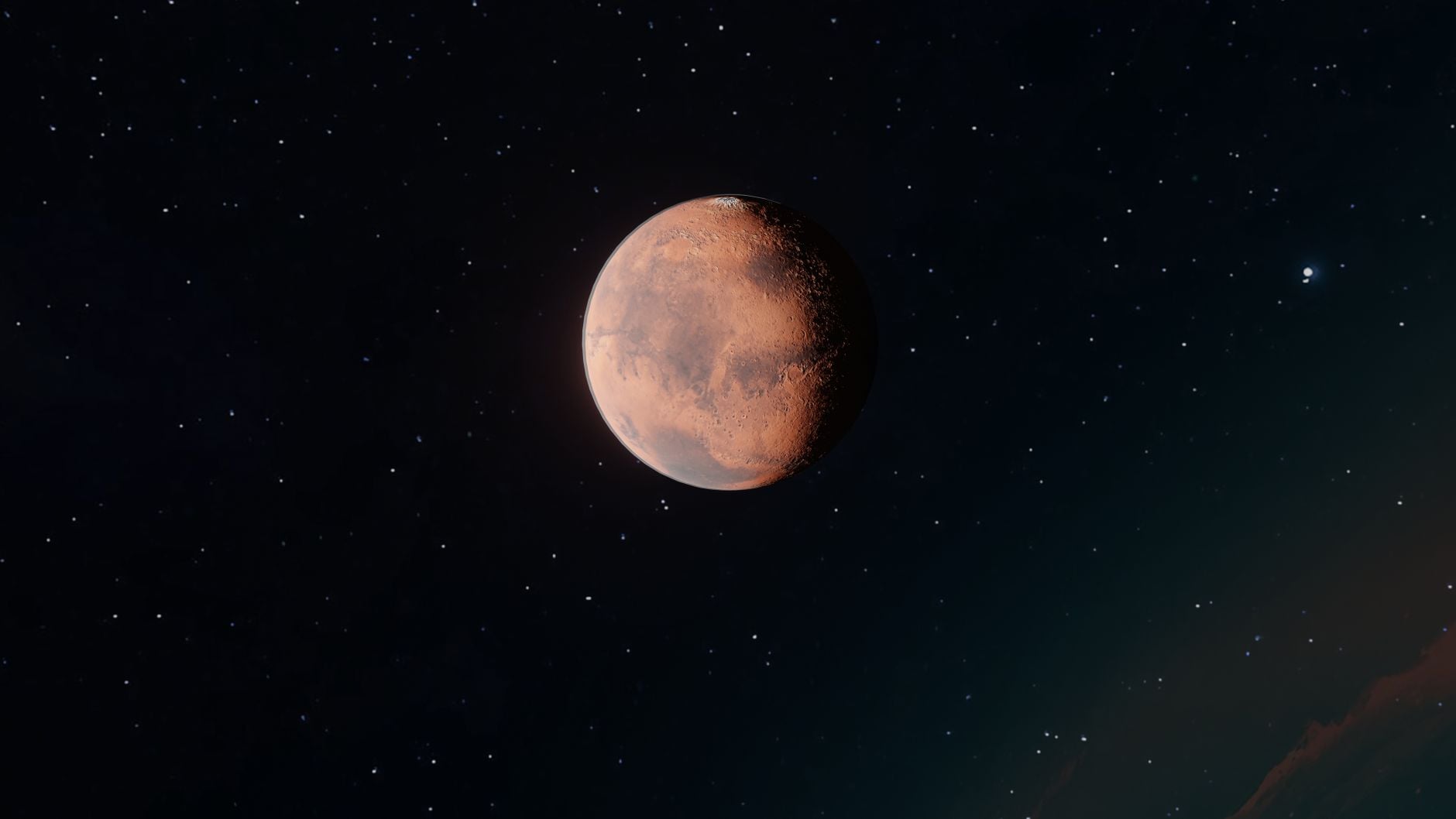
Mars today is a cold, dry desert, with an atmosphere far too thin to hold liquid water on its surface for long. The rock record tells a different story about its past. Orbiters and rovers have built a firm case that the planet once had flowing rivers and long-lived lakes, and a more contested case that its northern lowlands once held an ocean.
What stands out is not only that Mars was wet, but for how long. The wet conditions appear to have lasted not for a brief episode, but for a stretch of time that rivals how long complex animals have existed on Earth.
The rivers and lakes are not in doubt
From orbit, the older terrain of Mars is cut by branching valley networks that look like dried river systems, and the case has only firmed up on the ground. NASA’s Curiosity rover has spent more than a decade reading the layered rock of Gale crater, where it found the floor of an ancient lake that filled, drained and refilled around 3.8 billion years ago. The thickness of those layers implies water was present, on and off, for a very long time.
At Jezero crater, NASA’s Perseverance rover sits beside a fossil river delta so large it can be picked out from orbit, fed by rivers that flowed around 3.7 billion years ago. The rover’s ground-penetrating radar has since traced an even older buried channel system beneath it.
Two rovers, in two different craters, are standing in the beds of vanished lakes.
The ocean is the contested part
The larger claim is the northern ocean. For decades some researchers have argued that the low, flat plains covering much of the northern hemisphere once held a body of water, sometimes called Oceanus Borealis, perhaps four billion years ago.
The most direct recent evidence comes from China’s Zhurong rover, in the northern plains of Utopia Planitia. Its radar imaged buried layers that dip gently in one direction, which a team reported in 2024 as the signature of an ancient shoreline, and some of its surface rocks have been read as marine sediments. It is suggestive. It is not settled. Shorelines are fragile features, and after billions of years of erosion and burial, telling a true coastline from other layered ground is genuinely hard, which is why many planetary scientists remain unconvinced.
How long the water lasted
The duration is the part that is easy to underrate. The valley networks and lake deposits were not laid down in a single wet century. They point to surface water coming and going across the late Noachian period and into the one that followed, a span of several hundred million years, while individual lakes such as those at Gale and Jezero may each have lasted for up to millions of years.
Set that against Earth’s own timeline. Complex animals have existed here for roughly 540 million years, since the Cambrian. By the geological estimates, Mars held habitable surface conditions for a window in the same range, and by some readings a longer one. These are estimates rather than stopwatch readings, but they make the point.
Early Mars was not briefly damp. It was wet for an age.
And then it dried out
The water did not last. Mars is smaller than Earth and lost its global magnetic field early, leaving its atmosphere exposed to the solar wind, which NASA’s MAVEN orbiter has shown is still stripping gas away today. As the air thinned, the surface grew colder and the pressure fell too low for liquid water to stay stable. Some of the carbon dioxide that once warmed the planet appears to have ended up locked into rock, a process Curiosity has found chemical traces of in Gale crater. By around three billion years ago, the frozen, dry world we recognise had largely taken shape.
What to watch
The question underneath all of this is whether the long wet period was ever inhabited. Perseverance has been collecting and sealing samples from the Jezero delta, exactly the kind of setting where signs of past microbial life might be preserved, for a planned return to Earth where they could be studied properly. That effort, Mars Sample Return, is the next real test, although its schedule and design are still being reworked.
The ocean question, meanwhile, waits on more and better subsurface data. Whether the northern plains held a sea or only a scattering of lakes and ice changes the picture of how much water Mars had, and how long it could have stayed a place where something might live.
