
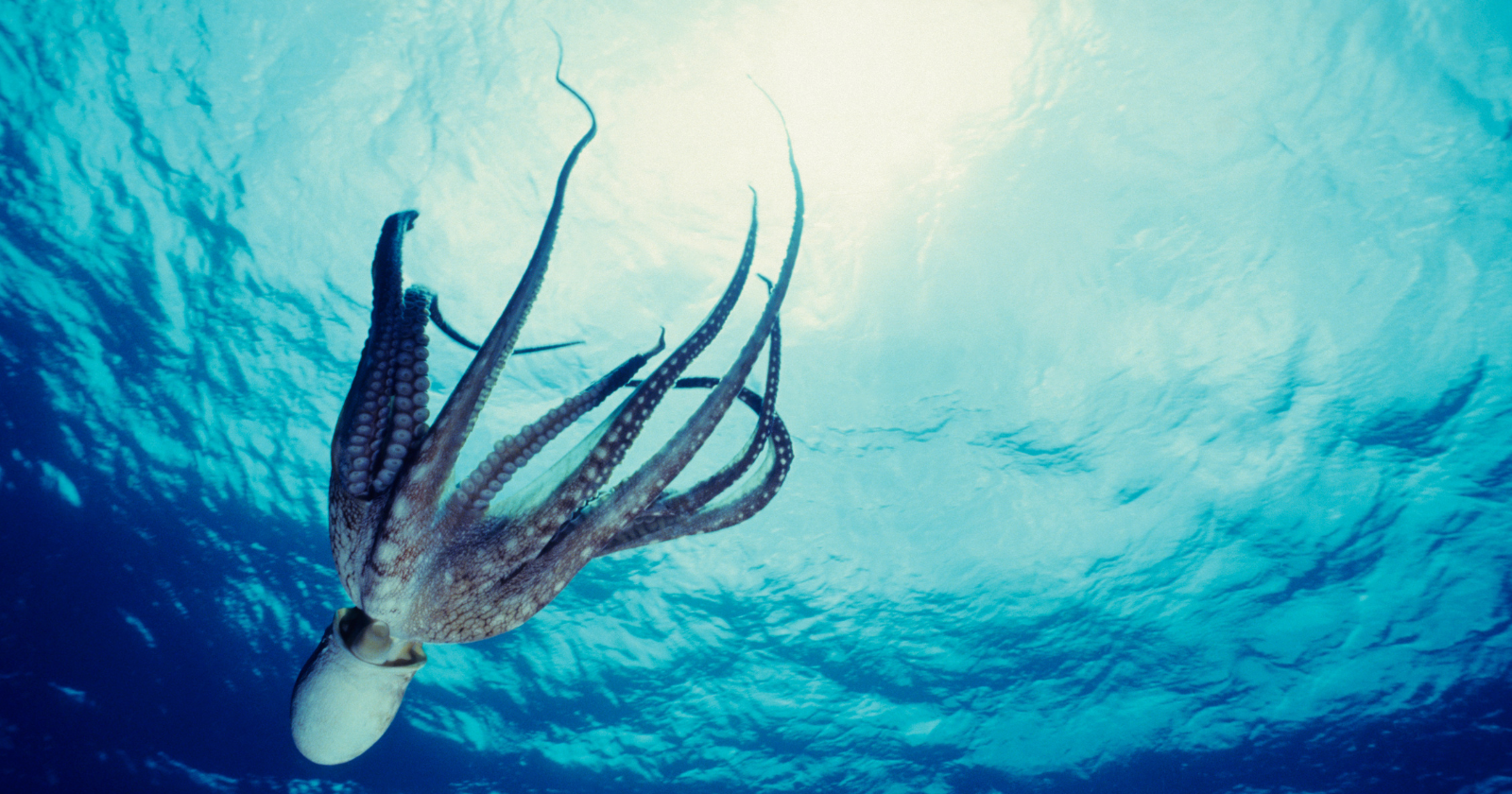
The last common ancestor of human beings and octopuses was a small, flatworm-like creature that lived in the ocean approximately 600 million years ago. Whatever this animal looked like, it almost certainly did not have a brain in any meaningful sense — its nervous system was probably a diffuse net of cells, capable of detecting light and chemicals and triggering basic motor responses, but lacking the central processing hub that both vertebrates and cephalopods eventually evolved on entirely separate evolutionary trajectories. Brains, in the sense that humans recognise them, have appeared in Earth’s evolutionary record twice — once in the lineage that produced fish, amphibians, reptiles, birds, and mammals, and once, completely independently, in the cephalopod molluscs that produced octopuses, squid, and cuttlefish. The two designs are not variations on a single theme. They are two different solutions to the same underlying problem, arrived at by lineages that had not shared a common nervous-system architecture for hundreds of millions of years before either started building one.
According to a Lab Animal article in Nature on the autonomous arms of the octopus, the distributional arithmetic of the octopus nervous system is fundamentally different from anything in the vertebrate lineage. A dog has approximately 500 million neurons, almost all of which are in the central brain. An octopus has approximately the same total number, but its central brain — the 40-lobed structure wrapped around its esophagus — contains only 40 to 45 million of them. The optic lobes behind the eyes contain another 120 to 180 million, organised into three cortical layers that bear a structural resemblance to the vertebrate retina. The remaining 300 to 350 million neurons — roughly two-thirds of the entire nervous system — sit inside the eight arms, distributed along axial nerve cords that run the length of each limb and form ganglia near every one of the approximately 200 suckers per arm. The octopus has, in effect, eight semi-autonomous neural processors operating in parallel, each one larger than the central brain that nominally coordinates them.
What this means for what the octopus is doing
The functional consequences of this architecture are not theoretical. They have been documented in laboratory experiments going back several decades. As reported by Big Think’s coverage of research presented at the Astrobiology Science Conference by Dominic Sivitilli and David Gire of the University of Washington, octopus arms can detect, evaluate, and respond to stimuli in under 100 milliseconds, without the signal ever travelling to the central brain. An arm reaching into a rocky crevice does not simply move where the central brain tells it to go; it touches surfaces, tastes them via the chemoreceptors lining the suckers, evaluates whether the surface is interesting or potentially edible, and either grasps or moves on, all on its own neural authority. The central brain, in many cases, does not know in real time exactly where each arm is in space. The arms know where each other are — connected by a neural ring that bypasses the central brain entirely — and they coordinate among themselves to keep the body functional.
The implications for how cognition can be organised are substantial. The vertebrate model — one large central brain, ruled by an executive prefrontal cortex, sending detailed commands to passive limbs that simply execute orders — is the model that essentially every theory of cognition humans have developed has been based on. It is the model that underlies how humans think about thinking, how humans think about consciousness, how humans think about the relationship between mind and body. The octopus model is something else. Sivitilli and Gire’s framing, in the conference presentation Big Think covered, was that the octopus represents a kind of cognition in which the distinction between “brain” and “body” is not as clean as the vertebrate case suggests — in which thinking happens distributed across the organism rather than concentrated in a single central location, and in which the arms themselves may be doing something that warrants being called cognition rather than merely reflex.
Why this matters for understanding minds
The philosophical implications were articulated most fully by the Australian philosopher Peter Godfrey-Smith in his 2016 book Other Minds: The Octopus, the Sea, and the Deep Origins of Consciousness, which has become the standard reference point for the broader cultural conversation about cephalopod cognition. Godfrey-Smith’s central claim is that if we want to understand what consciousness or intelligence can look like in forms substantially different from our own, the cephalopods are the most useful case study available on Earth. They evolved their nervous system independently of vertebrates. They process information in a way that does not centralise everything through a single executive structure. They appear to have something like subjective experience — they recognise individual humans, they play with objects in the absence of food reward, they solve novel problems, they apparently feel boredom — but the experience, if it exists, is presumably very different from anything a vertebrate mind has access to.
Per Stanford’s Wu Tsai Neurosciences Institute coverage of recent research on octopus cognition, the distributed-cognition architecture of the octopus has become a focus of interest not only for marine biologists but for theoretical neuroscientists trying to understand how nervous systems can be organised. The vertebrate template — central processing, peripheral effectors — is one possible solution to the engineering problem of coordinating a complex body. The cephalopod template — distributed processing, partial autonomy in peripheral nodes, coordination through a peer-to-peer neural ring rather than through a centralised hub — is another. Both work. Both produce animals capable of solving problems, recognising patterns, learning from experience, and acting purposefully in the world. The differences between them are not differences in capability but differences in architecture, with implications for what kinds of cognition are possible that researchers are only beginning to map.
The alien-mind framing
The “alien mind” framing has, in the literature, two distinct meanings. The first is metaphorical: the octopus is so different from the vertebrate norm — physiologically, neurologically, behaviourally — that researchers describing it tend to reach for science-fiction language because the ordinary biological vocabulary fails to capture how unlike a mammal it is. The second meaning is more literal. As detailed in a 2023 review in Current Biology on the evolution of cephalopod nervous systems, the cephalopod lineage represents the only fully developed alternative model of complex nervous-system organisation that has ever existed on Earth. If intelligent life evolves elsewhere in the universe, and if that life evolves brains, the brains it evolves are at least as likely to resemble the cephalopod architecture — distributed, partially autonomous, coordinated through peer-to-peer connections — as they are to resemble the vertebrate architecture. The octopus is, in this sense, not a metaphor for alien intelligence. It is the closest available approximation to what alien intelligence might actually look like, sitting in tide pools and aquarium tanks across the planet, opening jars and recognising individual humans and engaging in eight-armed problem-solving operations that nobody has yet fully understood.
