

Somewhere deep beneath the limestone hills of Slovenia, in caves that no sunlight has ever touched, lives an animal that has, in nearly every way, given up on the version of being alive that the rest of us would recognise.
It does not eat for years at a time. It does not move. It does not see, because somewhere over the last twenty million years it stopped bothering to grow proper eyes, and the eyes it has are now covered with a thin film of skin. It does not grow up — it remains a kind of permanent larva for its entire enormous lifespan, retaining the feathery red gills it was born with and never developing the lungs or limbs of an adult amphibian. It does not need company. It does not need anywhere to be.
It is called the olm — Proteus anguinus — and it has been quietly doing this for so long that biologists genuinely don’t know what to make of it.
The animal that almost isn’t
The first written record of the olm comes from 1689, when the Slovenian naturalist Janez Vajkard Valvasor reported that, after heavy rains, local people sometimes saw small white creatures washed out of underground caves. The locals had long believed these were the babies of dragons — dragons being, in their view, the only kind of animal that could plausibly live underground in the dark.
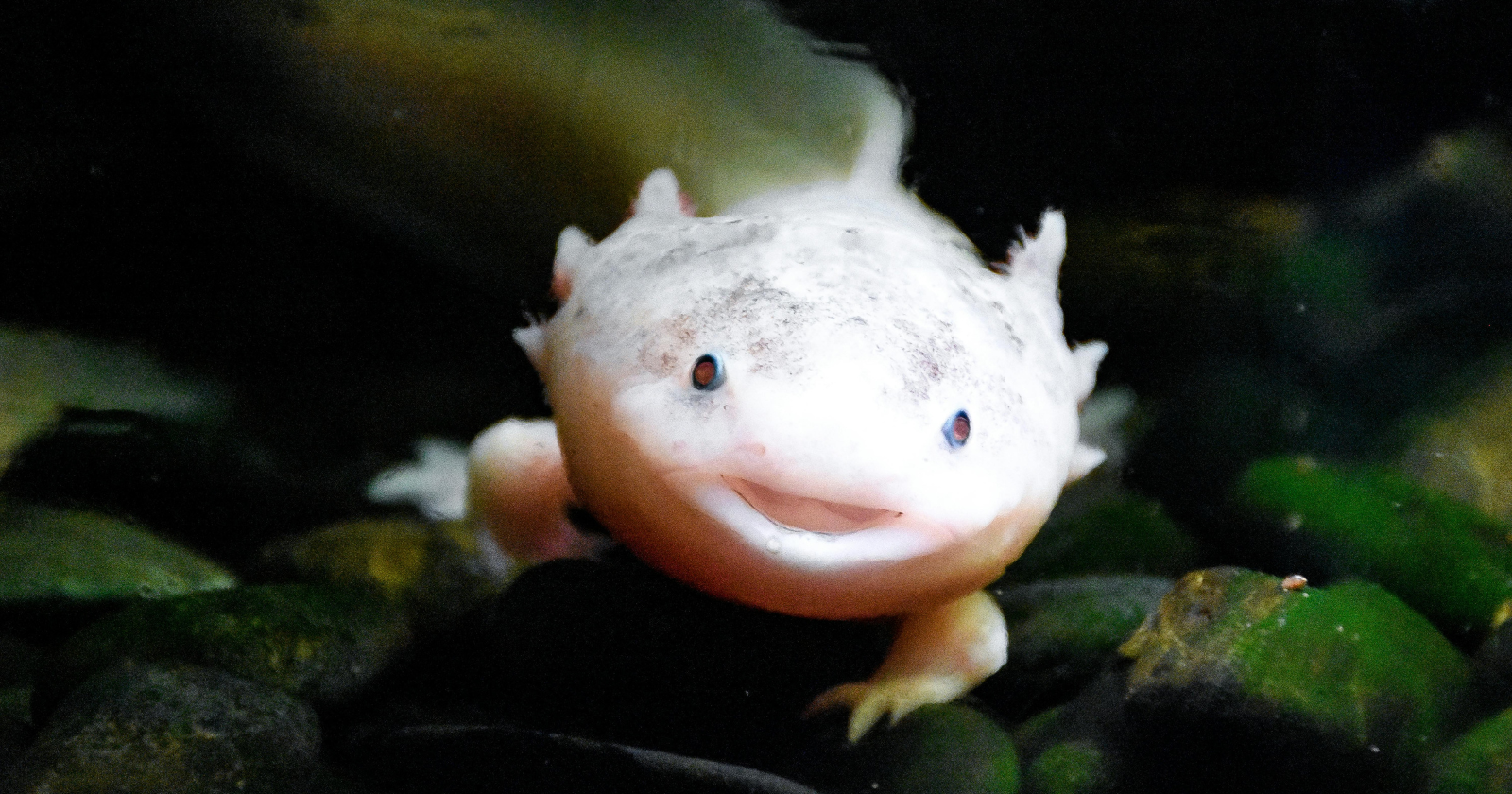
When Western science finally got a good look at one, the impression was barely less strange. The olm is about 25 to 30 centimetres long, snake-like in shape, with four small underdeveloped limbs. Its skin is pale pink — almost translucent in some lights — which is what earned it the popular name človeška ribica in Slovenian, or “human fish,” for the resemblance to human flesh tone.
It has almost no eyes. The optic nerves and rudimentary structures are still present, but the eyes themselves are sunken into the head and covered with skin. In their place, the olm has developed an exceptional sense of smell, a powerful ability to detect water vibrations, and an ampullary organ in its head that allows it to sense the faint electrical signals given off by other living things in the water — the same sense sharks use.
In a cave with no light, an animal that hunted by sight would simply starve. The olm hunts by chemistry, vibration, and electricity instead.
The seven-year stillness
The olm’s most famous biological trick is not its sightlessness. It is its remarkable, almost unbelievable, stillness.
Olms barely move. Field observations have recorded individuals remaining in the same spot for stretches of weeks, then months, then — in one extraordinary case — seven full years. The salamander was alive throughout. It simply had no reason to go anywhere.
The reason for the stillness is biological. The olm has one of the slowest metabolisms of any vertebrate ever measured. In an environment where food is scarce and temperatures are consistently cold (Dinaric karst caves run between 5 and 15 degrees Celsius), the olm’s strategy is the opposite of most other animals’. Rather than searching constantly for food, it has evolved to need almost none. A single meal — a small crustacean, an insect, a snail — can sustain an olm for up to ten years. Some observations suggest the figure can be even higher.
This is not torpor or hibernation. The olm is awake. It simply isn’t doing very much. It exists, very slowly, in a body that is barely consuming energy at all.
Living past a hundred
The slow life turns out to come with an extraordinary side effect.
The olm is the longest-living amphibian on Earth. A 2010 study published in Biology Letters by researchers in France analysed olms in a long-running cave laboratory in Moulis. They calculated an average adult lifespan of about 68 years, with a predicted maximum exceeding 100 years.
What makes this remarkable is what it doesn’t correlate with. In most vertebrates, longevity is associated with large body size, low metabolic rate combined with strong antioxidant defences, or freedom from predation. The olm is small. Its antioxidant systems aren’t unusually impressive. And while its caves are relatively predator-free, they aren’t unique in that respect.
In other words, the olm is living past 100 in defiance of most of what biologists thought they understood about ageing. It’s an outlier — a small amphibian that ought to be living thirty years and is, instead, living three times that. Scientists studying the molecular basis of olm longevity hope it may eventually reveal mechanisms of senescence that other species — including ours — could one day learn from.
Why it doesn’t move
The honest scientific explanation for the olm’s stillness is metabolic: when food is scarce and energy is expensive, evolution favours organisms that conserve both. The olm has been refining this strategy for around 20 million years. Almost everything about its body — the lack of eyes, the lack of pigment, the lack of adult metamorphosis, the slowed metabolism — is part of a single overarching adaptation to environments where there is very little of anything and you cannot afford to waste any of it.
But there is something else worth saying about the stillness, even if it isn’t strictly scientific.
In a cave system that has been dark for tens of millions of years, where the temperature does not change, where day and night do not exist, where the only food is the small things drifting past in the underground rivers, what would it actually mean to move? The destinations are indistinguishable. The directions are indistinguishable. The reasons most animals move — to find food, to find mates, to find shelter, to escape predators — are mostly absent here.
In total darkness, there is, in a strange sense, nowhere worth going.
The olm has worked this out. It conserves itself by staying. It waits. It lives, on average, longer than any of us will. And somewhere right now, in a cave system in Slovenia or Croatia, an olm is doing exactly what its ancestors have been doing for 20 million years — almost nothing at all, very patiently, for an extraordinarily long time.