

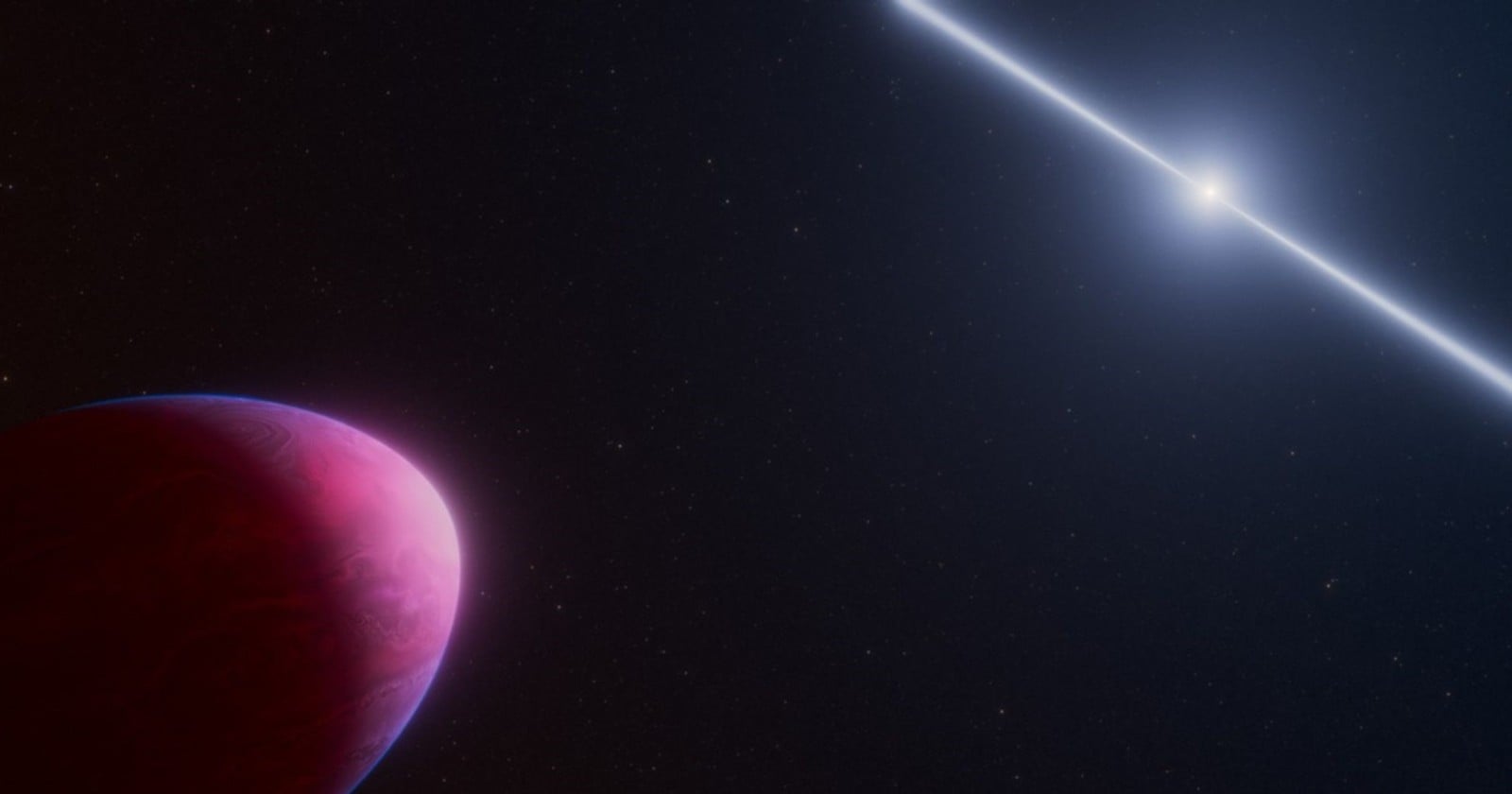
Astronomers pointed the James Webb Space Telescope at a planet circling a pulsar, watched it through a full orbit, and found an atmosphere dominated by molecular carbon, something almost never seen in a planet’s air. Instead of the water, methane, and carbon dioxide that turn up again and again on other worlds, what showed up on this one, named PSR J2322-2650b, was carbon bound to carbon.
The planet has roughly the mass of Jupiter, and the much heavier star it hugs has squeezed it into the shape of a lemon. The principal investigator, the University of Chicago’s Michael Zhang, put the deeper problem bluntly in NASA’s announcement of the work: the composition “seems to rule out every known formation mechanism.” In other words, the people who found this planet cannot yet say how it came to exist.
A planet you can see because its star is invisible
The star at the center of this system is a millisecond pulsar, the collapsed core of a dead star that spins hundreds of times a second. Zhang described it as having “the mass of the Sun, but the size of a city.” A pulsar like this one pours out gamma rays and other high-energy particles rather than the visible and infrared light that would normally flood a telescope and drown out a nearby planet.
That quirk is exactly why the planet could be studied at all. Because the pulsar’s glare is invisible to Webb’s infrared instruments, the telescope could track the planet’s own light across its entire orbit without the star washing it out. “This system is unique because we are able to view the planet illuminated by its host star, but not see the host star at all,” said Maya Beleznay, a Stanford PhD candidate who modeled the planet’s shape and orbit. “So we get a really pristine spectrum.”
An atmosphere of almost nothing but carbon
What that spectrum showed was, by the team’s own account, a shock. “I remember after we got the data down, our collective reaction was ‘What the heck is this?'” said co-author Peter Gao of the Carnegie Earth and Planets Laboratory. Instead of the usual water, methane, and carbon dioxide, Webb saw molecular carbon, specifically the forms written as C2 and C3.
That detail carries a lot of weight. Molecular carbon survives as a dominant gas only when there is almost no oxygen or nitrogen around to grab onto, because at these temperatures carbon binds readily to other atoms. The study reports a carbon-to-oxygen ratio above 100 and a carbon-to-nitrogen ratio above 10,000, both far outside the range seen on ordinary worlds. NASA notes that of roughly 150 planets whose atmospheres scientists have examined, inside the solar system and out, no other has shown detectable molecular carbon.
The planet is not a gentle place. NASA puts temperatures from about 1,200 degrees Fahrenheit at the coldest points of the night side to about 3,700 degrees Fahrenheit at the hottest points of the day side, and the study reports strong winds blowing westward through that carbon air.
Squeezed into a lemon
PSR J2322-2650b sits extraordinarily close to its star, about 1 million miles away. Earth, by comparison, orbits the Sun at roughly 100 million miles. At that range the planet whips around in a year lasting just 7.8 hours, and the pulsar’s gravity pulls so hard on the near side that the whole world is drawn out of round into a tapered, lemon-like shape.
By the numbers the planet still behaves a lot like a hot gas giant. The paper lists a minimum density of about 1.8 grams per cubic centimeter and an equilibrium temperature near 1900 kelvin, close to a hot Jupiter. Out of about 6,000 known exoplanets, NASA says this is the only one resembling a gas giant that orbits a pulsar, and only a handful of pulsars are known to host planets at all.
Why no one can explain how it formed
The hardest part is not the lemon shape or the heat. It is the carbon. The star and planet make up what astronomers call a “black widow” system, in which a fast-spinning pulsar slowly evaporates a small companion with its wind and radiation, the way the spider consumes its mate. Companions in those systems are stripped-down stellar cores, so they should carry a broad mix of elements, not a near-pure load of carbon.
“Did this thing form like a normal planet? No, because the composition is entirely different,” Zhang said. “Did it form by stripping the outside of a star, like ‘normal’ black widow systems are formed? Probably not, because nuclear physics does not make pure carbon.” Co-author Roger Romani, of Stanford and the Kavli Institute for Particle Astrophysics and Cosmology, floated one idea: as the companion cooled, carbon and oxygen inside it could have begun to crystallize, with pure carbon crystals floating up and mixing into the helium. Even that sketch leaves a gap, because something would still have to sweep the oxygen and nitrogen out of sight. “That’s where the mystery comes in,” Romani said.
How firm is “rules out every theory”?
It is worth being careful about what has actually been measured here and what has been inferred. What Webb recorded is a set of emission spectra gathered across one orbit of one planet, and the carbon-dominated reading, the extreme element ratios, the winds, and the distorted shape all come from fitting models to that light. Those measurements are striking, but they rest on a single object and a single instrument, and the headline conclusion, that the planet defies every formation pathway, is the researchers’ interpretation rather than a settled fact.
The team is careful too. Zhang says the composition “seems to rule out” known mechanisms, not that it has been proven impossible, and Romani’s crystallization idea is offered as a possibility with an admitted hole in it. The popular shorthand that the planet “is made of diamond” also runs ahead of the evidence: NASA notes only that carbon could condense into diamond deep inside the planet, which is a model-based maybe, not something anyone has seen. The reliable core of the result is narrower and still remarkable. Webb measured an atmosphere dominated by molecular carbon, the first of its kind among the planets studied so far, on a world that no current theory comfortably accounts for.
That gap is the point, not a flaw. “It’s nice to not know everything,” Romani said. “I’m looking forward to learning more about the weirdness of this atmosphere. It’s great to have a puzzle to go after.” For now the lemon-shaped planet keeps its secret, circling a dead star a million miles away, made of something no one expected and no one can yet explain.