
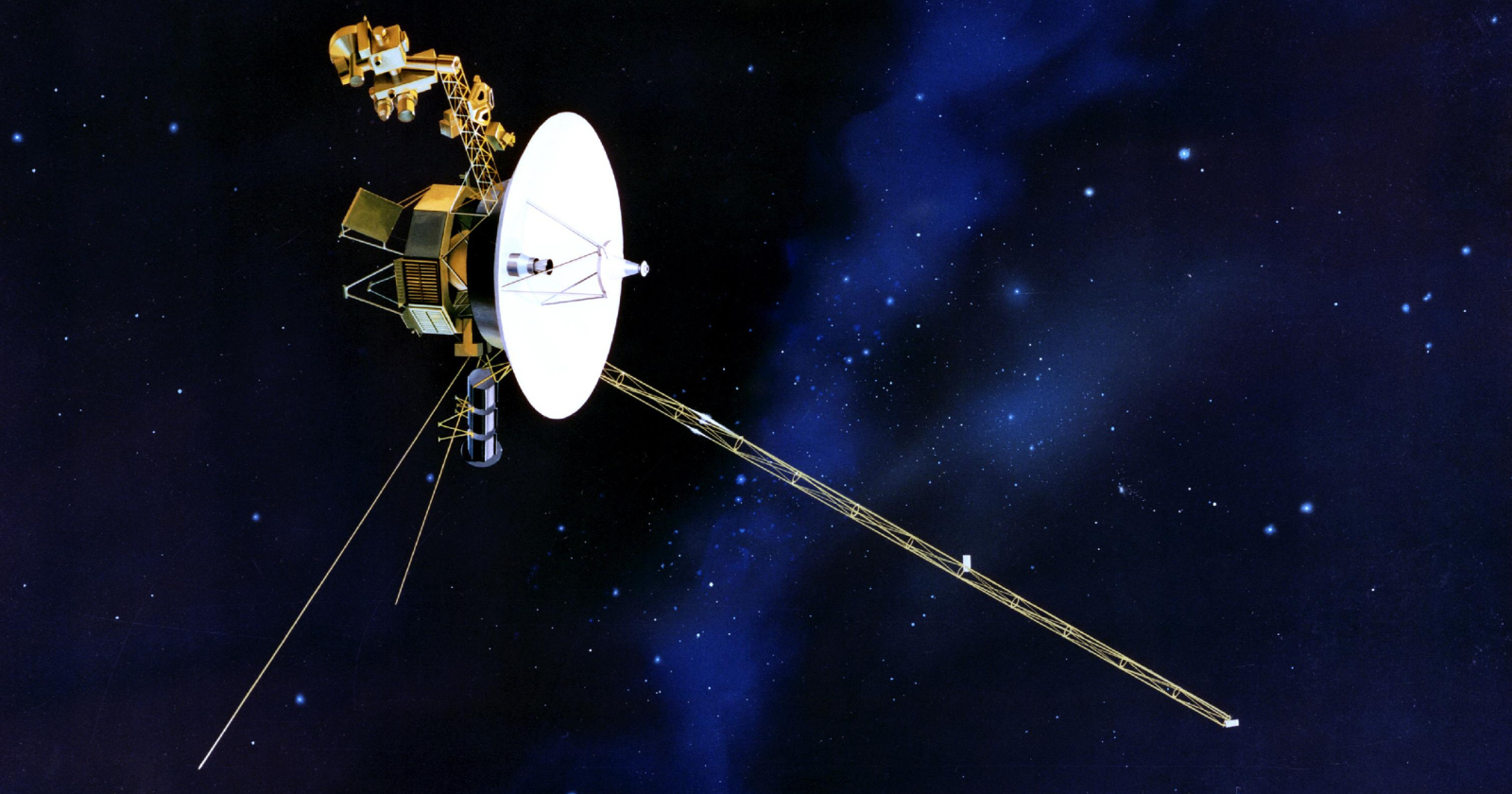
Voyager 1 is the fastest and most distant object people have ever built. It left Earth in 1977 and, almost half a century later, it is still moving at about 17 kilometres every second, far quicker than any rifle bullet. By that measure it holds a record nothing else comes near.
And yet, after all that time and all that speed, it has not covered even a three-hundredth of the way to a single light-year. Both of those things are true at once, and the gap between them is the real story.
Fast, by human standards
Voyager 1 launched in September 1977 and has been coasting ever since. It has no engine running. Its speed of roughly 17 kilometres a second, about 61,000 kilometres an hour, is momentum it gathered from the planets it swung past, and it has held that pace since its last encounter, with Saturn, in 1980.
It now sits about 170 times farther from the Sun than Earth is, a distance of roughly 25 billion kilometres. In 2012 it crossed the heliopause, the boundary where the Sun’s bubble of particles gives way to interstellar space, becoming the first spacecraft to operate between the stars. As a feat of distance and endurance, nothing else made by people is in the same range.
What a light-year does to the picture
The difficulty is the unit. A light-year is the distance light travels in a year, about 9.5 trillion kilometres, or some 63,000 times the gap between the Earth and the Sun. Voyager 1, for all its speed and all its years, sits at about 170 of those Earth-to-Sun units out. That works out to roughly one three-hundred-and-seventieth of a light-year.
Put the other way around, at 17 kilometres a second a full light-year would take something like 17,000 years to cross.
The nearest star to the Sun, Proxima Centauri, is more than four light-years away. Voyager 1 is not aimed at it, or at any star in particular. In about 40,000 years it will pass within roughly 1.6 light-years of a faint star called Gliese 445, and that is as near to another sun as its path will take it.
A light-day, reached this year
There is a smaller milestone that makes the scale easier to feel. NASA expects that in November 2026 Voyager 1 will become the first human-made object a full light-day from Earth, the point at which a radio signal takes about a day to reach it and another day to come back.
It has taken nearly 49 years to reach one light-day.
A light-year is 365 times farther again.
The power is running out
None of this will be tracked by instruments for much longer. Voyager 1 runs on heat from decaying plutonium, and that supply has been fading by about four watts a year. It began with around 470 watts and is now well under half of that.
To stretch what remains, engineers at NASA’s Jet Propulsion Laboratory have been switching instruments off one at a time. The cosmic ray subsystem was shut down early in 2025, and the low-energy charged particle instrument followed in April 2026. Two science instruments are still running, one measuring magnetic fields and one listening to plasma waves. The team has also been preparing a broader power-saving change, tested through the middle of 2026, to buy more time.
At some point in the next several years the available power will fall too low to run anything at all, and Voyager 1 will go quiet. It will not stop. It will keep coasting at the same 17 kilometres a second, dark and silent, through the thousands of years it would take to reach a light-year and the tens of thousands to approach another star.
What to watch
The near-term markers are concrete. There is the light-day crossing in November, and there is the question of how long the final two instruments can be kept alive as the power margin narrows.
After that, following Voyager 1 becomes a matter of arithmetic rather than observation. It will hold the speed and heading it has kept since 1980, carrying its golden record outward long after its radio has fallen silent.