
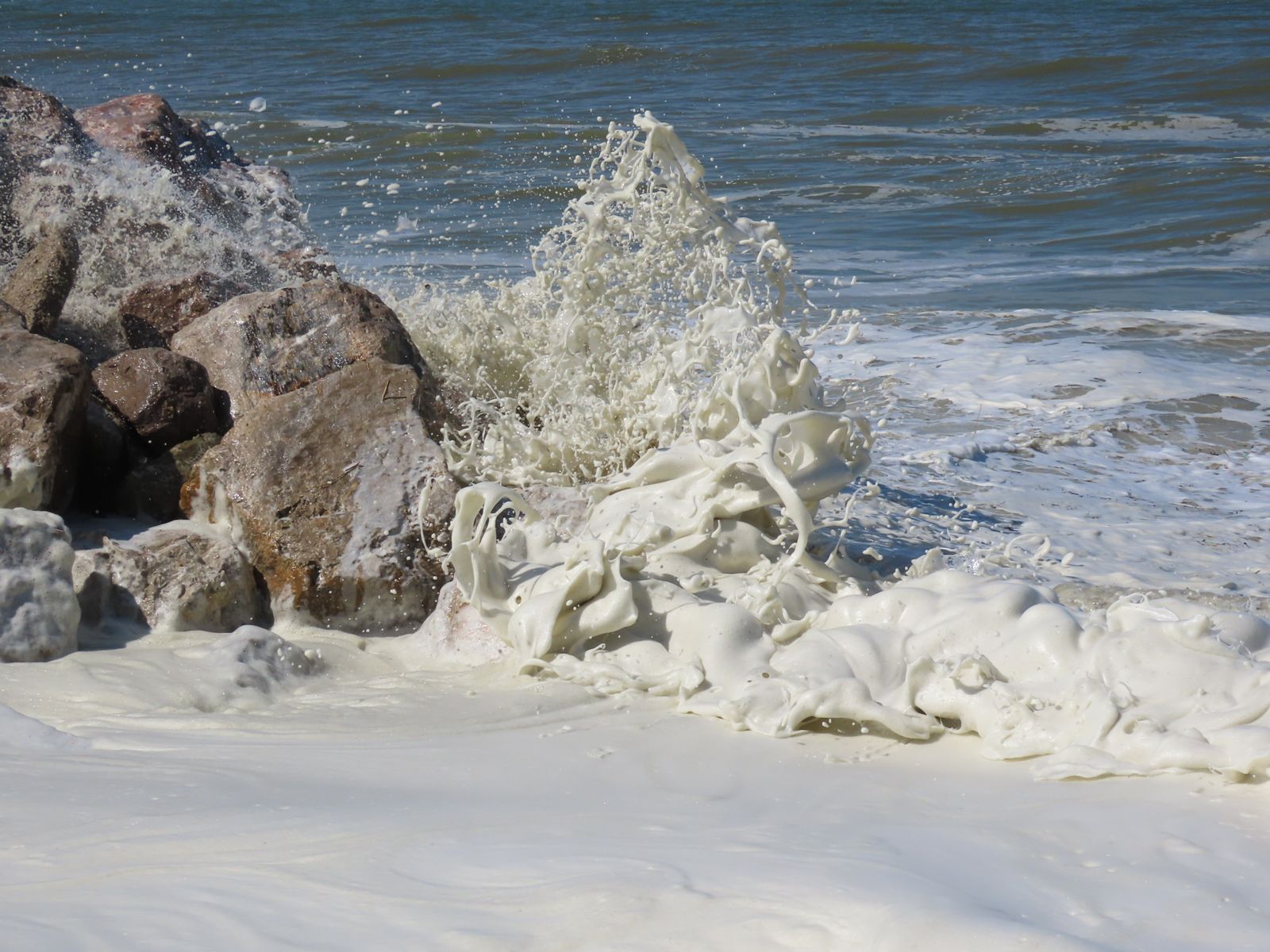
The smell most people mean when they say “the sea” is not salt. Salt is sodium chloride, a solid that does not evaporate at ordinary temperatures, so it has no odour at all. The scent that carries up off a beach is made of gases, and one of the main ones is dimethyl sulphide.
Dimethyl sulphide, usually shortened to DMS, is a sulphur gas produced by life in the sea. It is not the whole of the smell, but it is a large part of it, and following it back to its source leads through some of the most abundant organisms on the planet.
Where the smell comes from
The story starts with phytoplankton, the microscopic algae that drift through the sunlit upper ocean. Many of them make a compound called dimethylsulphoniopropionate, or DMSP, which helps them manage salt and cold inside their cells.
DMSP has no smell while it stays locked inside a living cell. It gets out when the cell is broken open, which happens when zooplankton graze on the algae, when viruses burst the cells, and when the algae simply die. Once the DMSP is loose in the water, marine bacteria feed on it and, with the help of certain enzymes, convert part of it into DMS.
DMS is volatile, so it escapes the surface and rises into the air.
That is the gas you smell. To be precise, the full scent of the coast includes other compounds as well, among them the products of DMS breaking down and various substances released by seaweed, but DMS is the part most people are describing when they talk about sea air.
A signal other animals follow
The gas is not only a smell to us. It is information to other species. Research by the sensory ecologist Gabrielle Nevitt and colleagues showed that seabirds such as petrels and albatrosses use DMS to find food across stretches of open ocean that otherwise offer few cues. A rise in DMS marks water where grazing is under way, which often means prey is close. The birds are reading the same thing a person smells at the shore, and treating it as a map.
From the sea to the sky
DMS matters well beyond the beach. Marine plankton are the largest natural source of sulphur entering the atmosphere, and most of it arrives as DMS. Once aloft, the gas oxidises into sulphur compounds that can form tiny aerosol particles, and those particles can seed cloud droplets.
In 1987, four researchers, Robert Charlson, James Lovelock, Meinrat Andreae and Stephen Warren, proposed that this could amount to a feedback loop, with plankton influencing clouds and therefore climate. The idea, known by their initials as the CLAW hypothesis, has been studied and argued over ever since. It is a hypothesis, not a settled account, and the real strength of any plankton-to-cloud feedback is still debated.
The same molecule, hunted on other worlds
Because DMS on Earth is made almost entirely by living things, astronomers have asked whether finding it in the air of a distant planet could point to life there. That question moved from theory to headlines with K2-18 b, a planet about 120 light-years away, larger than Earth, orbiting a small and cool star.
Using the James Webb Space Telescope, a team led by Nikku Madhusudhan at the University of Cambridge reported water vapour, methane and carbon dioxide in the planet’s atmosphere, and in 2023 a tentative hint of DMS. In April 2025 the same group reported a stronger signal, at a confidence level they put at three sigma. That is short of the five-sigma standard usually required before physicists will call something a detection, but the result was still widely covered as a possible sign of life.
Why the claim has not held up
It has not survived contact with other analyses. Several independent teams reworked the same JWST data and could not confirm the DMS signal. One study in Astronomy and Astrophysics found insufficient evidence for DMS, another argued the data do not meet the standard of evidence needed to claim life, and a NASA-led joint analysis combining new and older observations reached the same cautious conclusion.
The water and the methane look solid. The DMS does not.
There is a deeper problem for the idea as a whole. DMS was treated as a reliable marker of life largely because no one had found a way to make it without biology. That has changed. DMS has now been identified in comet 67P and in an interstellar gas cloud, places with no life at all, which means that detecting it, even cleanly, would not on its own prove biology.
What to watch
The useful work now is less about any single planet than about the standard of proof. Progress will need more telescope time on worlds like K2-18 b, better laboratory measurements of how DMS absorbs light, and a firmer account of how the gas can form without life.
Whether DMS turns out to be common on lifeless worlds or rare enough to mean something is the question the next round of observations has to settle.
