

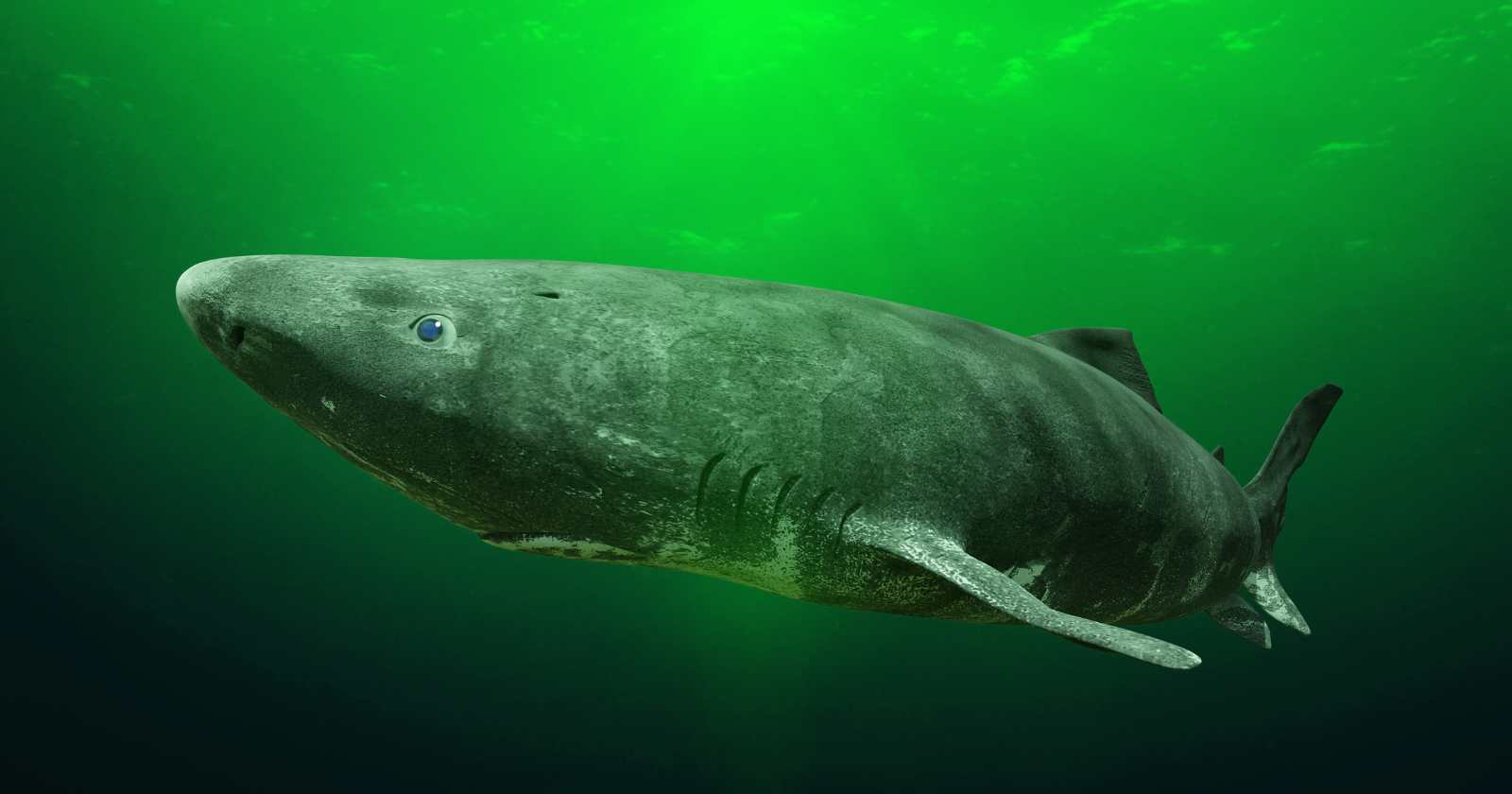
Somewhere in the cold dark water below the Arctic ice, several individual Greenland sharks alive today were almost certainly already swimming when the first European settlers landed at Plymouth Rock in 1620. Many of them were born before the invention of the steam engine. Some were probably alive when the Manchu dynasty was founded in China, when the Mughal Empire was at its peak in India, and when Galileo was still doing the observations that would establish the heliocentric model of the solar system. The species — Somniosus microcephalus — was identified as exceptionally long-lived in a 2016 paper in Science by the Danish biologist Julius Nielsen and colleagues, who used radiocarbon dating of the proteins in the lens of the shark’s eye to estimate the ages of 28 specimens. The largest individual examined, a 5-metre female, was estimated at approximately 392 years old, with substantial uncertainty in either direction. The species’ typical lifespan, as best as the available techniques can establish it, is approximately 400 years. Greenland sharks are believed to reach sexual maturity at around 150 years of age — slower than any other vertebrate ever measured.
According to Phys.org’s coverage of the September 2024 international team that first sequenced the Greenland shark genome, the project to map the species’ DNA was led by Arne Sahm at Ruhr University Bochum in Germany, in collaboration with the Leibniz Institute on Aging in Jena, the University of Copenhagen, the Scuola Normale Superiore in Pisa, and several other institutions. The team’s initial assembly, published on the bioRxiv preprint server on 10 September 2024, comprised approximately 6.45 billion DNA base pairs — roughly twice the size of the human genome and one of the largest non-tetrapod genomes ever sequenced. A follow-up paper in June 2026 by a separate team led by Shigeharu Kinoshita at the University of Tokyo extended the assembly to approximately 96.7 percent completeness and added substantial detail to the functional analysis.
What the genome actually shows
The most striking feature of the Greenland shark genome is what occupies the bulk of it. Approximately 70 percent of the genome consists of transposable elements — what geneticists informally call “jumping genes” — DNA sequences that can move around within the genome, duplicating themselves in the process. In most species, transposable elements are considered borderline parasitic; they tend to cause mutations, disrupt functional genes, and contribute to genetic instability. In the Greenland shark, the Sahm team’s analysis suggests that the species has evolved a different relationship with its transposable elements. Rather than being suppressed or eliminated, the jumping-gene machinery appears to have been co-opted: when transposable elements duplicate themselves, they sometimes drag adjacent functional genes along with them. Over evolutionary time, this process has produced substantial duplications of specific gene families — and among the most heavily duplicated are the genes that produce the proteins responsible for repairing damage to the DNA itself.
Per the Sahm team’s September 2024 bioRxiv preprint, the international group identified 81 duplicated DNA-repair genes in the Greenland shark genome — genes that exist as single copies in all other shark species examined but appear as multiple copies in Somniosus microcephalus — along with a unique insertion in the conserved C-terminal region of the p53 protein, one of the most important tumour suppressors in the vertebrate genome. The follow-up paper by the Kinoshita team in June 2026, as reported by Phys.org’s coverage of the more complete Tokyo-led assembly, added the identification of a unique amino acid substitution pattern in histone H1.0 — a protein involved in DNA packaging and chromatin stability that may help reduce the accumulation of genetic damage over time — along with expanded gene families related to immune function, cancer resistance, iron storage (via the FTH1b gene), and the NF-κB signaling pathway that regulates inflammation. The cumulative picture from the two papers is of a species that has, over the course of its evolutionary history, accumulated multiple parallel improvements to the molecular machinery responsible for protecting and repairing its own genetic material.
Why DNA repair matters for living 400 years
The connection between DNA repair capacity and lifespan is, in molecular biology, well-established. The DNA inside every cell of every animal sustains thousands of damage events per day — from ultraviolet radiation, from oxidative stress generated by ordinary metabolism, from spontaneous chemical reactions, from copying errors during cell division. Most of these damage events are repaired immediately by the dedicated cellular machinery that has evolved to do so. The damage events that escape repair accumulate over time, contributing to the gradual decline that biologists call senescence and to the cellular mutations that eventually produce cancer. Species that live unusually long lifespans — naked mole rats among rodents, bowhead whales among mammals, giant tortoises among reptiles — have repeatedly been shown to possess unusually efficient DNA-repair mechanisms compared to their shorter-lived relatives.
The Greenland shark fits this pattern at the extreme end. As reported by CNN’s coverage of the broader implications of the genome sequencing, the species’ approach to DNA maintenance appears to be quantitatively rather than qualitatively distinct from other vertebrates. The Greenland shark uses essentially the same DNA-repair toolkit that other sharks and other vertebrates use, but it possesses many more copies of the relevant genes — meaning that when DNA damage occurs, the cellular machinery for repairing it can be produced in larger quantities and deployed more efficiently. The duplications appear to have accumulated specifically in the DNA-repair pathway, suggesting that selection favoured organisms that could repair more damage faster, and that the species evolved its extreme longevity primarily by becoming better at fixing what was wrong with its own genetic material.
What this means for human aging research
The Greenland shark genome is now sitting in public databases, available to any researcher interested in comparing it against the genomes of other long-lived species or against the much shorter-lived humans whose maximum verified lifespan, set by Jeanne Calment of France, is 122 years. As covered by Live Science’s coverage of the Kinoshita 2026 paper and the surrounding scientific debate, the practical implications for human longevity research depend on whether the specific DNA-repair mechanisms identified in the Greenland shark can be transferred or replicated through pharmaceutical or genetic intervention. Vera Gorbunova, a longevity researcher at the University of Rochester who was not involved in the Greenland shark studies, has argued that different long-lived species solve the longevity problem through different molecular mechanisms — and that the goal of human longevity research should be to understand all of them rather than to pick one to copy.
Some caution is warranted in interpreting the 400-year lifespan figure itself. As Aaron MacNeil, a biologist at Dalhousie University in Nova Scotia, has pointed out, the radiocarbon-dating technique used by the Nielsen team in 2016 to establish the lifespan estimate carries substantial uncertainty — particularly for the very largest specimens, where the radiocarbon traces from Cold War nuclear testing become harder to interpret. The actual maximum lifespan of the species could be somewhat shorter or somewhat longer than 400 years. What is no longer contested is that Greenland sharks live for centuries, that their genome contains substantial duplications of the DNA-repair machinery that protects and maintains the genetic material in every cell, and that some individuals currently swimming in the cold dark water of the Arctic Ocean were already alive when William Shakespeare was writing his late plays. The biological strategy that has kept them alive for that long is now, for the first time, available to be read.