
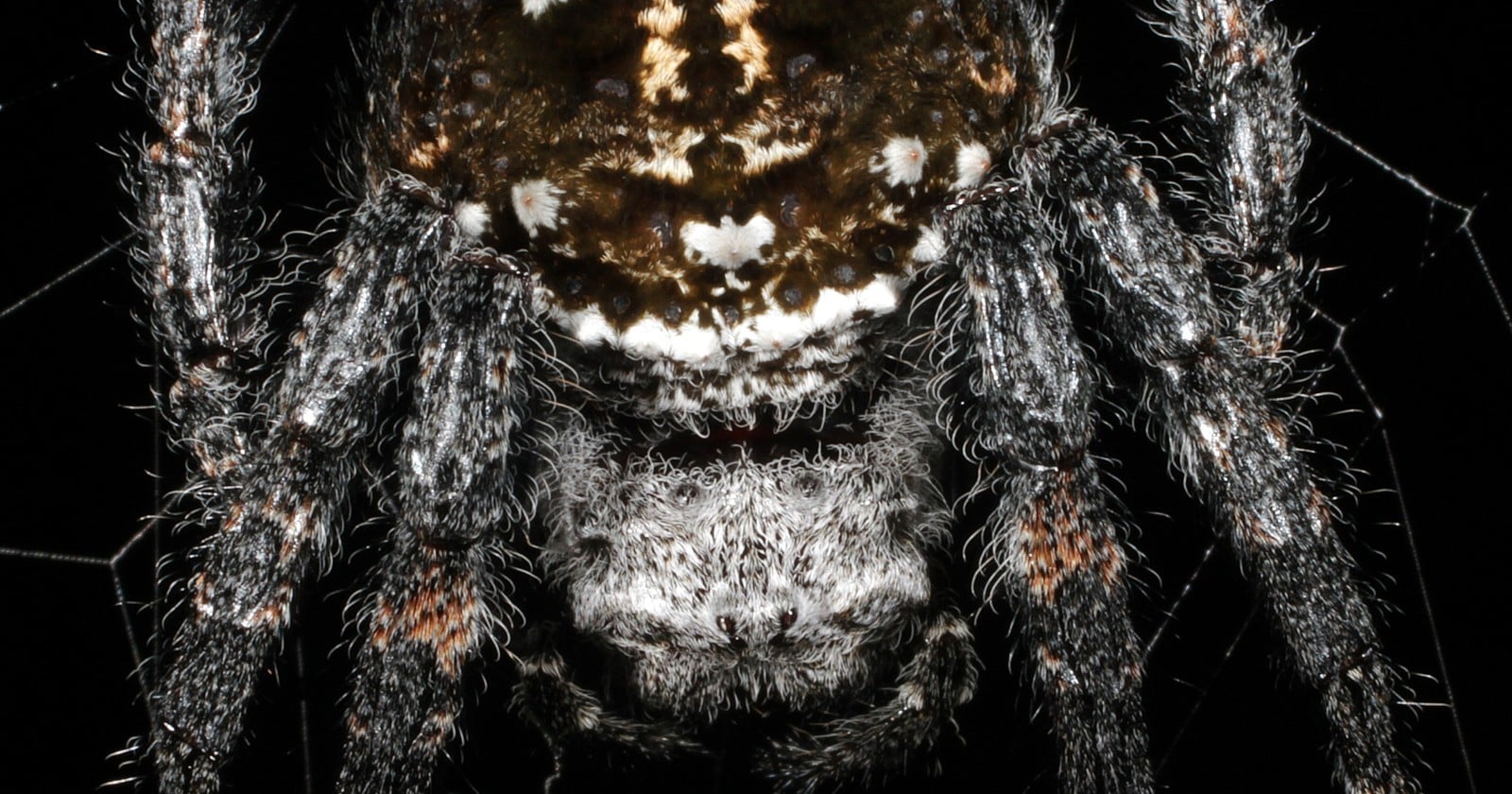
A spider in Madagascar makes a thread that outperforms anything in the materials labs of the human world. Its dragline silk is the toughest biological material scientists have yet measured, able to soak up more than ten times as much energy as Kevlar before it breaks. The spider that spins it does something no other known spider does at the same scale. It slings its web straight across rivers and streams, anchored to the banks on lines that can run up to 25 meters from one side to the other.
The animal is Darwin’s bark spider, Caerostris darwini, and the claim comes from the team that found it. In a 2010 study, biologists Ingi Agnarsson, Matjaz Kuntner and Todd Blackledge reported that the spider produces the toughest known biomaterial, with a toughness that averages 350 megajoules per cubic meter and reaches 520 in the strongest samples. That is more than twice as tough as any silk described before it, and roughly ten times the toughness of Kevlar, the synthetic fiber used in bulletproof vests.
A web cast across a river
The discovery began with the web, not the silk. The researchers first came across the giant river webs in Ranomafana National Park in 2001 and returned to study the spiders in the forests around Andasibe-Mantadia in 2008 and 2010. The animal turned out to be new to science, a recently discovered species the team named Darwin’s bark spider, Caerostris darwini.
Working in the rainforests of eastern Madagascar, the team kept finding enormous orbs suspended over moving water. The round capture area hung in the open air above a stream, and a single long bridge line attached to vegetation on each bank held up the whole structure.
The capture webs themselves reach up to 2.8 square meters, among the largest orb webs known. The bridge lines are the showpiece. Across small rivers the anchor threads typically ran several meters; across one lake, the team measured bridge lines stretching 25 meters. To span that gap, a spider almost certainly releases a strand of silk into the air and lets it drift on the breeze until it snags on something far away, then reels in and reinforces the connection.
A line that long, carrying a heavy spider and a large web, exposed to wind and rain over open water, has to hold without snapping or sagging into the river. That is the engineering problem the silk solves.
What “tough” actually means
Toughness is not the same as strength. Strength is how hard you can pull before a fiber breaks. Toughness is the total energy the fiber can absorb before it fails, which depends on combining decent strength with the ability to stretch a long way first. A material can be very strong and still shatter if it cannot give.
Darwin’s bark spider silk turns out to be only ordinary in strength. What sets it apart is its stretch. Its dragline silk is roughly twice as extensible as the dragline silk of other orb weavers, and that extra elasticity, multiplied by respectable strength, is what produces the record toughness. The fiber can deform and absorb the shock of a heavy insect, or a gust pushing on a giant web, rather than breaking.
For comparison, the researchers noted that typical spider dragline silk already runs about 150 megajoules per cubic meter, which comfortably beats steel and Kevlar by toughness. Kevlar itself sits near 33. Darwin’s bark spider silk, averaging 350 and topping out above 500, leaves all of them behind. Even the sticky capture spiral of the web, a different silk built to be stretchy rather than load-bearing, proved unusually tough in this species, getting there through extra strength while keeping its normal elasticity.
Ecology as a search engine
The most useful idea in the study may not be the spider at all, but the method that found it. There are more than 41,000 described spider species, most spinning several kinds of silk, which means hundreds of thousands of distinct silks exist and only a few dozen have ever been tested. Picking species at random is slow. The authors argued that a spider’s natural history can predict its silk, that an animal building an outlandishly demanding web is a good bet to be spinning an outlandish fiber.
So they reversed the usual order. They saw the river-spanning webs first, predicted that the silk holding them up would have to be exceptional, and only then pulled threads from captured spiders and tested them on a tensile machine. The prediction held. That logic, sometimes called bioprospecting, turns the search for useful natural materials from blind fishing into something closer to a targeted hunt.
How firm is the word “toughest”
The record deserves its qualifiers, and the original paper supplies them. The silk is the toughest biological material examined to date, not the toughest that can possibly exist. Because only a sliver of spider diversity has been measured, the authors themselves suspected that tougher silks are still out there, waiting in species no one has tested.
Toughness also depends on how a fiber is pulled. All the headline measurements were taken at the slow, steady speeds standard in the lab. Silk in a real web is loaded much faster, by an insect slamming into it, and earlier work found that under very high strain rates a common garden spider’s silk could reach toughness values several times higher than at lab speeds. Tested the same way, Darwin’s bark spider silk might post even larger numbers, but the clean comparison is the one made at matching conditions.
There is one more honest hedge. The researchers floated the appealing idea that the spider evolved its giant web and super-tough silk to trap unusually large prey crossing the river. The silk is consistent with that story, but the evidence is not. The prey they actually found in the webs were mostly small, including mayflies and the occasional bee or dragonfly. Why the spider needs silk this extreme remains an open question, with the best supported answer being durability, keeping a hard-to-build web from collapsing into the water, rather than catching giants.
The thread we cannot yet copy
Spider silk has been a target for materials scientists for decades. It pairs strength and stretch in a way synthetic polymers struggle to match, and it is spun at room temperature out of water rather than forged with heat and harsh chemicals. A fiber that beats Kevlar by an order of magnitude in toughness is exactly the kind of model engineers would like to imitate for everything from surgical thread to lightweight cordage.
The catch is that no one can yet mass-produce it. Spiders are territorial and cannibalistic, so they cannot be farmed like silkworms, and reproducing the silk’s structure in the lab has proven stubborn. For now the toughest material known to science is made only by a small brown spider in a Malagasy forest, casting its line into the wind and waiting for it to catch.
