
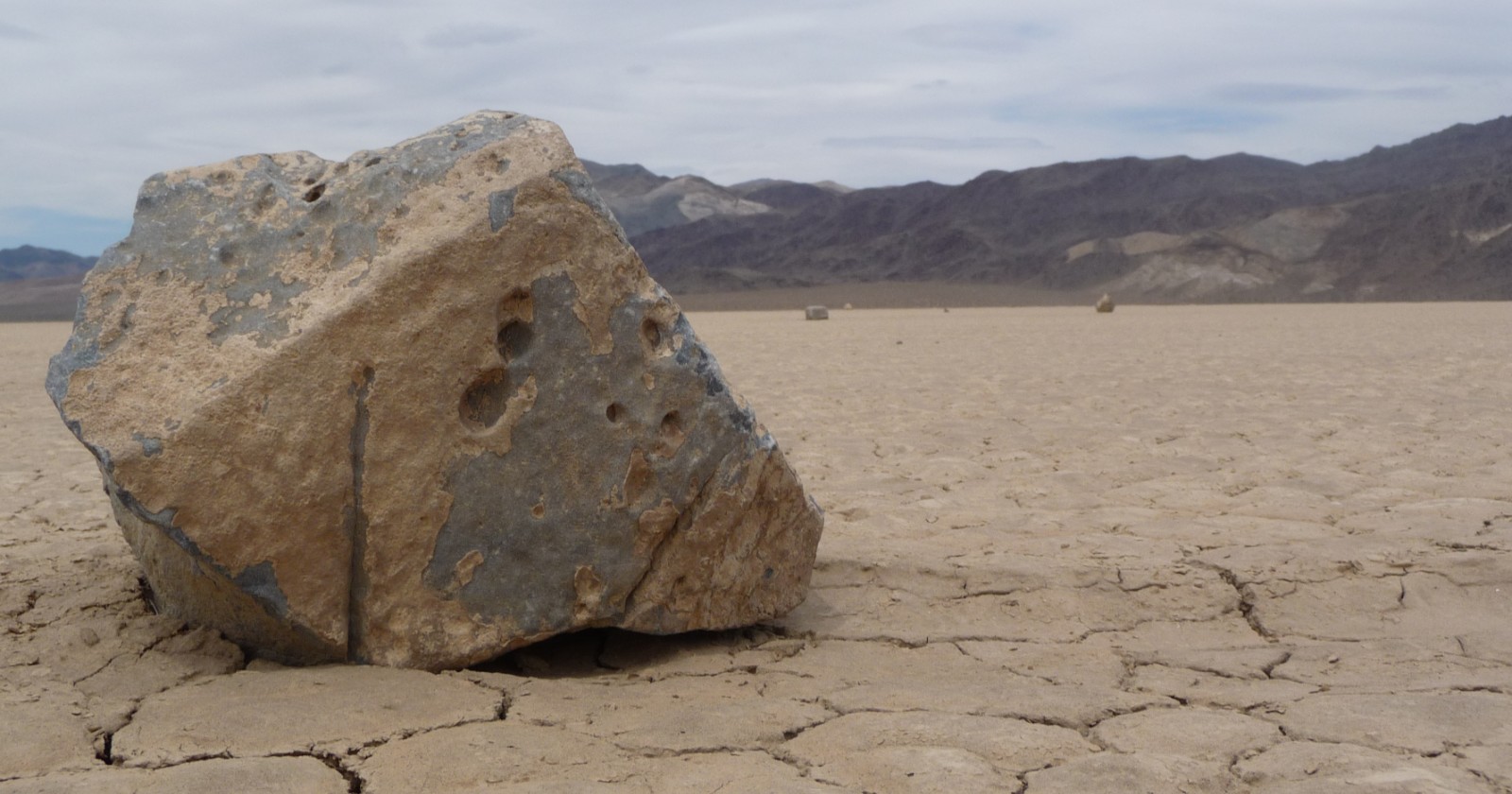
On a flat dry lakebed in Death Valley National Park, heavy rocks sit at the end of long grooves they have plowed across the mud. The trails run for tens of meters, some bending in sharp turns or doubling back, yet no one had ever watched a rock actually move. For more than sixty years the question of how they travel sat unanswered, the subject of guesses that ranged from hurricane-strength winds to floating sheets of ice.
In 2014 a research team published the first direct scientific observation of the rocks in motion, and the mechanism turned out to be far gentler than the leading theories. The stones glide when a thin sheet of ice, only three to six millimeters thick, covers a shallow winter pond, starts to melt in the late morning sun, and breaks into floating panels that a light wind nudges across the water. The ice shoves the rocks along at a walking pace of a few meters per minute.
The mystery on Racetrack Playa
Racetrack Playa is a dry lakebed ringed by mountains, known for the tracks left by hundreds of stones of dolomite and granite, some the size of pebbles and others heavy enough to need two hands. Scientists have written about the moving rocks since the first report in 1948, and the puzzle drew decades of theodolite surveys, repeat photography and, more recently, precise GPS mapping of the rocks and their trails.
Those surveys established something strange. The rocks move very episodically, often sitting still for several years to a decade at a stretch. Many trails run parallel, with matching turns, as if the stones had been steered in formation. Yet the playa sits in one of the hottest, driest places in North America, and catching a movement in person seemed nearly impossible.
Earlier researchers split into camps. Some argued for very high winds, with friction tests suggesting gusts of tens of meters per second, in some calculations up to 80, would be needed to push a rock across wet mud. Others argued that rocks freeze into large sheets of ice that cut the friction with the lakebed and catch the wind like a sail. A famous test from 1976 drove stakes into the playa around several rocks: one rock slid out of the corral over the following winter while another stayed put, which the researchers read as evidence against ice doing the work.
What the cameras and GPS rocks recorded
To settle it, the 2014 team instrumented the playa itself. They installed a weather station beside the lakebed recording wind, temperature, sunlight and rainfall, set up time-lapse cameras overlooking the southeast corner, and placed fifteen limestone blocks fitted with GPS loggers. Each logger was rigged to start recording its position the moment the rock pulled away from a magnet buried beneath it.
A shallow pond, no more than about ten centimeters deep, formed on the playa after a winter storm in late November 2013 and lingered into February. On cold nights it froze. On sunny mornings the surface ice began to melt and break apart, and that combination turned out to be the trigger.
The largest event the team documented involved more than sixty rocks on December 20, 2013. The GPS rocks logged their own movements on December 4 and December 20, and people watched stones move in person on later days. One instrumented rock traveled about 65 meters in a single sixteen-minute push; another stone, tracked across multiple events, ran up a total trail length of 224 meters over the winter.
A few millimeters of ice doing the work
The surprise was how little force was involved. Far from the thick ice or violent winds earlier models called for, the moving ice was a fragile “windowpane” layer three to six millimeters thick. As the morning sun warmed it, the sheet cracked into panels tens of meters across, accompanied by a chorus of popping sounds as the ice fragmented.
Steady light winds of roughly four to five meters per second, little more than a stiff breeze, drove those floating panels across the meltwater. Where a panel met a rock, it pushed. The stones did not roll or tumble. They were bulldozed along the saturated mud at two to five meters per minute, often for only a dozen or so minutes before the ice stalled or shattered.
That gentle, brief, low-speed motion explains why the rocks were never caught in the act. A stone creeping a few meters per minute under a skin of muddy ice is almost invisible to a casual observer, and the trail it carves forms underwater, becoming visible only after the wind blows the shallow water away and the mud dries. The mechanism also tidily explains the old corral experiment: cracking ice can decouple two nearby rocks, so one moves while its neighbor stays.
How firmly is the case closed?
The 2014 study is the first and clearest direct record of the rocks moving, but it is worth being precise about what it shows and what it does not. The team observed and instrumented a single pond season, the winter of 2013 to 2014, on one part of the playa. They captured several movement events in detail, including GPS tracks and time-lapse images, which is strong evidence that this is how the rocks move when conditions line up.
What the study does not claim is that every trail on the playa, including the longest historical ones, formed exactly this way. The authors note that the floating ice sheets at breakup start out large, so the most congruent parallel trails may form early in an event before the ice fragments, an idea proposed by earlier researchers. Older theories that depended on hurricane winds or thick buoyant ice are hard to reconcile with what was actually filmed, but the playa keeps no record of past events beyond the trails themselves.
The conditions are also genuinely rare, which kept the answer hidden for so long. The team’s time-lapse record going back to 2007 shows that most winters never produce the right mix of a shallow pond, repeated overnight freezing and steady daytime breezes. The freezing temperatures and light winds are common on the playa; what is scarce is enough rain or snow to fill a winter pond in the first place. So the rocks may indeed go years between moves, not because the motion is exotic, but because the weather rarely cooperates.
A quiet kind of magic
Part of the appeal of the sailing stones was always the suspicion that something dramatic was happening when no one was looking. The real answer trades drama for delicacy. It takes a pond a few centimeters deep, a night cold enough to glaze it, a morning sun to loosen the glaze, and a breeze a person could stand comfortably in. Under those conditions a sheet of ice no thicker than a few sheets of paper can shove a rock heavier than a bowling ball across the desert floor.
The stones are still out there, mostly sitting still, waiting for the next rare winter when the lakebed floods and freezes and the wind picks up at midday. The next time it happens, the rocks will move again, slowly, quietly, and probably with no one standing close enough to notice.
