

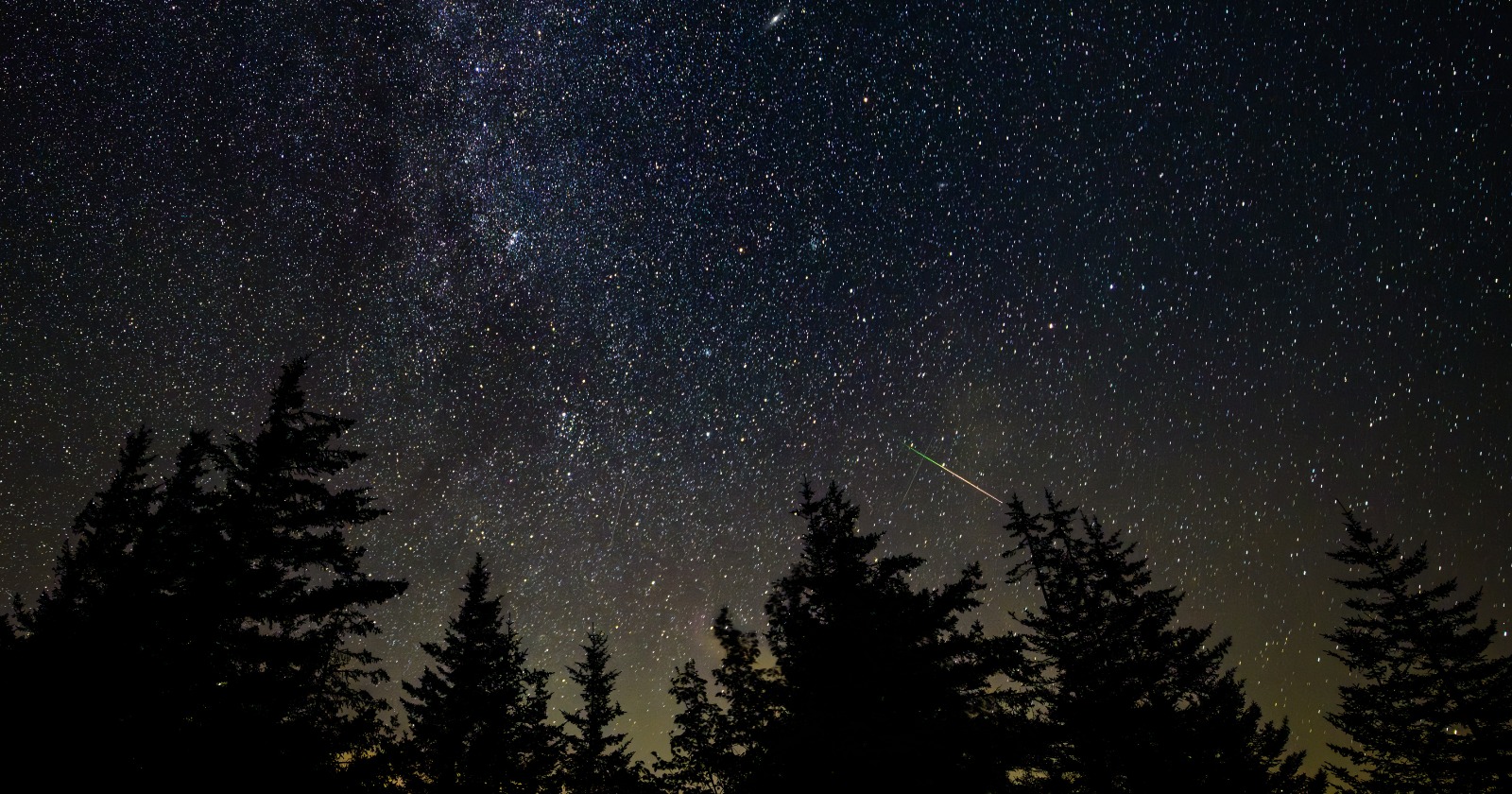
The June Bootids are running again. From June 22 through July 2, Earth drifts through a thin scattering of dust left by an old comet, and on a few celebrated occasions that dust has lit up the sky with dozens of meteors an hour. The International Meteor Organization, the group that tracks these things, files the shower under a single telling label for its rate: variable, anywhere from zero to more than a hundred.
For 2026, the honest forecast is the dull one. The IMO’s 2026 meteor shower calendar lists no prediction of unusual activity this year, and recent video data place the shower’s weak annual maximum on June 22. The famous outbursts are real, but they are the exception, and nothing in the current models says one is due.
A shower that mostly does nothing
In a typical year the June Bootids are among the quietest entries on the calendar. The rate astronomers quote, the zenithal hourly rate, describes the number a single observer would catch under perfect dark skies with the shower’s radiant directly overhead. That figure for the June Bootids is logged simply as variable, spanning zero to one hundred or more, and in most years it sits near the bottom of that range.
The meteors themselves are slow. They strike the atmosphere at about 18 kilometers per second, far gentler than the Leonids that tear in at around 70, which makes any June Bootid that does appear a long, leisurely streak rather than a quick flash. The radiant sits in the constellation Boötes, high in the northern sky, and from mid-northern latitudes it stays up almost all night.
That last detail comes with a catch this time of year. Near the solstice, the short summer nights and lingering twilight at northern latitudes leave only a brief window of true darkness, which trims the already slim odds of catching anything.
The years it roared
The reason anyone watches a shower this faint is a short list of nights when it refused to stay faint. The June Bootids are remembered for their returns in 1998 and 2004, with a few earlier, less certain appearances logged in 1916, 1921 and 1927.
The 1998 event is the one that earned the shower its reputation. On June 27 that year, the rate peaked near 100 an hour and stayed above 40 for more than twelve hours, a broad and sustained display rather than a brief spike. It was the kind of display normally associated with far more reliable showers, arriving out of a source most people had never heard of.
The shower stirred again in 2004, reaching a rate near 50 around June 23. A return forecast for 2010 fizzled, producing a poorly measured rate below ten. The pattern, such as it is, is that the June Bootids deliver rarely and on their own schedule.
Set against those nights, the silence is the more striking part. Before 1998 the shower had drawn solid notice in only three earlier years, 1916, 1921 and 1927, and the records from those returns vary in reliability. That leaves a stretch of some seventy years in which the June Bootids all but vanished, then produced one of the better displays of 1998 with almost no warning. A shower can sit dormant for a human lifetime and still, for reasons tied entirely to where its old dust has drifted, deliver a single memorable night.
Why no one can promise a repeat
The dust comes from comet 7P/Pons-Winnecke, which loops the Sun about every 6.3 years and last rounded it in May 2021. As a comet swings through the inner solar system, it sheds debris that spreads into streams roughly following its path. When Earth plows through a dense streamer, a shower flares. When it threads through empty space between them, almost nothing happens.
Each pass lays down a fresh trail, and over centuries those trails fan out and drift, pushed around by the gravity of the planets, until the region near the comet’s path is threaded with ribbons of dust of different ages and densities. Whether Earth runs into any one of them in a given year is a matter of timing and geometry that has to be worked out trail by trail. That is painstaking modeling even for showers whose parent still crosses our path, and harder still for one whose debris was laid down on an orbit the comet no longer follows.
The complication is that the comet’s orbit has shifted over time, nudged by the planets. Its path now passes about 0.23 astronomical units outside Earth’s orbit at the closest point, which is to say the comet itself no longer comes near us. The 1998 and 2004 outbursts were not produced by fresh material. They came from meteoroids the comet released long ago, when it traveled a different orbit that did cross Earth’s, leaving trails our planet happened to intersect on those particular years.
That history is exactly what makes the shower so hard to call. Forecasting an outburst means knowing where every old, drifting trail sits and whether Earth will hit one. For 2026, the IMO notes that the activity responsible for the 1998 and 2004 displays is currently not in our path at all.
What the 2026 calendar actually says
Here is where the popular version and the primary source part ways. Roundups this week point to a peak around June 27 and rates of up to a hundred meteors an hour, numbers borrowed from the 1998 outburst. The IMO’s own 2026 calendar tells a quieter story: a weak annual maximum on June 22, no forecast of any special activity, and a recommendation that observers monitor the nights around the listed time in case the sky surprises everyone.
It is worth being clear about what the headline rate means. A zenithal hourly rate of a hundred is a ceiling measured under ideal conditions, not a promise of a hundred streaks across an ordinary backyard sky. Light pollution, a radiant that is not overhead, and this season’s stubborn twilight all pull the real count well below the quoted figure. A strong June Bootid year is a treat for dedicated observers. It is not a guaranteed show, and 2026 is not even forecast to be a strong year.
None of that means the shower is not worth a look. It means the right expectation is curiosity, not certainty. The June Bootids have earned their watchers precisely because they cannot be counted on.
How to watch, expecting little
The approach is simple. On any dark night in the active window, find a spot away from city lights, let your eyes adjust for twenty minutes or so, and look generally toward the northern sky where Boötes rides high. There is no need to stare straight at the radiant; meteors can streak across any part of the sky, and they trace back to that point.
Because the meteors are slow, they tend to be easy to recognize when they do appear. The IMO’s advice for 2026 is to watch not only the listed maximum but the adjacent nights too, since the shower’s real behavior has a long record of ignoring the schedule. If nothing comes, that is the likeliest outcome and no failure of preparation. If something does, it will be the kind of night people still talk about decades later.
That is the strange appeal of the June Bootids. They ask for patience with no assurance of reward, and on the rare nights they pay out, they pay out in a way almost no one saw coming.