

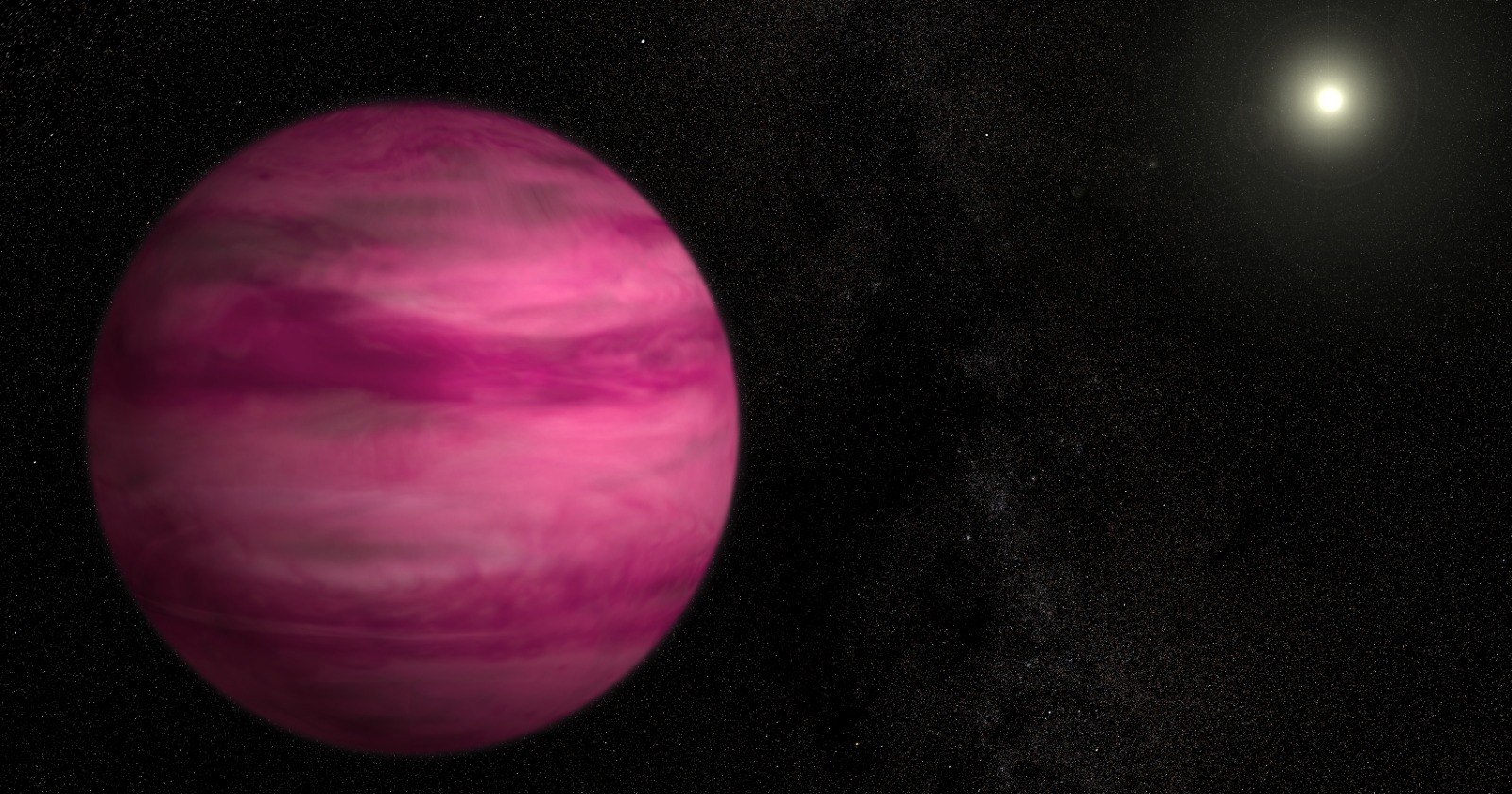
For more than a decade, one of the coldest worlds ever photographed around another star kept slipping out of reach. Astronomers could see the faint pink dot of GJ 504 b, nicknamed the Pink Planet, but they could not read its light. Now the James Webb Space Telescope has captured its spectrum for the first time, and the atmosphere that best explains that light is veiled in clouds made of salt.
The result, from a Northwestern-led team published in The Astronomical Journal on June 18, is described by the researchers as some of the first direct evidence for salt clouds in the atmosphere of such a cold object, a kind of cloud theorists predicted more than fifteen years ago but had never needed to invoke to explain a real spectrum.
A planet too faint to read
GJ 504 b was first directly imaged in 2013, orbiting a Sun-like star about 57 light-years away. It was the first planetary-mass companion ever imaged around a star like our own, and from the start it was strange. Most worlds caught in a direct image glow at around 1,000 kelvin or hotter, fresh from the heat of their formation. GJ 504 b sits near 564 kelvin, roughly 290 degrees Celsius, closer to the temperature of a hot oven than a young star.
That coolness is the point, and the problem. A cold companion is a dim companion. Repeated attempts to pull a spectrum from GJ 504 b with the largest ground-based telescopes came up empty, leaving researchers with only photometry, brightness measured through a handful of filters, rather than the detailed fingerprint a spectrum provides.
The object has also resisted an easy label. At roughly 25 times the mass of Jupiter, it straddles the fuzzy line between a giant planet and a small brown dwarf, the failed stars that never grew massive enough to fuse hydrogen. That uncertainty is why astronomers call it a planetary-mass companion rather than simply a planet.
Hours, not years
What stymied ground telescopes for years took Webb only a few hours. Using the NIRSpec instrument, lead author Aneesh Baburaj and his colleagues recorded GJ 504 b across wavelengths from 2.9 to 5.3 microns, then used careful processing to strip away the overwhelming glare of the host star and isolate the companion’s own light.
The spectrum that emerged was rich. The team identified water vapor, carbon monoxide, methane, carbon dioxide, ammonia and hydrogen sulfide, along with rarer isotope-bearing versions of carbon monoxide. The modeling also pointed to an atmosphere enriched in heavier elements, what astronomers call metals, beyond what its host star carries.
The mix also carried signs of what astronomers call disequilibrium chemistry. In a still, settled atmosphere, reactions would nudge the gases toward a predictable chemical balance. GJ 504 b’s gases were not in that balance, a hint that the air is being churned, dredging molecules up from warmer layers faster than they can settle into place. It is exactly the kind of detail that a handful of brightness measurements could never reveal, and the reason a full spectrum was worth the wait.
“When we finally obtained its spectrum, it immediately looked interesting,” Baburaj said in the announcement from Northwestern’s astrophysics center. “But once we started digging deeper into the data, we realized it was not like anything we have analyzed before.”
Why salt, and why it matters
The salt clouds did not announce themselves. They surfaced because the data refused to behave. When the team modeled the atmosphere without clouds, the only way to match the observations was to invoke physical conditions that made no sense. Add clouds, and those impossible features fell away.
The researchers tested three different cloud types against the spectrum. Salt clouds fit best. In the model, a deck of salt clouds sits over the deeper atmosphere and quiets the signatures of molecules below it, reshaping the light in exactly the way Webb recorded.
Clouds of salt may sound exotic, but they are a natural consequence of chemistry at these temperatures. In atmospheres too cool for the rock and metal clouds of hotter worlds, salts can condense out of the gas and gather into haze, much as water vapor condenses into clouds on Earth. The idea has been in the theoretical literature for years. What the GJ 504 b spectrum offers, the team argues, is the first case where that haze is essential to explaining what the telescope actually saw.
“This is the first time we’ve found that salt clouds are critical to explaining the spectrum of an object,” Baburaj said. “It’s a good reminder to account for clouds in our models.”
How sure are we about the salt?
The honest answer is that nobody photographed a salt cloud. The clouds are an inference, the best-fitting solution to a model of a faint spectrum, not a feature anyone can point to in an image. That distinction matters. The case for salt rests on the fact that, of the options the team tried, salt clouds reconciled the data without forcing the atmosphere into physically implausible territory. It is a strong fit, and it is still a fit.
The planet’s deeper identity stays unsettled too. Because GJ 504 b’s mass sits so close to the boundary between planets and brown dwarfs, and because the age of the system has been debated for years, the new spectrum does not finally resolve what the object is or how it formed. The team is careful on this point: the measured enrichment in heavy elements tentatively supports a planet-like formation, the paper says, but does not entirely rule out that the companion has the composition of a small star. The headline word in the study’s own title is “possible.”
Even the temperature and mass carry error bars rather than single clean numbers, and the salt-cloud interpretation is tangled up with how much metal the atmosphere holds, a known difficulty in this kind of modeling. None of that erases the achievement. Pulling any spectrum at all from a world this cold and this faint is the genuinely new thing here, and it is what makes the salt clouds worth arguing about in the first place.
A test run for colder worlds
The reason a salty haze 57 light-years away is more than a curiosity is what it implies about reach. Jupiter, in our own system, wears clouds of ammonia ice that current telescopes cannot resolve on a distant exoplanet. GJ 504 b is a step in that direction, a world cold enough to start behaving like the giant planets close to home, finally bright enough, with the right instrument and enough patience, to read.
The techniques the team leaned on, including a first successful use of a star-subtraction method called angular differential imaging with NIRSpec’s integral field unit, are meant to travel to other faint, cold companions. If they hold up, the Pink Planet will be remembered less for its salt than for being the place the method was proven.
For now the rosy dot that outlasted a decade of ground-based attempts has yielded a single, complicated spectrum, and a sky that appears, on the best available reading, to be hazed with salt.