
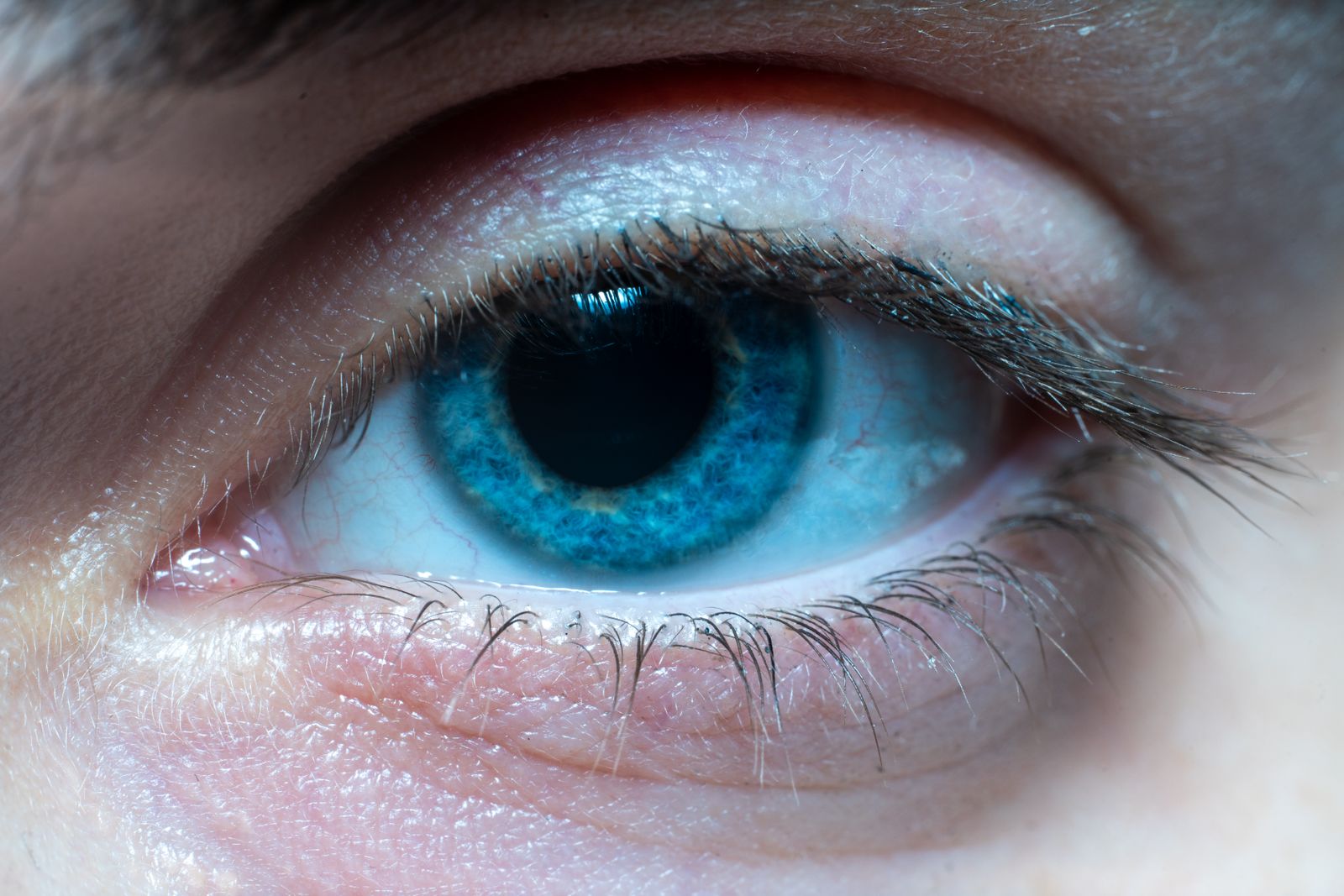
If you have ordinary inherited blue eyes, you appear to share an ancestor with every other blue-eyed person on Earth. Not a recent one, but a single individual who probably lived somewhere between 6,000 and 10,000 years ago, in whom a tiny genetic switch first turned down the brown pigment in the iris. On the leading explanation, blue eyes as we know them today trace back to that one ancient mutation.
It is a striking claim, and it comes with the usual fine print of a finding built on inference rather than a birth record.
What the switch actually does
Eye colour comes down to melanin, the same brown pigment that colours skin and hair. A brown iris is rich in it; a blue iris has very little. Blue is not even really a pigment in the eye, but the way light scatters in an iris that lacks the brown, in much the way the pigment-free sky looks blue.
The switch that sets the level is a single change in the DNA. It sits in a gene called HERC2, in a stretch that acts as a control dial for a neighbouring gene, OCA2, which helps produce melanin. The mutation turns that dial down, so less brown pigment is made in the iris, and the eye reads as blue. One base-pair change accounts for most of the difference between brown eyes and blue.
Why a single ancestor
The case for one origin comes from a 2008 study led by Hans Eiberg at the University of Copenhagen, published in the journal Human Genetics.
His team looked at blue-eyed people from Denmark, and then from Turkey and Jordan, populations separated by great distances. They all carried the same stretch of DNA around the switch, the same string of genetic markers inherited as a block. That degree of uniformity across such different groups is the fingerprint of a single source: a founder mutation that arose once, in one person, and was passed down ever since. As the researchers put it, blue-eyed humans share a single common ancestor.
How old, and how sure
The 6,000 to 10,000 year estimate is just that, an estimate, read out of the genetics rather than pinned to a date. The mutation appears to have arisen relatively recently in human history, well after our species emerged, probably in a Neolithic population somewhere around Europe and the Near East, but the exact age and place carry real uncertainty.
The word “ordinary” is also doing quiet work. This switch explains the common, inherited form of blue eyes, the kind most blue-eyed people have. As geneticists note, it is not the only way an eye can end up light, and conditions affecting pigment can produce pale eyes by other routes. Eye colour is also shaped by several genes working together, with this one acting as the main on-off control rather than the whole story.
Held with those caveats, the conclusion stands as the best current explanation: the common blue eye is a founder variant, traceable to a single ancient origin.
One mutation, hundreds of millions of eyes
What lingers is the scale of the thing. A single, small genetic accident, in one person thousands of years ago, dialled down one pigment by a fraction, and the result now looks back from hundreds of millions of faces.
Every pair of ordinary blue eyes is, in effect, a copy of the same original edit, handed down an unbroken chain of generations from a person no one will ever identify, who almost certainly had no idea they were the first of a lineage now scattered across the whole of the world.
