

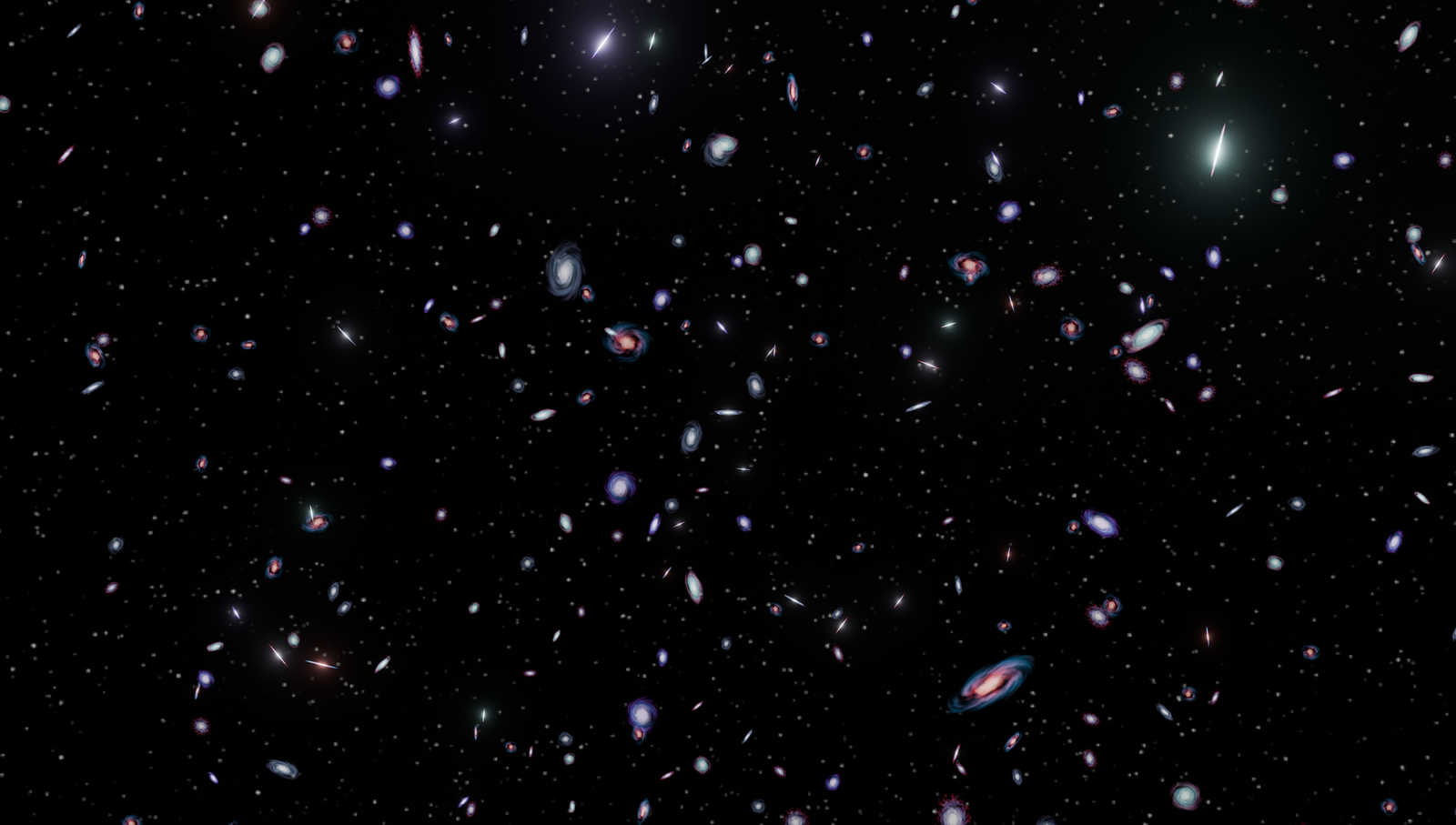
You are sitting still, more or less, but the galaxy beneath you is not. The Milky Way and its neighbours are tearing through space at more than two million kilometres an hour, and that motion is not random. It is the result of a tug-of-war: distant concentrations of mass pulling us forward, and a vast, near-empty region of space effectively shoving us from behind.
The speed is real and measured. The direction tells a story about how matter is spread across the universe.
How we know we are moving
The yardstick is the cosmic microwave background, the faint afterglow of the early universe that fills the sky in every direction. If we were truly at rest, it would look the same temperature all around us. It does not. It reads very slightly hotter in one direction and cooler in the opposite one, a pattern called the dipole, and that asymmetry is a Doppler effect caused by our own movement into it, much as the pitch of a siren rises as it races toward you.
Read off that dipole, the Local Group of galaxies is moving at about 631 kilometres a second relative to the background, which works out to roughly 2.3 million kilometres an hour. We are not drifting. We are racing.
The pull ahead
Some of that motion has a long-known cause. In the direction we are heading lies the Great Attractor, a concentration of mass partly hidden behind the dust of our own galactic disc, which is why it took so long to make sense of. Beyond it sits something larger still, the Shapley Concentration, the densest collection of galaxy clusters in our part of the universe.
These overdense regions do what mass does. They pull, and the Local Group is being drawn toward them across hundreds of millions of light-years.
The push behind
The pull was only half the picture, and the other half is stranger. In 2017, a team led by Yehuda Hoffman mapped the local flow of galaxies and found that the motion is also being driven by a huge, sparsely populated region on the opposite side, which they named the Dipole Repeller.
A void cannot literally push anything. But gravity is a competition between directions, and a region with very little matter exerts very little pull. With density on one side and near-emptiness on the other, the net effect is that we drift away from the emptiness as surely as if it were pushing, falling toward the fuller side of the sky. The 2017 work found that this push and the pull ahead are of roughly equal importance.
What it actually means
None of this is the galaxy falling toward a single dramatic point. It is the Local Group riding the large-scale lumpiness of the cosmos, sliding down the gentle gradient from where matter is thin toward where it is thick.
The map is still being sharpened. The Great Attractor lies in the so-called Zone of Avoidance, the band of sky our own galaxy blocks from view, so it is awkward to study, and the Dipole Repeller is inferred from models of how thousands of galaxies are flowing rather than from a clear photograph of nothing. The broad conclusion, that we are caught between a distant abundance of mass and a distant absence of it, is well supported. The fine detail is still being filled in.
It is a strange thing to sit with. The ground feels still, the sky looks fixed, and all the while the entire galaxy is being carried across the universe at a speed no human machine has ever approached, pulled by what is out there and pushed by what is not.