
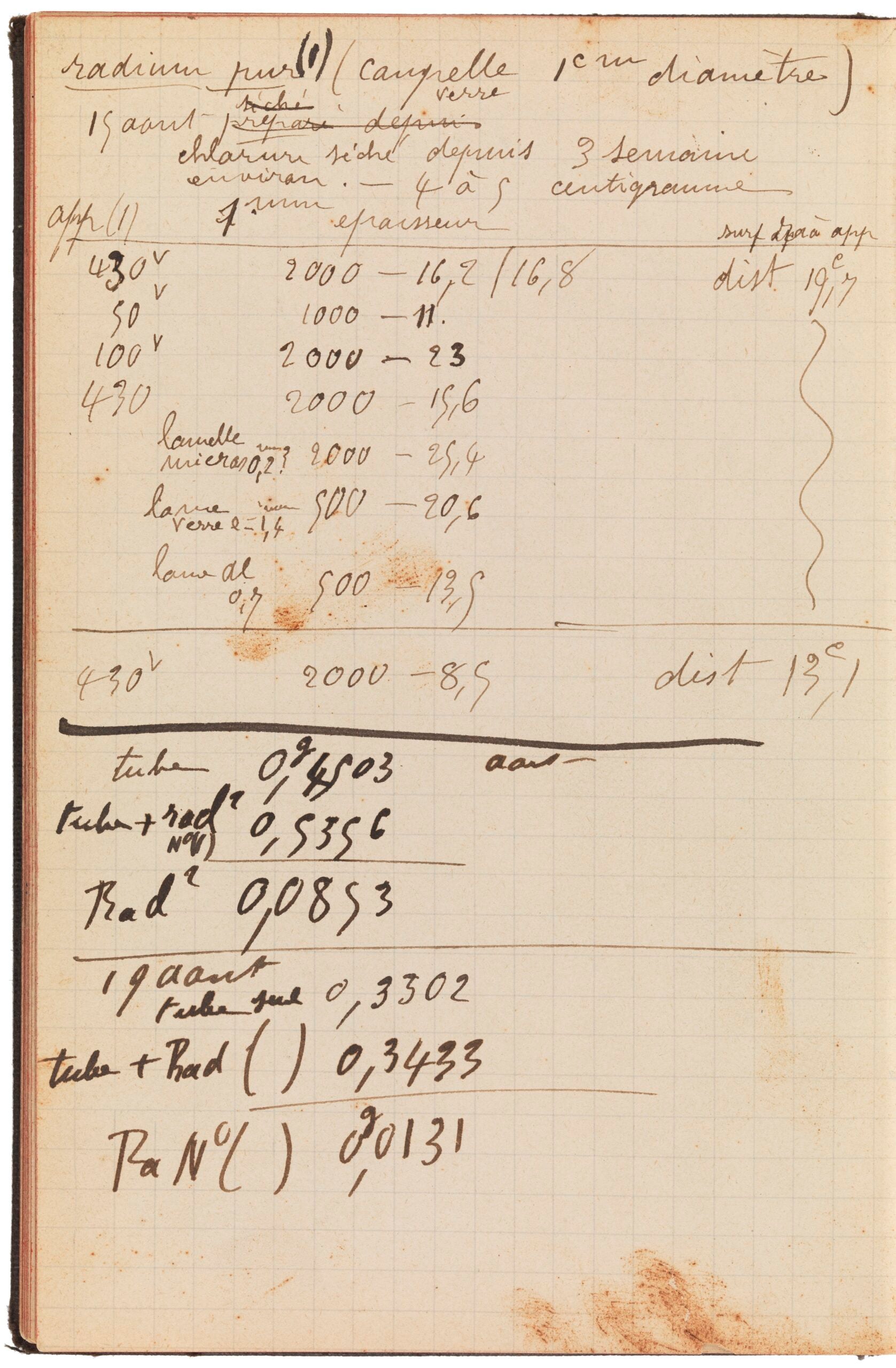
The notebooks Marie Curie filled with her research are still dangerous to touch. More than a century after she wrote in them, the pages remain radioactively contaminated, mostly with radium-226, and the original volumes are kept under strict radiation controls. To read them at the Bibliothèque nationale de France in Paris, where they are stored in lead-lined boxes, you sign a liability waiver and put on protective clothing first.
This is not a curiosity of preservation. It is a direct consequence of the physics Curie helped uncover.
Why a notebook stays dangerous
The contamination is dominated by radium-226, and the key number is its half-life: about 1,600 years. A half-life is the time it takes for half of a radioactive substance to decay away. After a hundred years, radium-226 has barely begun, only a few per cent of it is gone, which is why a century has done almost nothing to make these pages safer. It also decays into a chain of further radioactive products, including radon gas, so the contamination is not one substance sitting quietly but a small, self-renewing source.
On that timescale, estimates suggest the notebooks will stay hazardous to handle freely until around the year 3500. The ink and paper are ordinary. What soaked into them is not.
How a notebook gets contaminated
Curie worked with radium and polonium by hand, every day, at a time when no one understood what that exposure did. She and her husband Pierre had isolated the two elements in 1898, and she coined the term radioactivity itself, but the harm in what they were handling was simply not yet known. She stirred glowing solutions, carried test tubes of radioactive material in her pockets, and is said to have kept a sample by her bed because she liked its glow.
In a laboratory like that, radioactive dust gets onto everything: the bench, the door handles, the pages of the notebook open beside the work. It was not just her papers. Her furniture, her cookbook, and her clothing carry the same contamination, and her old laboratory in Paris was not fully decontaminated until 1991, nearly sixty years after her death.
The controls around them
So the library treats them as what they are, low-level radioactive objects of immense historical value. They sit in boxes lined with lead, because radium-226 and its decay products emit gamma radiation that ordinary materials do not stop. A researcher who wants to consult an original signs an acknowledgement of the risk and works under protection. The notebooks form part of a wider Curie collection the library holds, available to scholars only on those terms.
The hazard is real but modest if handled correctly, which is the point of the controls. The waiver is less about a single dangerous afternoon than about making sure no one treats a radioactive artefact as if it were just an old book.
A record of what was not yet known
There is something fitting, and sad, in all of this. The notebooks are the working record of the woman who gave us the word radioactivity, and they are radioactive because she did the work before anyone, including her, grasped the cost.
Curie died in 1934 of a blood disorder widely linked to her years of exposure. Her pages will go on quietly emitting radiation for another fifteen centuries, long after the science they describe became common knowledge, a physical reminder of how new and how dangerous that knowledge once was. By the time the pages can finally be handled bare-handed, they will have outlasted her by the better part of two thousand years.
