
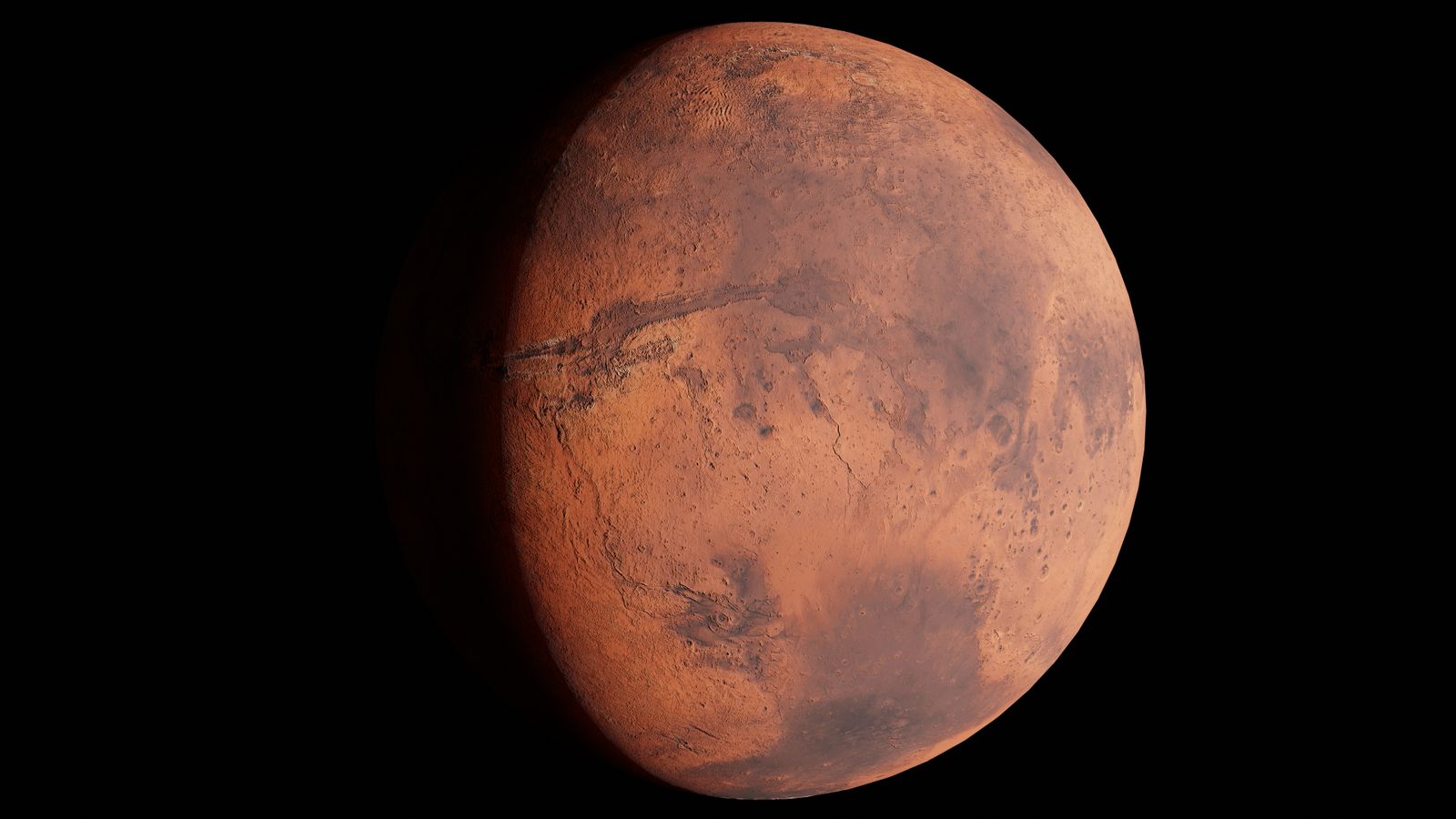
Olympus Mons on Mars is the tallest volcano in the solar system, rising about 22 kilometres above the surrounding plains, roughly two and a half times the height of Mount Everest. You might expect the largest mountain anywhere to be the most dramatic thing on the horizon. It is almost the opposite. Stand on its slopes and you would probably not register that you were on a mountain at all.
The reason is not the height. It is the width.
Big in a way that hides itself
Olympus Mons is roughly 600 kilometres across, a footprint about the size of the US state of Arizona, broader than a good many countries. It is a shield volcano, built from countless runny lava flows rather than explosive eruptions, and that gives it an extremely gentle profile. Its flanks rise at only a few degrees, the slope of a shallow ramp rather than a peak.
Put those two facts together and the mountain defeats the eye. The summit of a 600-kilometre-wide dome sits so far away from anyone on the flanks, and the ground tilts so gently, that the curve of Mars carries the high ground below the horizon. Mars is a smaller world than Earth, so its horizon is closer to begin with, and Olympus Mons is far wider than that horizon. From most of its slopes you would see a faintly tilted plain running off into the distance, not a summit ahead of you.
It is less a mountain you look at than one you would cross without quite noticing.
Why it grew so large
The size comes down to how Mars is built. Earth’s crust is broken into plates that drift slowly over the hot interior, so a volcanic hotspot does not stay under the same patch of surface for long. As the plate moves, the hotspot punches out a string of separate volcanoes instead of one, which is how the Hawaiian island chain formed.
Mars, as far as we can tell, has no such moving plates. Its crust sits still over the heat below, so eruption after eruption piled lava onto the same spot for a very long time, stacking up a single colossal shield rather than spreading the output across a chain. Lower Martian gravity, which lets a pile of rock stand taller before it collapses under its own weight, helped it grow further.
The drama is at the edge
There is a twist worth knowing. The one part of Olympus Mons that does look like a sheer mountain is not the summit but the rim.
The whole volcano is ringed by a steep escarpment, a cliff in places several kilometres high, where the gentle flanks end abruptly and drop to the plains below. A traveller approaching from outside would meet a wall of rock taller than most mountains on Earth. Climb it, and the dramatic relief would stop. Beyond the rim lies the long, mild upward slope that hardly reads as a climb at all. Far away at the very top, out of sight from almost anywhere on the flanks, sits a complex of overlapping craters, the collapsed calderas of past eruptions, together spanning roughly 80 kilometres.
A mountain too big to see
This is the strange thing about superlatives at planetary scale. The biggest mountain in the solar system is also one of the hardest to perceive as a mountain, because it is built on a scale the human eye was never meant to take in from the ground.
From orbit, Olympus Mons is unmistakable, a vast blister on the face of Mars. From its own slopes, it would mostly just be the ground, sloping away, with the rest of the mountain hidden over the edge of a smaller world.
