
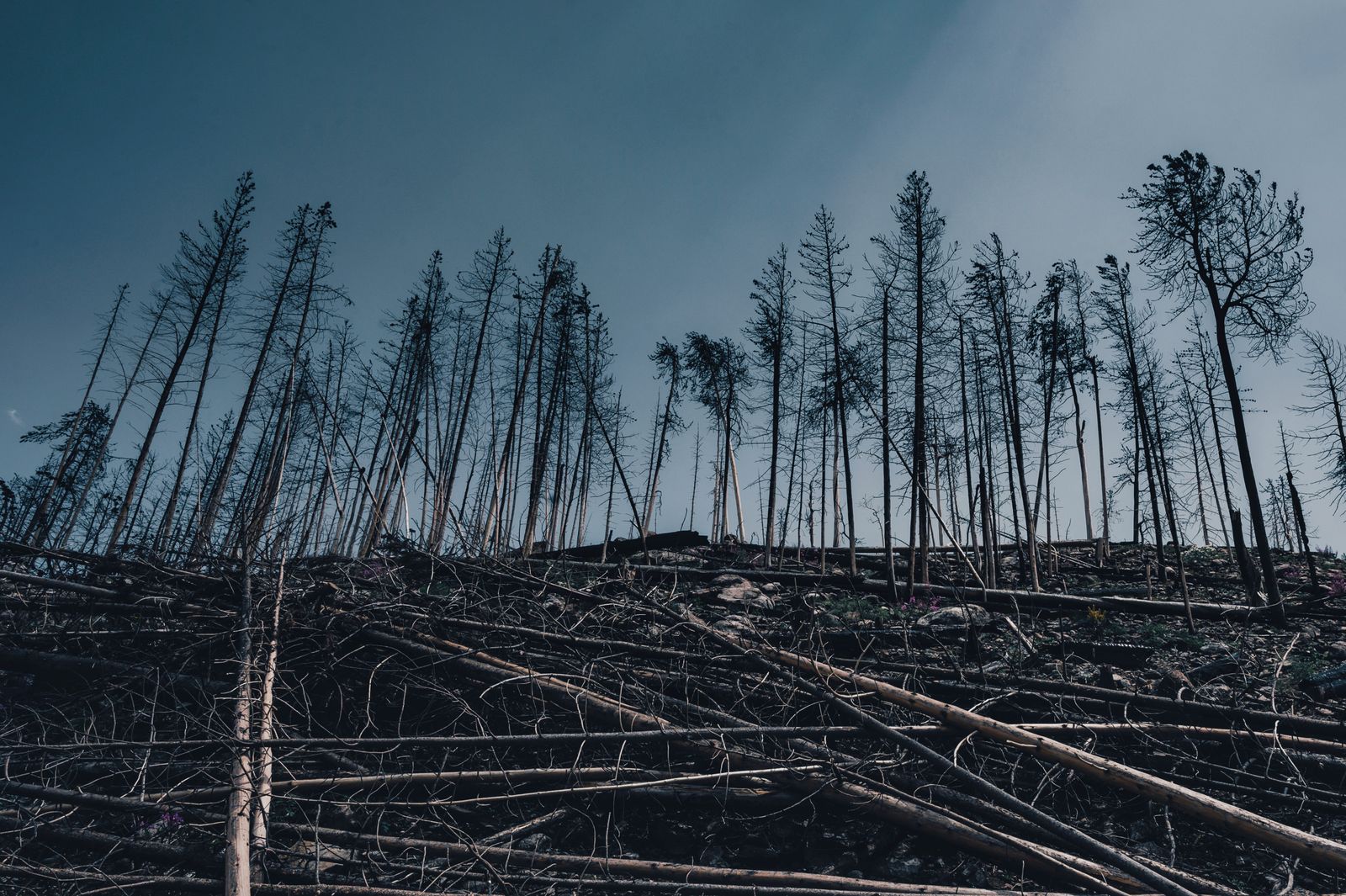
On the morning of 30 June 1908, something detonated in the sky over the Podkamennaya Tunguska River in remote Siberia and flattened roughly 2,000 square kilometres of forest. An estimated 80 million trees were knocked down, splayed outward from a central point like spokes. More than a century of searching has never turned up an impact crater, and the reason is now the accepted explanation: the object never reached the ground. It blew itself apart in the air.
It remains the largest impact event in recorded history, and it left no hole.
The morning of 30 June 1908
Witnesses far from the epicentre described a column of light brighter than the Sun, followed by a blast that threw people to the ground and rattled windows hundreds of kilometres away. The energy released is usually put at around 10 to 15 megatons, roughly a thousand times the bomb dropped on Hiroshima.
The region was so remote, and Russia so unsettled in the years that followed, that no scientist reached the site until 1927, when Leonid Kulik led the first expedition. He expected to find a crater. Instead he found mile after mile of trees stripped bare and flattened in a radial pattern, with a patch near the centre left standing upright, scorched but rooted. There was no pit, no meteorite, nothing buried.
Why there is no crater
The answer is what scientists call an airburst. The leading reconstruction, set out by Christopher Chyba and colleagues in a 1993 paper in Nature, describes a stony asteroid perhaps 50 to 60 metres across entering the atmosphere at something like 27 kilometres per second.
At that speed the air in front of the object cannot get out of the way. It piles up into a wall of enormous pressure and heat, and a stony body cannot hold together against it. Several kilometres up, the asteroid fragmented and vaporised almost all at once, dumping its energy into the atmosphere as a shockwave rather than into the ground as an impact. The blast flattened the forest beneath it. The object itself essentially ceased to exist before it could land.
That is why the damage looks the way it does.
A radial blast pattern is the signature of an explosion above the trees, not a rock hitting the dirt.
What it was, and what is still argued
The stony-asteroid airburst is the mainstream view, but a few things remain unsettled. For decades a comet was the favoured culprit, an icy body that would vaporise completely and explain the absence of fragments. Because almost no convincing meteoritic material has ever been recovered, the exact composition of the Tunguska object is still not settled.
The crater question has had its own revivals. In 2007, an Italian team led by Luca Gasperini proposed that a small lake about eight kilometres from the epicentre, Lake Cheko, might be a crater gouged by a surviving fragment. The idea drew interest, but later work, including sediment cores suggesting the lake is older than 1908, has led most researchers to reject it. As things stand, there is still no confirmed crater.
Why a century-old blast still matters
Tunguska is the clearest evidence we have that an object only tens of metres across, far too small to notice until it arrives, can devastate an area the size of a major city without ever touching the surface. It is also a reminder that the absence of a crater does not mean the absence of an impact.
The point is not hypothetical. In 2013 a much smaller object, around 20 metres wide, broke up over Chelyabinsk in Russia, and the airburst alone shattered windows and injured roughly 1,500 people. A Tunguska-scale event over a populated region would be far worse.
That is the reasoning behind the sky surveys now cataloguing near-Earth objects, and behind Asteroid Day, the awareness effort held each year on the Tunguska anniversary of 30 June. The 1908 blast is a closed case in one sense and an open warning in another. The forest grew back. The thing that flattened it is the kind we are still learning to see coming.
