

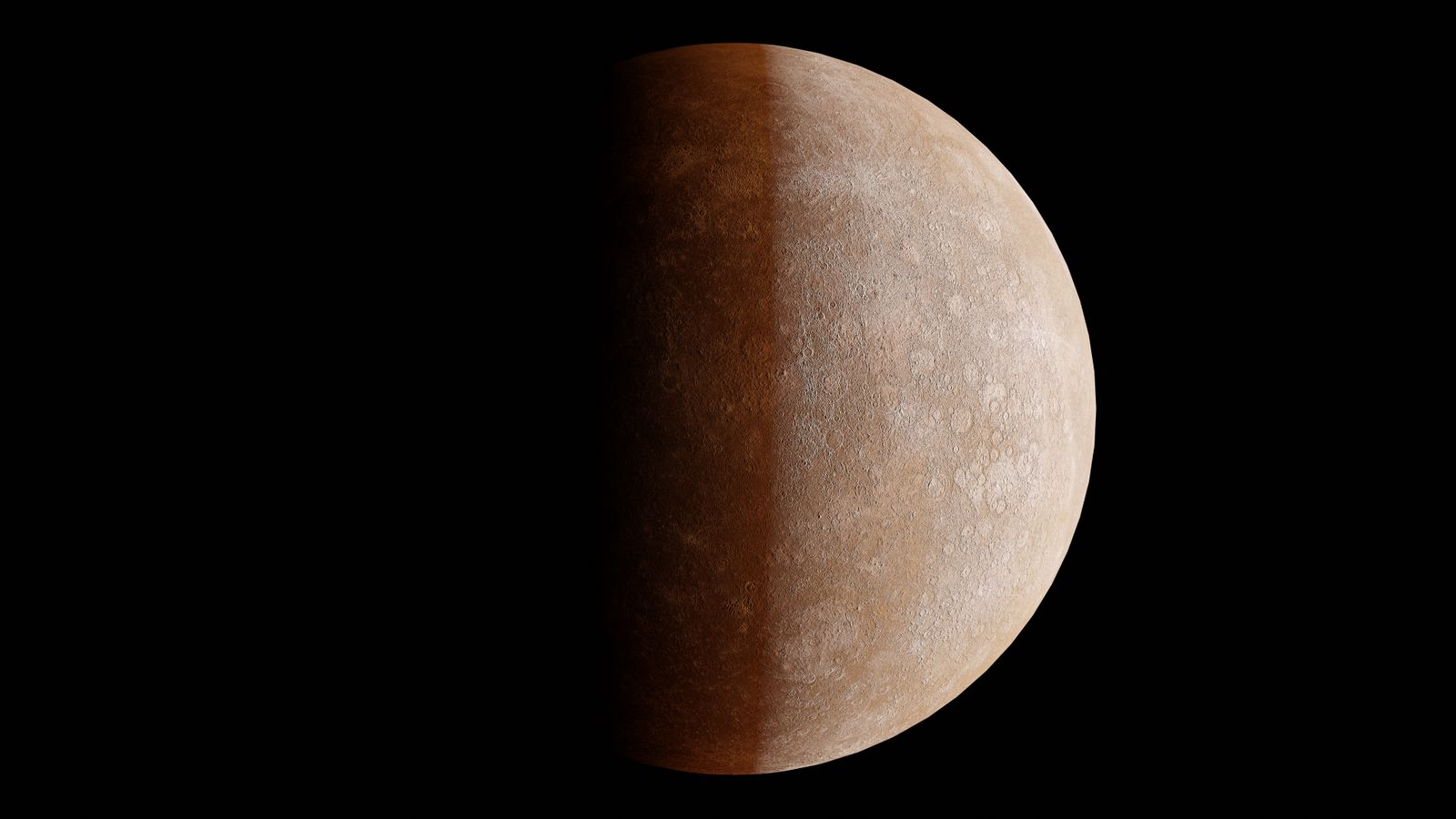
Mercury is the closest planet to the Sun, and for a long time that was reason enough to assume it could not hold ice anywhere. The surface in direct sunlight can reach well over 400 degrees Celsius. And yet there is water ice on Mercury, tucked into craters near its poles where the Sun has never reached, and a NASA spacecraft has confirmed it.
The claim sounds like a contradiction. The explanation is geometry.
The radar hint
The first sign came in 1991, when the Arecibo radio telescope in Puerto Rico bounced radar off Mercury and picked up unusually bright patches near both poles. Bright radar returns of that kind are the sort of thing water ice produces, and many of the patches lined up with large impact craters that the Mariner 10 spacecraft had mapped in the 1970s.
It was a strong hint rather than proof. Radar brightness can be caused by other materials too, so for two decades the polar patches were a promising suspect awaiting a closer look.
Why ice can survive next to the Sun
The reason ice is even possible on the hottest planet comes down to how Mercury sits. Its spin axis is almost perfectly upright relative to its orbit, tilted by only about a hundredth of what Earth manages. With essentially no tilt, the floors of deep craters near the poles never catch a single ray of sunlight.
Those permanently shadowed floors are among the coldest places in the solar system, far colder than anywhere on Pluto, sitting at roughly minus 170 degrees Celsius and staying there for billions of years. A planet can bake on average and still keep a few pockets that the Sun has never touched. Ice trapped in one of them has nowhere to go.
What MESSENGER actually showed
The closer look came from MESSENGER, the NASA spacecraft that orbited Mercury from 2011 to 2015. In 2012 its team reported not one measurement but three that pointed the same way.
Its neutron spectrometer detected the signature of hydrogen concentrated at the north pole, in the amounts you would expect from buried water ice. Its laser altimeter found the polar deposits were either unusually bright or unusually dark exactly where the temperature models said surface ice, or ice under a dark covering, should sit. And those thermal models tied the whole picture together. Taken together, as the mission team concluded, water ice is the main constituent of Mercury’s north polar deposits.
The convergence is the point. Any one of those readings could be argued with. Three independent methods agreeing is much harder to dismiss, which is why 2012 is when the radar suspicion became a confirmed finding.
The ice is mostly hidden
One detail complicates the tidy image of gleaming polar ice. Across most of the deposits, the ice is not exposed at the surface at all. It is buried under a dark layer, thought to be rich in complex organic compounds, in the spots that are cold enough to preserve buried ice but a little too warm to keep it stable right at the surface.
Only in the very coldest craters does the ice sit exposed and bright. So the picture is layered: dark organic material on top, water ice beneath, with the proportions set by exactly how cold each crater floor stays.
What is still open
Where the water came from is not fully settled. Impacts from comets and water-bearing asteroids are the usual explanation, with some contribution possible from chemistry driven by the solar wind. However it arrived, the cold traps near the poles held on to it.
The same phenomenon turns up at the Moon’s poles, which matters for anyone planning to use lunar ice as a resource. Mercury itself will get another visitor before long: the European and Japanese BepiColombo mission is on its way and due to settle into orbit in the coming years, carrying instruments that can sharpen what MESSENGER began. The headline is already secure. There is ice on the planet nearest the Sun, and it has been there, in the dark, for a very long time.