
The six American flags planted on the Moon between July 1969 and December 1972 — beginning with the nylon banner Buzz Aldrin and Neil Armstrong drove into the regolith at Tranquility Base — are almost certainly no longer red, white, and blue. After more than five decades of unfiltered ultraviolet light, hard solar wind, and temperature swings from roughly 120°C in lunar day to deep cold at night, the dyes have almost certainly broken down.
What remains is likely stranger than the original photographs suggest: five upright flag assemblies casting shadows across the regolith, and five rectangles of brittle nylon that have probably faded toward blank cloth.
NASA’s own history of the lunar flags notes that the Apollo flag was a standard nylon banner modified so it could appear to fly in an airless environment. The Lunar Flag Assembly was not a monument built for centuries. It was a practical device, designed in a rush, meant to work during a moonwalk and hold its shape long enough for television cameras.
NASA and the Lunar Reconnaissance Orbiter Camera team have since confirmed that the flags left at the later Apollo sites still appear to be standing. The exception is Apollo 11. Buzz Aldrin said he saw the first flag knocked over by the Lunar Module’s ascent engine, and later orbital imagery is consistent with that account.
Standing, yes. Coloured, almost certainly not.
The flags were never built to last
The banners were not engineered as permanent monuments. They were nylon flags, modified with a hinged horizontal rod that made the cloth appear to fly in the airless lunar environment.
The team had weeks, not years, to solve the problem of planting a flag on a world with no wind. They chose nylon because it was light, packable, and available. Nobody asked them to make the dyes survive half a century of cosmic exposure. The mission was to get the flag upright in front of a television camera for the duration of a moonwalk.
That single afternoon of broadcast was the real design brief.
What sunlight does without an atmosphere
On Earth, the atmosphere absorbs the most destructive part of the solar spectrum. The ozone layer blocks essentially all UV-C, most UV-B, and a meaningful fraction of UV-A. Even a flag flown outdoors in Arizona for a decade fades slowly compared with anything left exposed on the Moon.
The Moon has no such shield. Solar ultraviolet radiation arrives at the lunar surface without the same atmospheric filtering that protects materials on Earth. For dyed nylon, that matters. High-energy UV photons can break the chemical bonds that give synthetic dyes their colour. Red dyes tend to be especially vulnerable. Blue dyes may last longer, depending on their chemistry, but they are not immune.
The white areas of the flag were already white. The red and blue areas were the colours most likely to vanish. Over enough lunar days, the flag stops looking like a flag and starts looking like old cloth.
The radiation environment is brutal in other ways too
UV is only the start. The lunar surface also sits in the path of the solar wind — a continuous stream of protons and electrons travelling at hundreds of kilometres per second — and is periodically hit by solar particle events that dump high-energy particles onto exposed materials.
Radiation degradation of materials in space is a serious engineering problem even for devices designed to survive it. Solar cells are built for that environment, yet high-energy protons, electrons, and heavy ions can still create defects and reduce performance over a mission lifetime. A consumer-grade nylon flag has no comparable defence.
Recent work by scientists at the University of New South Wales on electron irradiation effects on PERC and TOPCon solar cells shows how charged particles can damage even hardened silicon devices intended for space power. The flags are not silicon devices. They are organic polymer textiles, woven from long carbon chains. Under ultraviolet light, ionising radiation, and thermal cycling, those chains can break. The cloth becomes brittle. Threads weaken. Stitching gives way.
Then there is the temperature
Each lunar day lasts roughly 14 Earth days, followed by roughly 14 Earth days of darkness. Surface temperatures can swing from about 120°C in direct sunlight to well below freezing in darkness or shadow. A flag at Tranquility Base, Hadley Rille, or Taurus-Littrow has now experienced hundreds of these cycles.
Nylon’s glass transition temperature sits around 50°C. Above it, the polymer becomes more flexible. In deep cold, it becomes glassier and more brittle. Cycling between those states hundreds of times — while simultaneously being degraded by UV and particle radiation — produces the textile equivalent of fatigue. Microscopic fractures propagate through the weave. Threads that were once taut go slack, then snap.
What the orbital images actually show
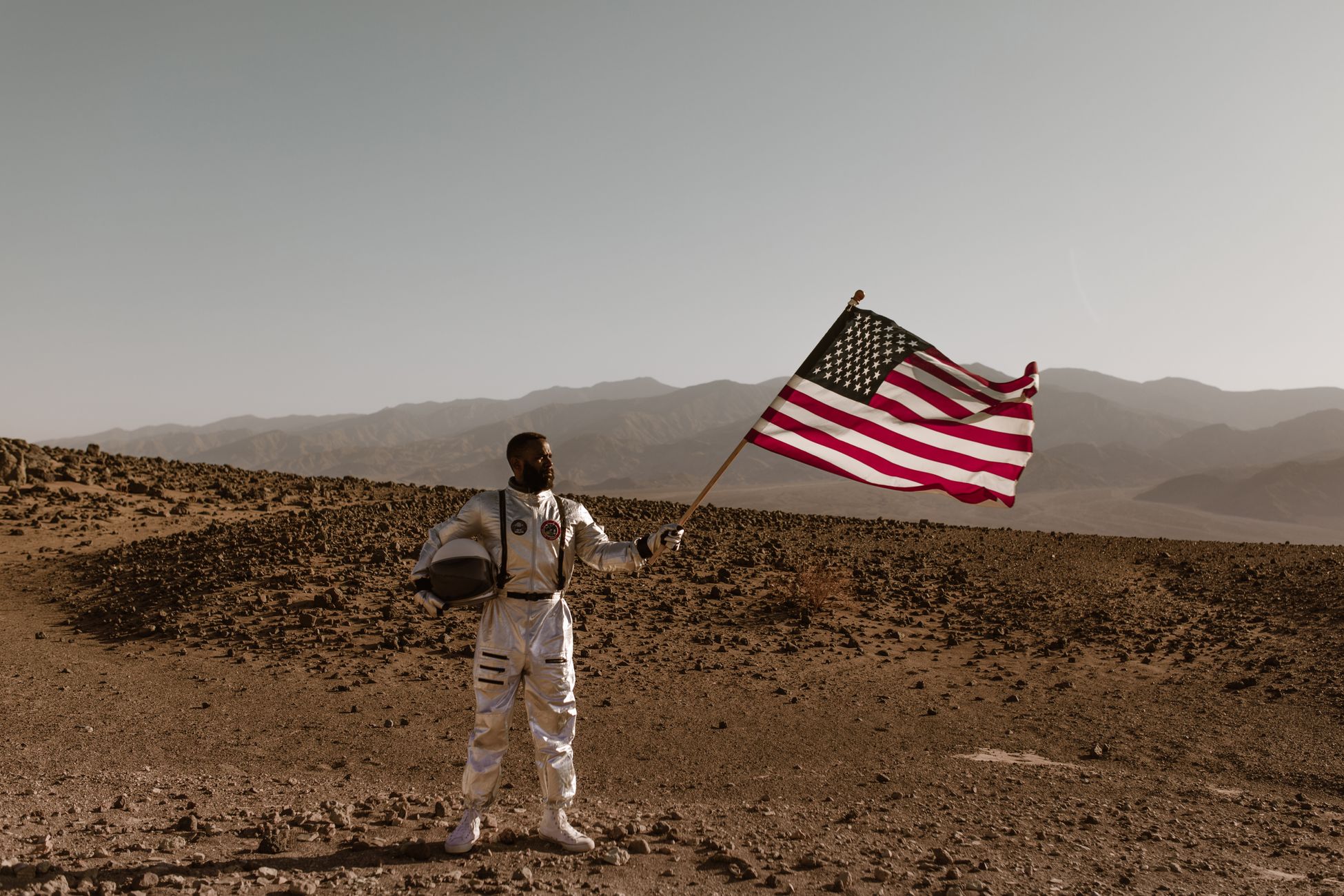
The Lunar Reconnaissance Orbiter has photographed the Apollo landing sites repeatedly from lunar orbit. Its narrow-angle camera can resolve many surface features, including the descent stages, rover tracks, and disturbed regolith around the landing sites. The flags themselves are tiny, but their shadows can still give them away.
In 2012, the LROC team reported that the American flags were still standing and casting shadows at all Apollo sites except Apollo 11. At the first landing site, no comparable standing-flag shadow appears, matching Aldrin’s account that the flag was blown over during liftoff.
What the images cannot tell anyone is the colour of the cloth. There is no spectral data fine enough to distinguish a faded red stripe from bare nylon. The conclusion that the flags have bleached is an inference from materials science, not a direct observation. But the inference is strong. The harsh ultraviolet light from the Sun would have almost certainly bleached the colours out long ago.
The flags planted by each crew
Apollo 11, Tranquility Base, July 1969 — believed to have been knocked over at liftoff. Apollo 12, Ocean of Storms, November 1969. Apollo 14, Fra Mauro, February 1971. Apollo 15, Hadley Rille, August 1971. Apollo 16, Descartes Highlands, April 1972. Apollo 17, Taurus-Littrow, December 1972.
The Apollo 17 flag has been exposed to lunar surface conditions for about 53 years. The earlier flags have had more than 56.
Other things at the landing sites are also changing
The flags are not the only artifacts being slowly rewritten by the environment. Aluminum descent stages, lunar rovers, scientific instruments, plaques bolted to ladders, and Charlie Duke’s family photograph at Descartes are all exposed to the same broad forces: ultraviolet radiation, charged particles, thermal cycling, abrasive dust, and micrometeorite impacts.
Recent reporting on the Moon’s harsh surface environment has focused on why future settlements will have to contend with jagged regolith, vacuum, intense radiation, and extreme temperature swings. Those same conditions are already acting on the Apollo sites. Painted surfaces fade. Plastics yellow and crack. Adhesives outgas and fail. Even bootprints, sharp and crisp in the 1969 photographs, are slowly being softened by the quiet gardening of micrometeorite impacts.
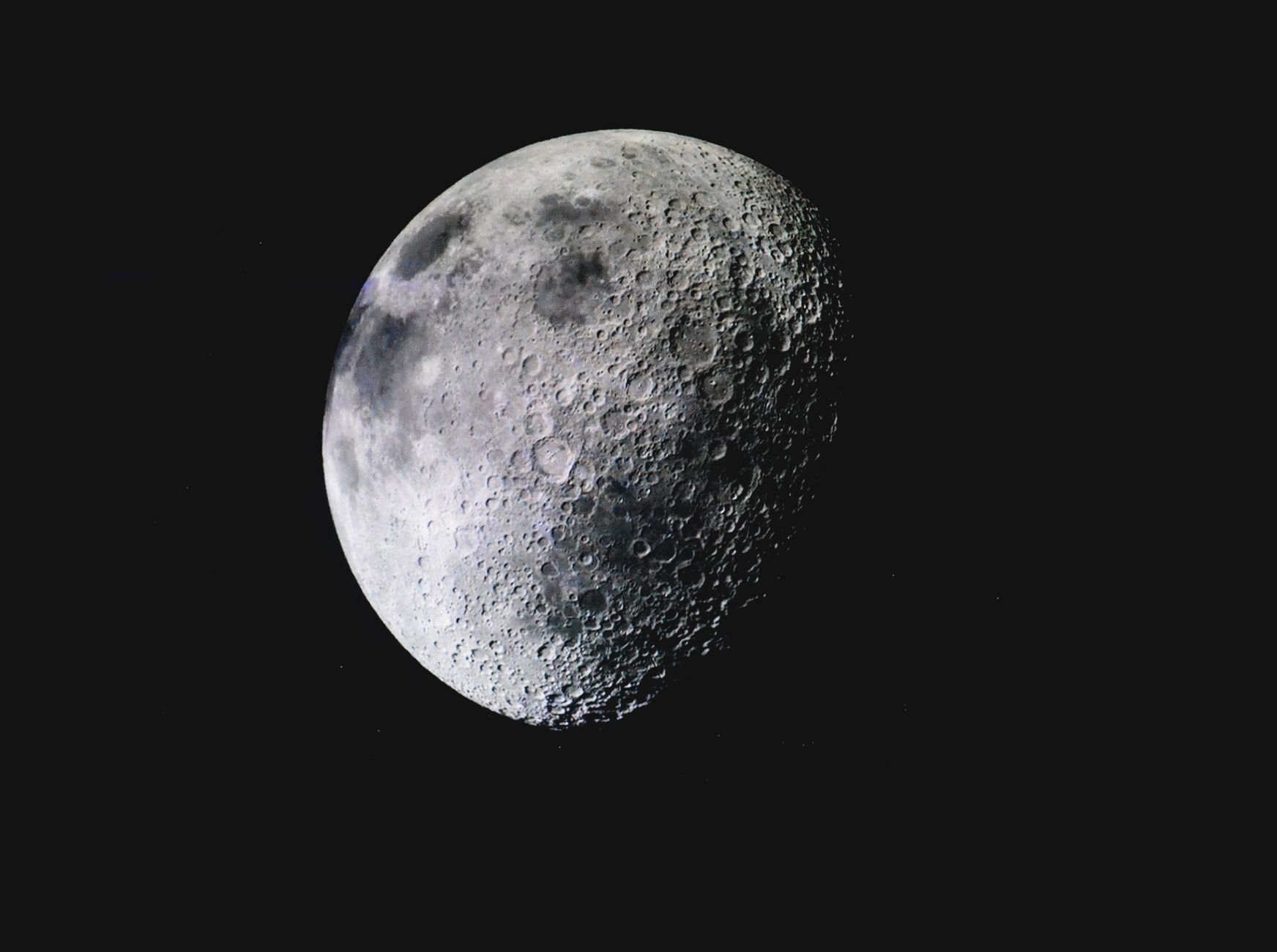
What is left, then, after fifty-six years
Five poles still upright. Five horizontal rods still extended. Five rectangles of what was once dyed nylon, almost certainly now the colour of old bone. The stitching that held the stripes has likely come apart. The hems are likely fraying. In some places the cloth may have torn through entirely, leaving ragged white strips that flutter not at all, because there is no air to flutter in.
The flags were planted as gestures. Armstrong and Aldrin had about two and a half hours on the surface. The flag-planting took minutes. Nobody on the ground in Houston was thinking about 2026, or 2069, or what UV does to synthetic dyes across geological time.
And yet the flags, in their bleached state, may be a more honest monument than the coloured banners ever were. A flag that held its colour for half a century in vacuum would be a lie about what the Moon is like. A flag that has gone white tells the truth: this is a place that erases things. Slowly, patiently, photon by photon, the Moon is taking back the cloth.
The next humans to stand at Tranquility Base — whenever they arrive — will not find the flag Armstrong and Aldrin planted still upright. It likely fell in 1969. But at the other five sites, they may find white rectangles on bent poles, casting the same shadows the orbiter has been photographing for years, the colour long gone, the gesture somehow still standing.
